CONNECTED | Apr 23, 2026
Curator Q+A reveals insights into Indigenous research on Edmonia Lewis
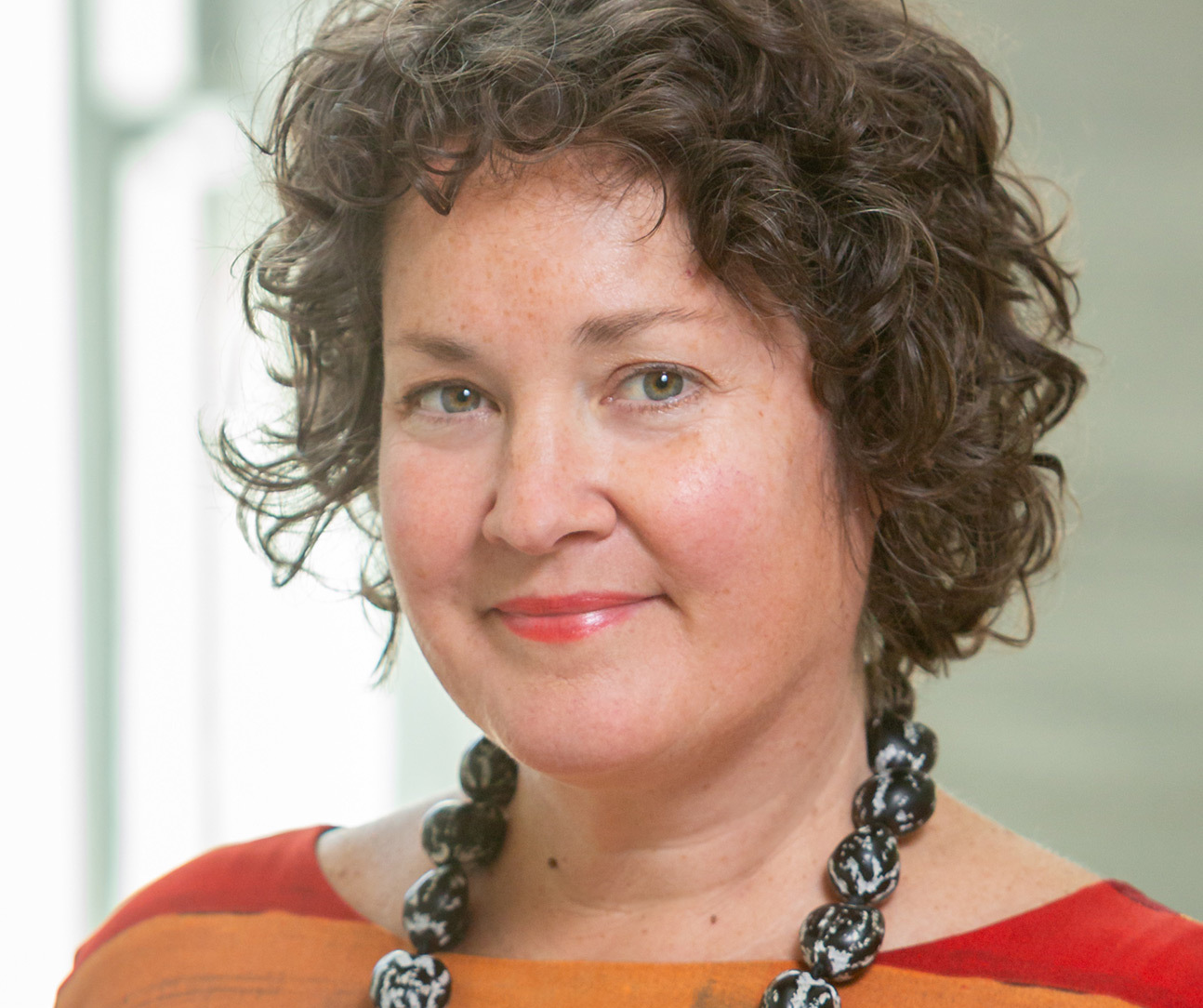
Edmonia Lewis is widely recognized as a groundbreaking Black sculptor who achieved international acclaim in the 19th century. Yet an essential part of her story — her Indigenous identity — has too often been treated as a footnote. As PEM presents Edmonia Lewis: Said in Stone, a landmark retrospective that brings together the most comprehensive presentation of her work to date, we spoke with Karen Kramer, The Stuart W. and Elizabeth F. Pratt Curator of Native American and Oceanic Art and Culture at PEM. We discussed the research behind Lewis’ Indigeneity, the importance of community-based scholarship and what this deeper understanding reveals about Lewis’ art and life.
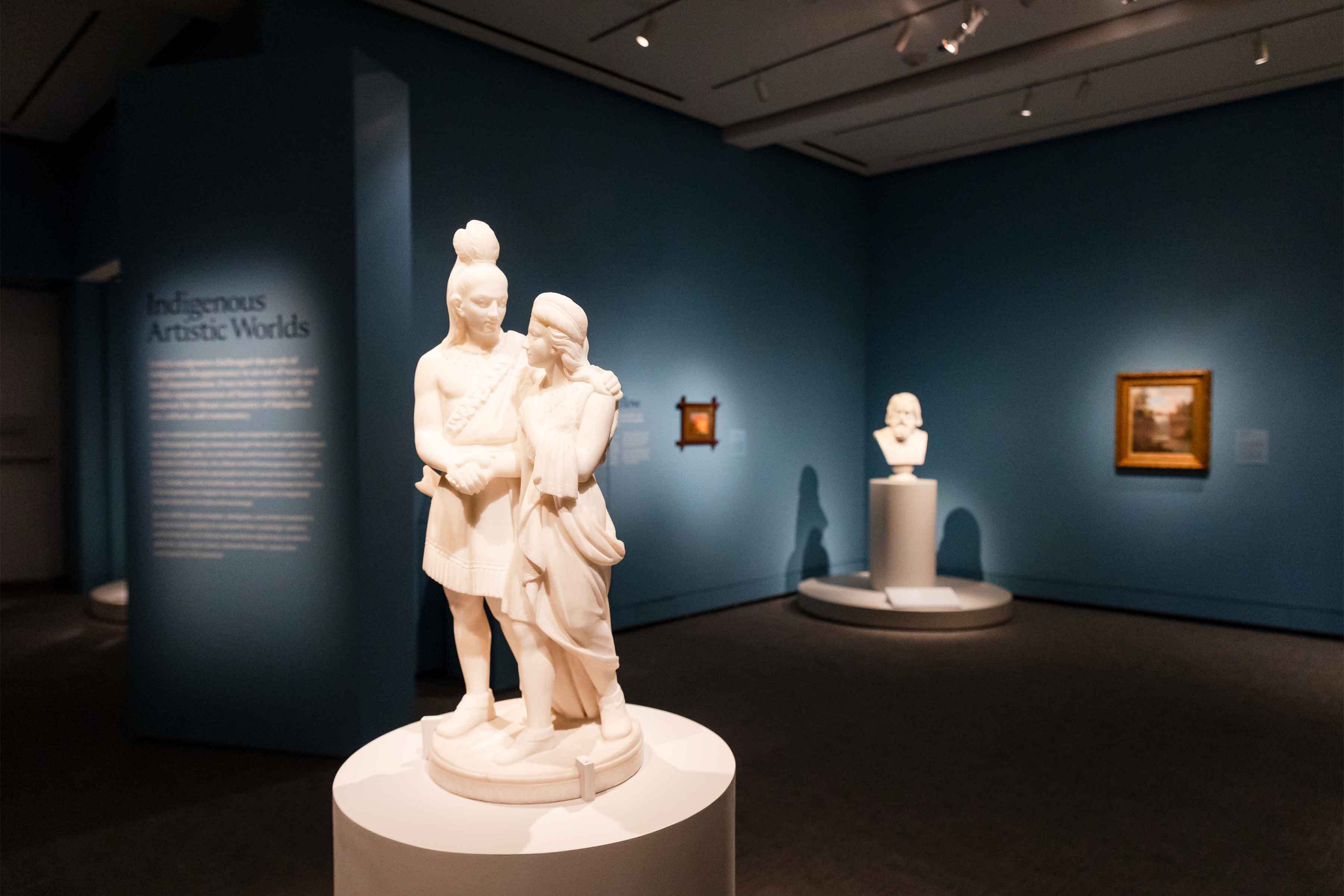
Edmonia Lewis’ Hiawatha’s Marriage in the gallery at PEM. Photo by Kim Indresano.
Q: First, how did you become involved in this exhibition at PEM?
A: I was honored to be part of this Edmonia Lewis project as an advisor and contributing author to the exhibition publication, with a particular focus on her Indigeneity.
From very early conversations, there was a shared understanding that this exhibition needed to lift up Edmonia Lewis’ Indigenous background and place it on equal footing with her identity as a Black artist. That simply hadn’t been done before at this scale. When Lewis’ work appeared in exhibitions in recent years, there was very little research connecting her Indigenous identity to her home community in a meaningful and responsible way. This project presented an opportunity — and a responsibility — to do that work differently.
Q: What was the first critical question you asked when this research began?
A: Well, how do we know that she is Anishinaabe? And would the community claim her? Because we see in the field right now, and over the past couple of decades, that there are a lot of people who claim Indigenous ancestry and their communities do not claim them. And so we really wanted to close this gap and make sure that if we are saying Edmonia Lewis is Indigenous, that we could back that up and connect with her home community.
Q: What did you learn from community-engaged research?
A: Working with community partners was essential. We gathered a group of amazing historians, scholars, artists and educators, including Kate Dalton (Mississaugas of the Credit First Nation) from Woodland Cultural Centre in Ontario, Philip J. Deloria (Dakota descent) from Harvard University, Bonnie Devine (Member of Serpent River First Nation) from OCAD University, Heather George (Kanien'kehá:ka descent) from Woodland Cultural Centre, Cody Groat (Kanyen'kehaka [Mohawk] and band member of Six Nations of the Grand River) from Western University, Leslie King Hammond from the Maryland Institute College of Art and Tiya Miles from Harvard University. We connected with the Mississaugas of the Credit First Nation and their tribal historian, followed archival research in Canada and spoke with Indigenous scholars from the communities connected to Lewis’ family. What emerged was a more complex and nuanced story. Lewis’ likely family connections include Tuscarora heritage, and Six Nations at Grand River connections, and she is Credit River First Nation.
Q: Where is Lewis’ Indigenous home community located, geographically?
A: Lewis’ Indigenous community is now known as the Mississaugas of the Credit First Nation, located in the Lake Huron region, in what is now Ontario, Canada. At the time of Lewis’ birth, this area was a politically complex landscape shaped by shifting borders. So it's above Lake Erie, on the northeastern shore of Lake Huron, where there are a lot of waterways and rivers and tributaries.
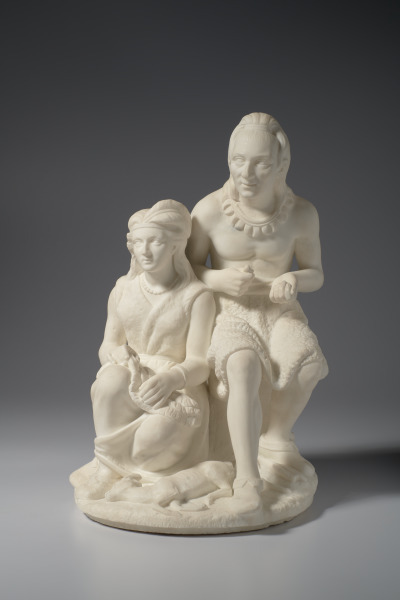
Edmonia Lewis, The Old Indian Arrow Maker and His Daughter, modeled 1866, carved 1867. Marble, 21 1/4 × 14 × 13 1/2 in. (54 × 35.6 × 34.3 cm). North Carolina Museum of Art, Raleigh. Gift of Marilyn Jacobs Preyer, 2022.6.
Q: Why do you think Lewis’ Indigenous identity was overlooked for so long?
A: I think scholars put more emphasis on her Blackness because that was a story that scholars could more easily see and make visible for visitors in a museum setting and for other scholars. But perhaps it's as simple as the right questions weren't being asked about her Indigenous background as well. She reveals the obvious parts of her Indigenous identity through her works of Indigenous people. And we see some really interesting treatments of Native people, some very sensitive renderings.
The Old Indian Arrow Maker and His Daughter was done in 1866-67 in marble. There is an Indigenous man who's sitting and is in the process of making an arrow. And a woman is kind of kneeling by his side. It seems like a very warm and cozy domestic moment. His musculature is very pronounced. His bear claw necklace is in relief; it's highly detailed. And the texture of their clothing is remarkably detailed. You can almost feel that it's some kind of animal fur that he has on. And I love to look at how artists treat people's hair. One of the things that makes Edmonia Lewis' work so interesting to me is how she was expressing her Indigeneity, even with marble, even with subjects who were not Native. She's still expressing her Indigeneity because her worldview comes through her art and her hands and her eyes.
Q: Why was it important to convene Indigenous scholars and artists as part of this project?
A: In my curatorial practice, it is extremely important to include Native people, and have them speak for themselves. Indigenous scholars help us understand the complexities of the politics at the time, help connect us to community members and help us better understand the intensive colonial pressures at the time. It helps by talking through some of these really tough genocidal policies that Native peoples and First Nations peoples were navigating and continue to navigate. It helped us understand the world in which Edmonia Lewis was growing up.
Having all of these amazing thinkers at the table was very important. This time period is right on the heels of the American Revolution, and the American military had just razed thousands of acres of Mohawk territory and there was so much displacement happening in Canada. So the Mississaugas actually got removed. And the Six Nations at the Grand River gave them some land so that they could have a place to live and be solvent as a community. Edmonia was living in a really interesting time. I think we came away with a deeper understanding of the politics of the time, including how the market economy drove artists to create.
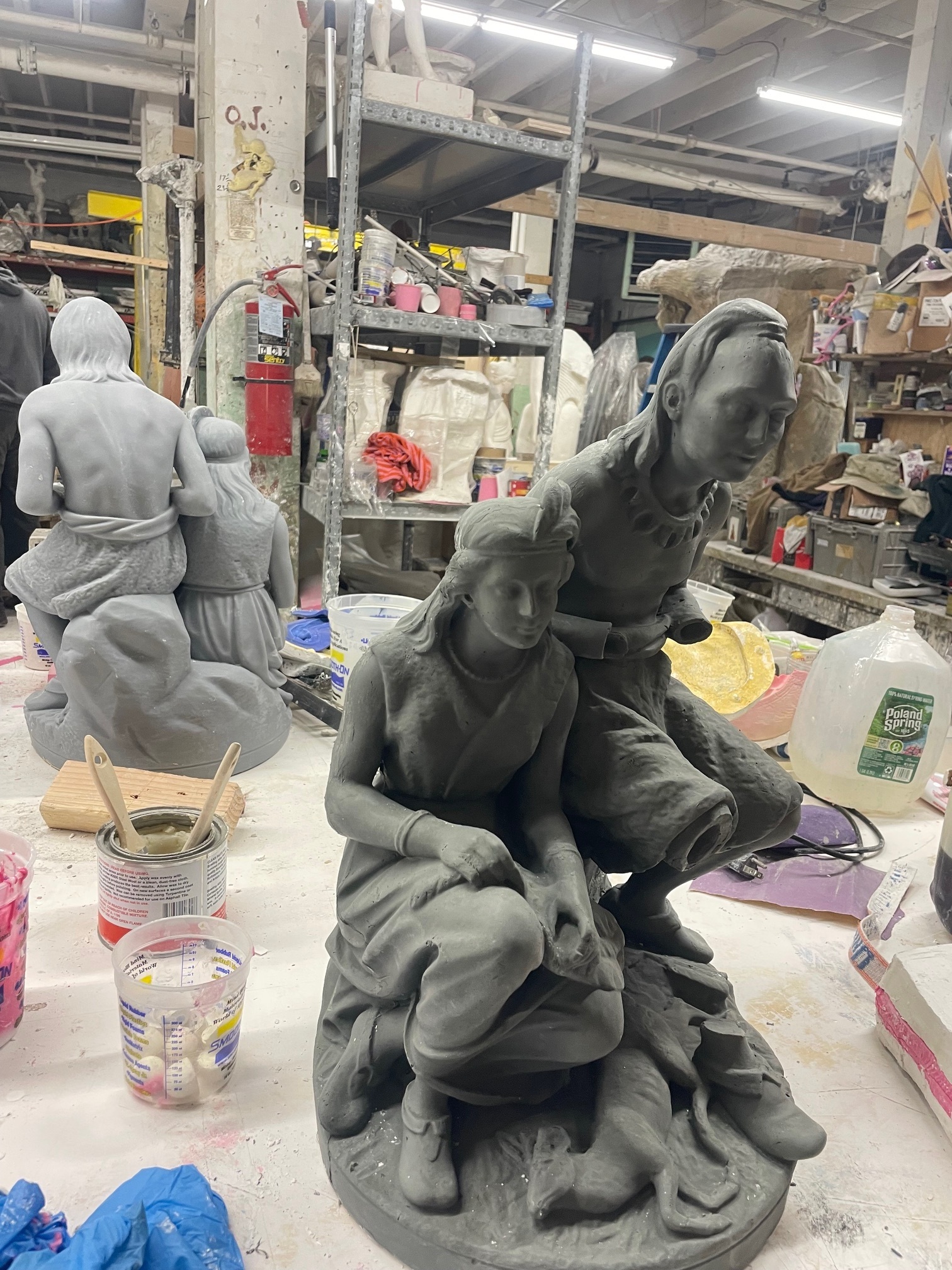
The Old Indian Arrow Maker and His Daughter being reproduced at Skylight Studios in Woburn. Photo by Dinah Cardin/PEM.
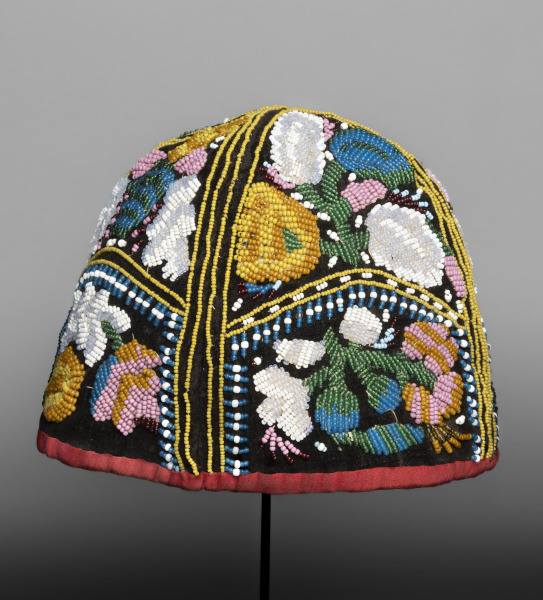
Mohawk artist, Glengarry cap, late 19th century. Glass beads, cotton, velvet, paper. Gift of Mr. and Mrs. Williard C. Cousins, 1958. E34655. Peabody Essex Museum. Photo by Ani Geragosian/PEM.
Q: How does the exhibition help visitors imagine Lewis’ early artistic environment?
A: Her aunties were teaching her, and she was surrounded by beadwork and carved pipes and carved wooden bowls and similar items that she would have grown up around. We are including some of those works in the exhibition, as this is what Edmonia would have known and been familiar with — because carving traditions go back millennia for her Anishinaabe peoples. It is not a new thing to carve into stone at all. So that's one thing that made it so exciting to think about: how figures and figurative works that we see from the 19th century in Anishinaabe art were readily transferred into marble by Edmonia, because it's something she would have been used to seeing.
You will see some beaded bags that would have been sold at Niagara Falls, a kind of community of crossroads where Edmonia Lewis would have attended with her aunts who were selling works. You will see a very beautiful carved wooden feast bowl and a carved wooden spoon used in a feast. Very elegant and sophisticated carving. There will be a walking staff that has a carved figure on it. There will be some dolls who are dressed in their finery from the 1850s to 80s. We also are including some painted portraits of some leaders from Edmonia's community that also show some beautiful details of their clothing and accoutrement.
Q: Lewis crossed international borders constantly throughout her life. How do you understand that mobility?
A: She was growing up in what is now the border of Canada and the United States. There is a region in between there that is Mohawk territory, and she had relatives in Mohawk territory. This is also Anishinaabe territory. There were also four or five different laws in Canada that were dictating who she was as far as her identity goes and where she could be and when. And so she was crossing those borders, dealing with those laws. So some of this was invisible borders. I think many Indigenous people do think of this so-called medicine line that is between the United States and Canada as being permeable and fluid. And it's a political border for some, but not for them because these lines have always been crossed. And so I do think that being someone who's a person of color of both African and Indigenous descent, that already she's quite familiar with what it means to be fluid in this identity as well as being fluid in this world.
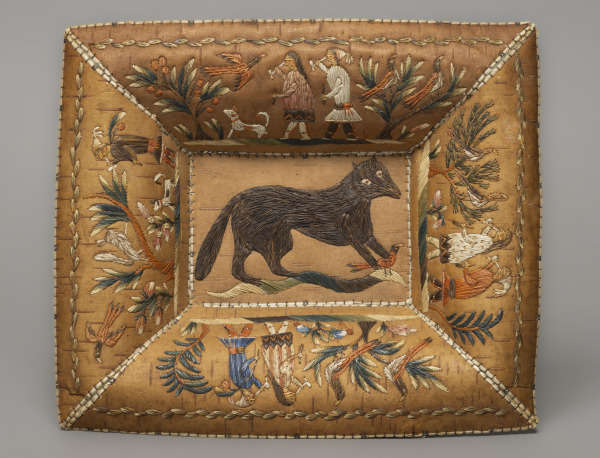
Huron artist, Calling card tray, before 1853. Birchbark and moose hair. Gift of Mr. and Mrs. Charles D. Carey, 1990. E77743. Peabody Essex Museum. Photo by Ani Geragosian/PEM.
Q: In your essay, you describe Lewis as a “cosmopolitan.” What does that mean in this context?
A: The application of this comes from Kwame Anthony Appiah, a scholar who has done a lot of deep thinking about what it means to be a cosmopolitan. The line is, “a cosmopolitan is one who retains rootedness to place across distances while being a citizen of the world. A cosmopolitan, in other words, belongs not to a city and not to the earth, but to the universe and the cosmos.” So that really struck me as an important way of thinking about Edmonia Lewis. When we had a convening with several Native American scholars and artists, as well as deep thinkers who know Edmonia Lewis well, it became very clear that her cosmopolitanism was so evident because she was going to Rome, living in London, very self-possessed, and someone who had faced a lot of adversity, as you said. I guess what I was trying to lean into when I think about Edmonia Lewis as a cosmopolitan is someone who can retain their identity and their worldview. It continues to shape them no matter where they are. And because she was such a sophisticated city dweller, but also quite obviously firmly attached to her roots and family backgrounds, it just seemed like the perfect way to frame her – while also thinking about these unending ties of belonging to her Mississauga family and community and land.
Q: What do you hope this project makes possible going forward?
A: I would say that there is still a lot more work that can be done on Edmonia Lewis and her Indigenous background. While we will be looking to stay connected to her Mississauga community and invite the people that we worked with to our openings and programs, there's a lot more deep work that can be done. I'd like to think that this is just a beginning. We've opened the door and hopefully it's open wide enough for lots of people to come through.
Edmonia Lewis: Said in Stone is on view through June 7, 2026. Follow along on social media using #EdmoniaLewisatPEM. It then moves to the Georgia Museum of Art from August 8, 2026 to January 3, 2027 and to the North Carolina Museum of Art from April 3 to July 11, 2027.
Tune into this episode of the PEMcast where curators and experts explore the remarkable life and work of 19th century sculptor Edmonia Lewis.
Keep exploring
Blog
Engaging Edmonia: Sharing the life and work of an extraordinary artist through PEM programs
6 min read
Blog
Artist Edmonia Lewis visited Boston women sculptors in Rome in December 1865
6 min read
Blog
Curator Q & A reveals insights into Edmonia Lewis’s life and work
5 min read
Blog
Curator Q & A reveals insights into Edmonia Lewis’ lasting legacy and the power of marble
5 min read