CONNECTED | May 18, 2026
Curator Q & A: Behind the scenes of Pressing Importance

Pressing Importance: Salem and the Declaration of Independence coincides with the 250th anniversary of the American Revolution as well as the 400th anniversary of the European settlement of Salem. Curated by Dan Lipcan, Director of PEM’s Phillips Library, this exhibition looks at Salem’s connections to the Declaration of Independence. These connections center around Ezekiel Russell, a local printer who played a key role in publishing and disseminating the Declaration in 1776. Rare and iconic works on view include two of the earliest broadside editions of the Declaration of Independence alongside Revolutionary-era manuscripts, newspapers, pamphlets and broadsides that showcase the nation’s founding values of democracy: freedom, liberty and equality. We spoke with Dan Lipcan about this timely exhibition, its local connections and what visitors can expect to learn and see.
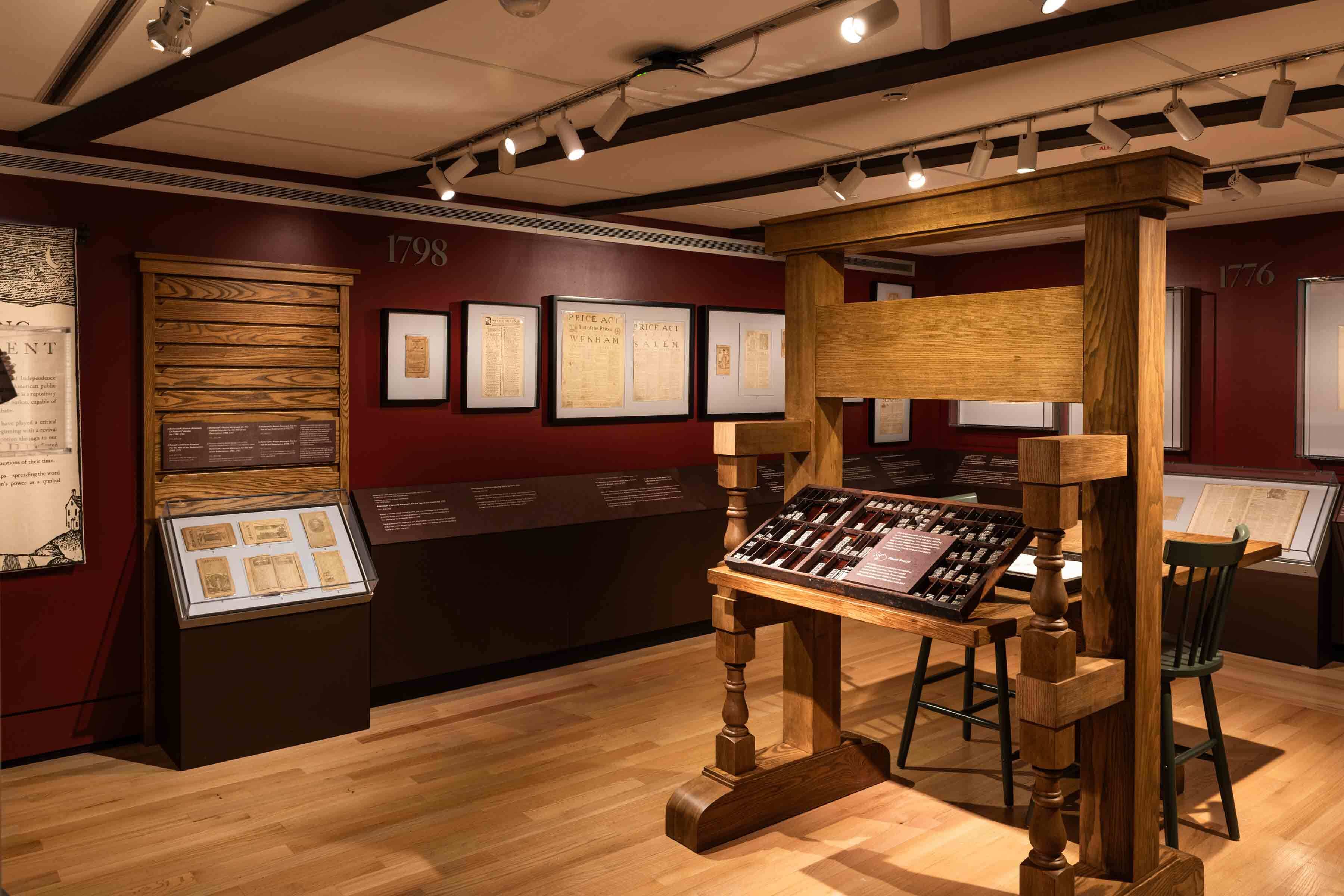
Gallery installation of Pressing Importance: Salem and the Declaration of Independence. Photo by Kim Indresano/PEM.
Q: What is this exhibition about? And what does the title Pressing Importance signal to visitors about the story you’re telling?
A: This exhibition is about the critical role Salem played in the printing and dissemination of the Declaration of Independence in 1776, primarily told through the story of Ezekiel Russell, who was a local printer.
"Pressing importance" is a phrase from the text of the Declaration itself: King George of England “has forbidden his Governors to pass Laws of immediate and pressing importance.” It also nods to the act of pressing paper to inked metal type, making prints and making these broadsides and pamphlets. Finally, it refers to the critical urgency of the messages and the documents and the calls to civic engagement that these objects in the exhibition show.
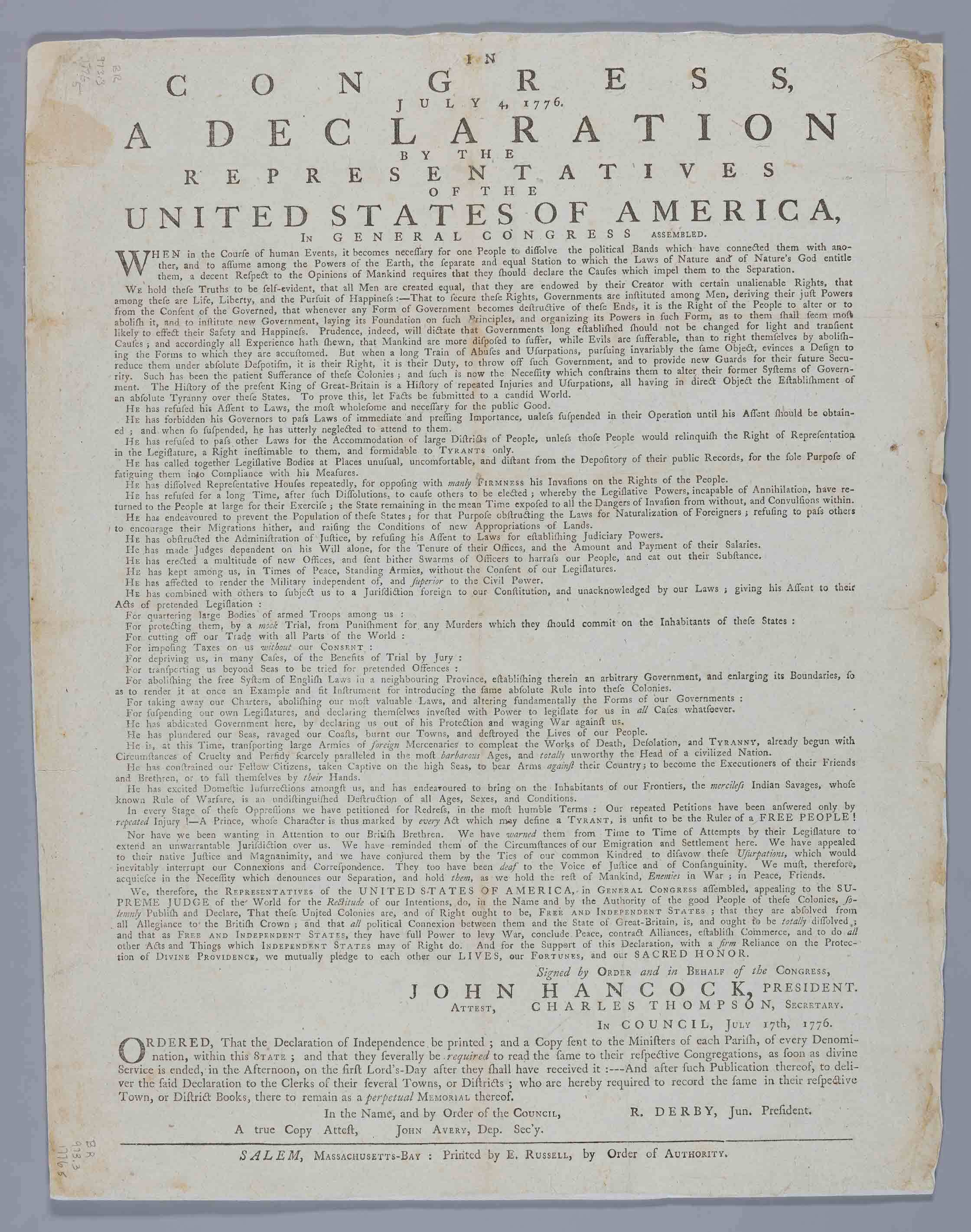
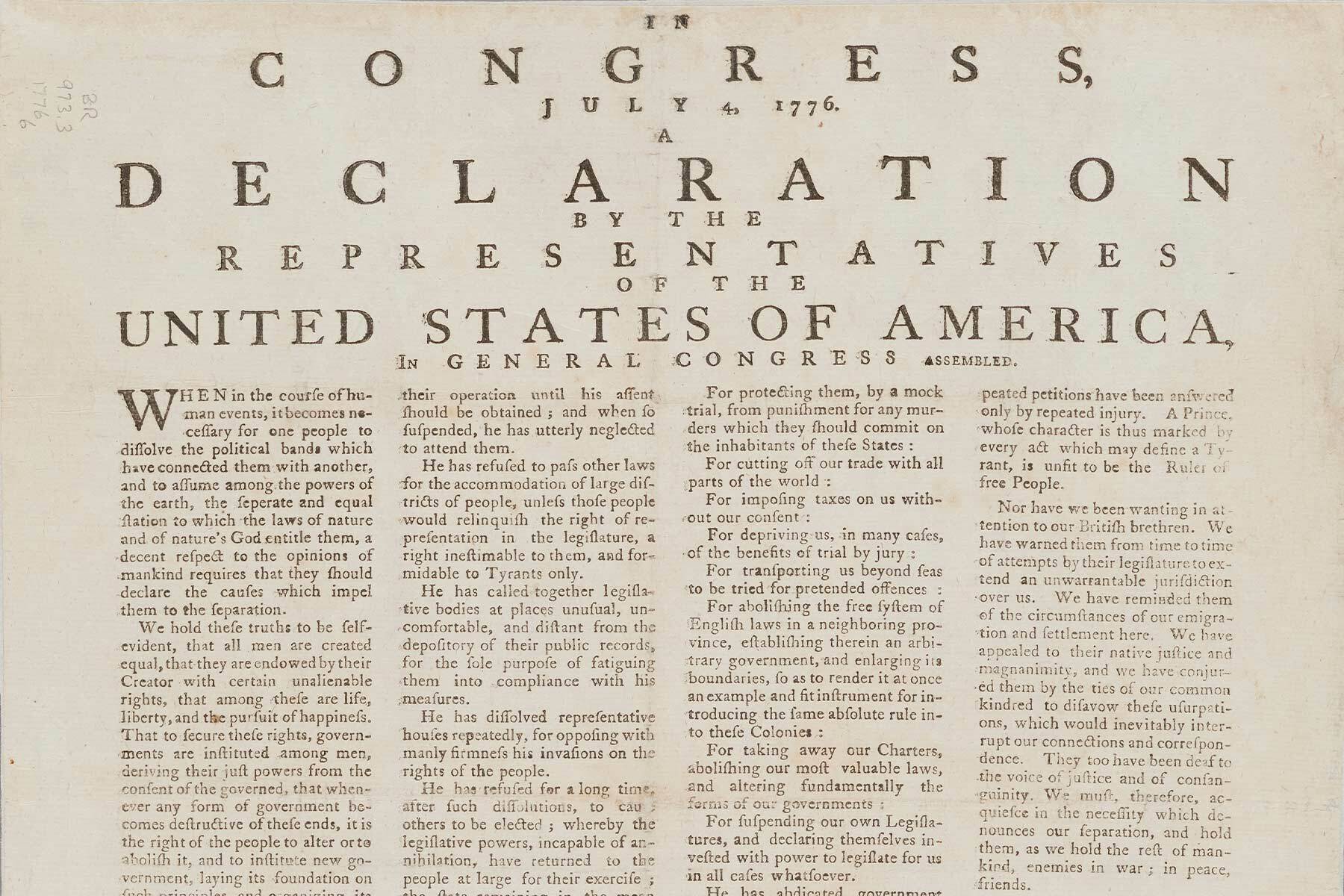
United States Continental Congress; Ezekiel Russell, printer, In Congress, July 4, 1776. A Declaration by the Representatives of the United States of America, in General Congress Assembled, 1776. Ink on paper. Phillips Library, Peabody Essex Museum. KF4506 .U558 1776b +++
Q: What makes Salem’s role in the early circulation of the Declaration so significant, and maybe surprising?
A: The information about Russell and Salem is a little bit hidden in these documents, but it's visible in the imprint statements: Printers would credit themselves as, "Printed and published by Ezekiel Russell on Main Street." Those aren't necessarily details that somebody would think to look for. As a library and cultural memory institution that has a responsibility to steward and share the history of our area, it's something that we're a little bit more attuned to.
Because we have such rich and deep collections here at PEM, we can investigate our holdings, poke around and start to see these commonalities and these threads that lead to really interesting and compelling local stories that have a national significance.
Q: This exhibition coincides with both the 250th anniversary of American independence and Salem 400+. How do those milestones shape your approach?
A: In leading a library that's very strong in historic material, initially I had just been kicking around ideas of what we could do to commemorate the 250th anniversary of the American Revolution and the Declaration and American independence. There's quite a movement here in Massachusetts for Revolution 250. I was poking around in our collection looking at the copies of the Declaration of Independence that we have from all different eras, from 1776 all the way through the 20th century. At a certain point, I realized that the two of them had been printed here in Salem, and with a little bit of further research, I was also able to determine that Ezekiel Russell's print shop, when he printed those copies of the Declaration, was a stone's throw from the museum. It's basically down the block from the museum on Essex Street. It was called Main Street then.
As I started to do a little bit more digging, I realized that we actually had dozens of works printed and published by Russell, whether that was during his time here in Salem from 1774 to '77 or when he moved to Danvers and then back to Boston. In preparing for the 250th anniversary of the Revolution and the Declaration, I stumbled across this hyperlocal story that was really central to the dissemination of the Declaration in 1776. Ezekiel Russell was commissioned to print a copy of the Declaration for every parish in the Massachusetts Bay Colony. He was responsible for distributing this document across the entire colony. It was a no-brainer that this story sits at that intersection of the 400th anniversary of Salem and the 250th of the Revolution.
Q: Tell us more about Ezekiel Russell.
A: Ezekiel Russell was from Boston, born in 1743. He spent his teenage years apprenticing with his older brother, learning the art and craft of printing. He worked in various places throughout New England in the 1760s and early 1770s. Russell printed materials that expressed a range of viewpoints. He remains well-known to historians for his antislavery publications, attempts to publish Phillis Wheatley’s poetry, and for several early pro-Loyalist publications. He began printing in Boston, and then he moves to Salem in 1774. He's here in Salem at a really crucial time of the American Revolution, the immediate runup and the initial years of the revolution. He has an enormous effect on how Salem prints, publishes, disseminates, shares and advocates for American independence.
He returns to Boston in 1781. His wife, Sarah Hood Russell, helps him run the print shop the entire time. She is probably responsible for a lot of the verse and poetry on some of the poetic and ballad-oriented broadsides that you see in the exhibition. The last object in the chronological run of Russell publications is a 1798 almanac. After Ezekiel dies in 1796, Sarah keeps the family printing business going for at least a few years — she was responsible for printing and publishing the 1798 almanac, and she's listed in the Boston directory of 1798 as a printer.
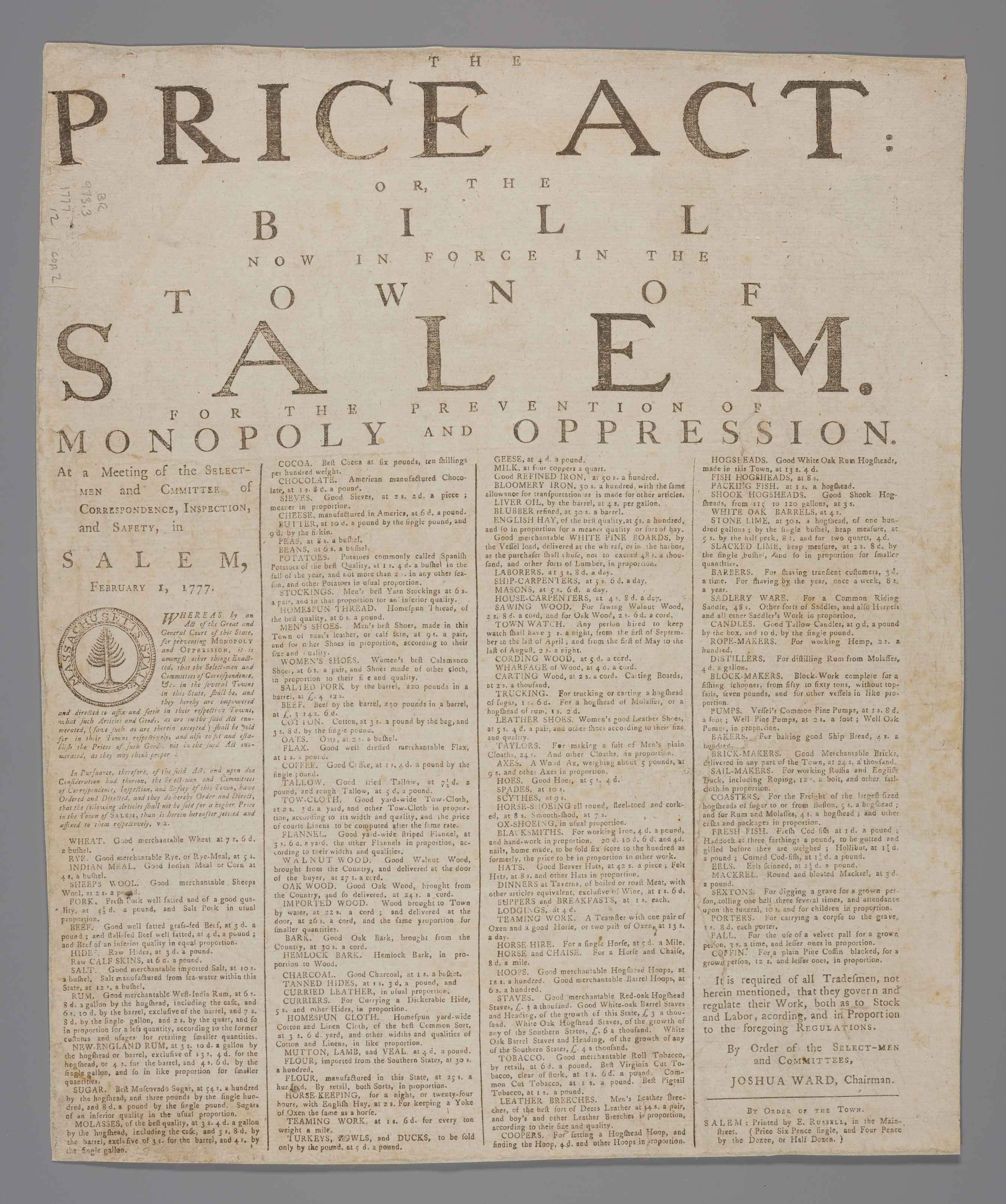
Select-Men and Committees in Salem, Massachusetts, and Ezekiel Russell, The Price Act: or, the Bill Now in Force in the Town of Salem, February 1, 1777. Ink on paper. Phillips Library, PS504 .E275 no.15590.
Q: PEM is stewarding three exceptionally rare broadsides, including two printed in Salem. What is a broadside and what makes these objects so extraordinary?
A: A broadside is a single sheet of paper printed on one side, like a poster, and usually illustrated. Broadsides are special because they were 18th-century advertising. They were meant to communicate information rapidly and almost informally. They were posted up on walls. They were distributed, handed out. They were sold. You can see folds in these broadsides. They all have the same patterns of folds because they were folded in half vertically and then again into quarters horizontally. A lot of them were put in pockets or in bags and carried around.
You can think of broadsides as TikTok reels or concert posters pasted to a wall. They were meant to communicate information quickly, but they were very ephemeral in the same way that Instagram stories disappear after 24 hours. Broadsides might have been printed, distributed, put on a wall, then taken down when the news was no longer current. That's one of the reasons why many of them don't exist anymore, but it's also an interesting parallel to think of broadsides as the primary mechanism for rapid communication of current information in the 18th century.
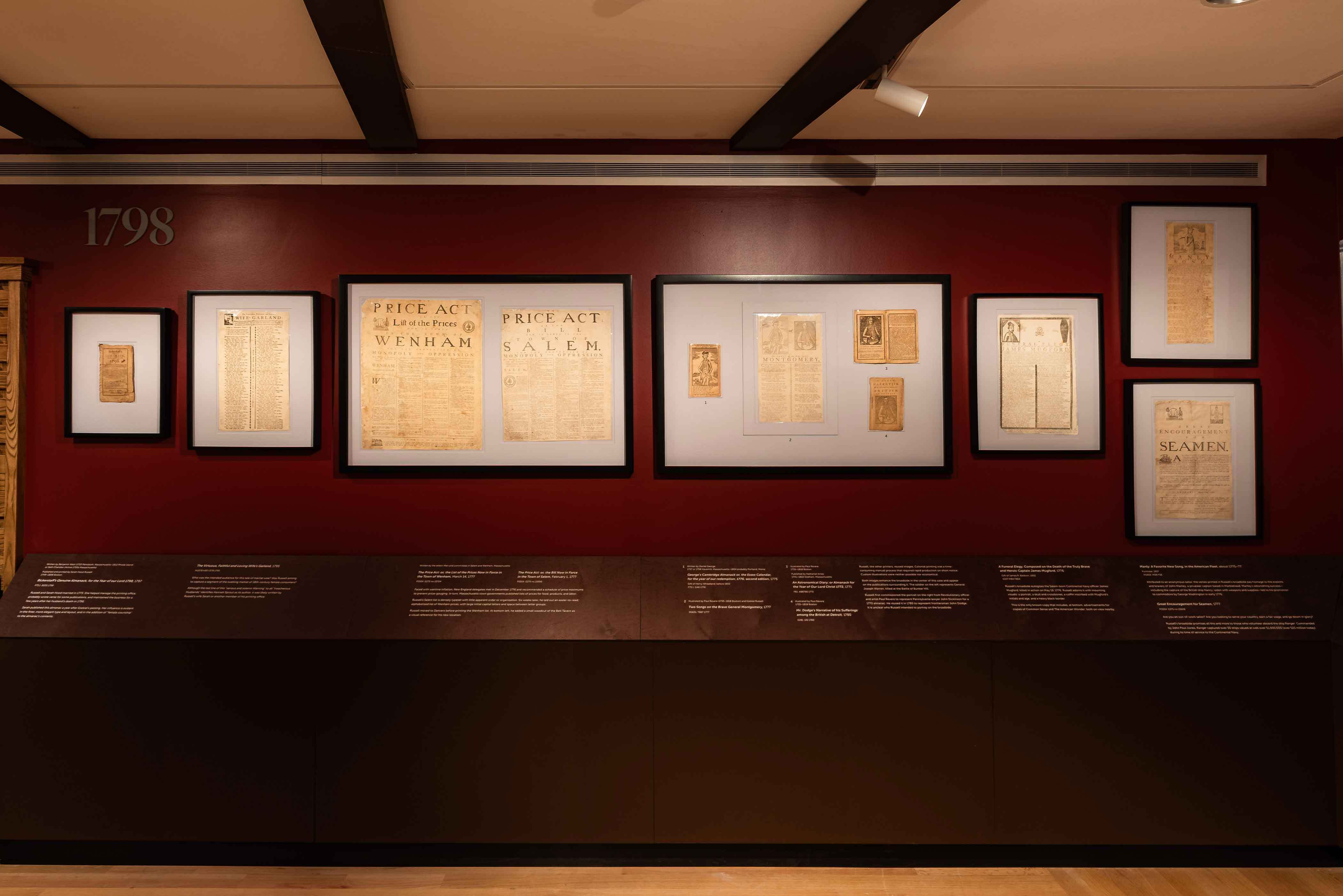
Broadsides in the Pressing Importance gallery installation. Photo by Kim Indresano/PEM.
Q: Why are early broadside printings of the Declaration so rare today?
A: The 18th-century broadsides in the exhibition are particularly special because broadsides, to a great extent, were not meant to survive. Many of them were torn off of walls, for example, or probably many of them were recycled into new paper, because paper was scarce during the Revolution. They are quite rare as a form. The early broadside printings of the Declaration are extremely rare because they were distributed rapidly throughout the colonies, posted onto walls, read in congregations of churches.
In July and August 1776, there were 12 or 13 broadside editions of the Declaration published by printers throughout the American colonies, beginning with the first edition printed in Philadelphia by John Dunlap. He made around 150 or 200 copies that were then distributed to the colonies for further distribution by local printers. Of all dozen editions of those broadsides, with maybe a few hundred copies each, there are only about a hundred copies that survive. The fact that the Phillips Library has three, including two printed here in Salem, is extraordinary.
Q: These broadsides are extremely sensitive to light and rarely displayed. How does that shape the urgency or specialness of this exhibition?
A: Because they are so light sensitive, we have restrictions on how brightly we can light them, and how long we can put these broadsides and other documents on view. What's particularly special about this exhibition is visitors will have the opportunity to see them all in a group at once, in context with other documents, broadsides and pamphlets from the era. We'll have the opportunity to enjoy them together for about 14 months, and then they'll go back into their folders and drawers.
I'll also add that folks are more than welcome to come up to the Phillips Library to see these broadsides individually when they're not on exhibition. But having them together in the gallery is a really special opportunity.
Q: Tell us more the physical qualities of these materials, like the paper.
A: We have them installed on the wall as if you might be encountering them on the street or on a wall in 18th-century Massachusetts and Salem. I hope that visitors realize that the paper that these broadsides are printed on is actually quite well made and strong and in good condition, despite some of the holes and ragged edges that they have. Paper was made from linen and cotton rags in the 18th century. Despite the fact that paper was quite scarce, these textiles that paper was made from are very strong. They're acid free. They last a long time. These broadsides look a lot better than books that we have in our collection from the 1910s whose paper was made from wood pulp and is falling apart and disintegrating.
Q: How is this exhibition making the craft of printing accessible to people?
A: I hope that visitors are able to appreciate the typography and the layout that Ezekiel Russell used and the precision and attention to detail and difficulty of actually typesetting these documents. Typesetting happens backwards and in reverse. It's a mirror image of what is printed. You have to lay out every word, every punctuation mark — all the spaces are set as well — and you have to do this backwards and in reverse. It's miraculous that printers could work at such a small scale in a lot of cases and make documents whose columns line up and produce what are actually really beautiful prints.
There are a couple of interactives that visitors can enjoy and try out. We have a type case (the rack of trays where type was organized by letter in tiny compartments) on a structure in the middle of the gallery that is meant to evoke a printing press of the type Ezekiel Russell worked on, and visitors will be able to touch that metal type.
On the other side of the press is a pamphlet-folding activity, so visitors will be able to get a sense of how a colonial printer might have taken a double-printed sheet and made it into an eight-page pamphlet.
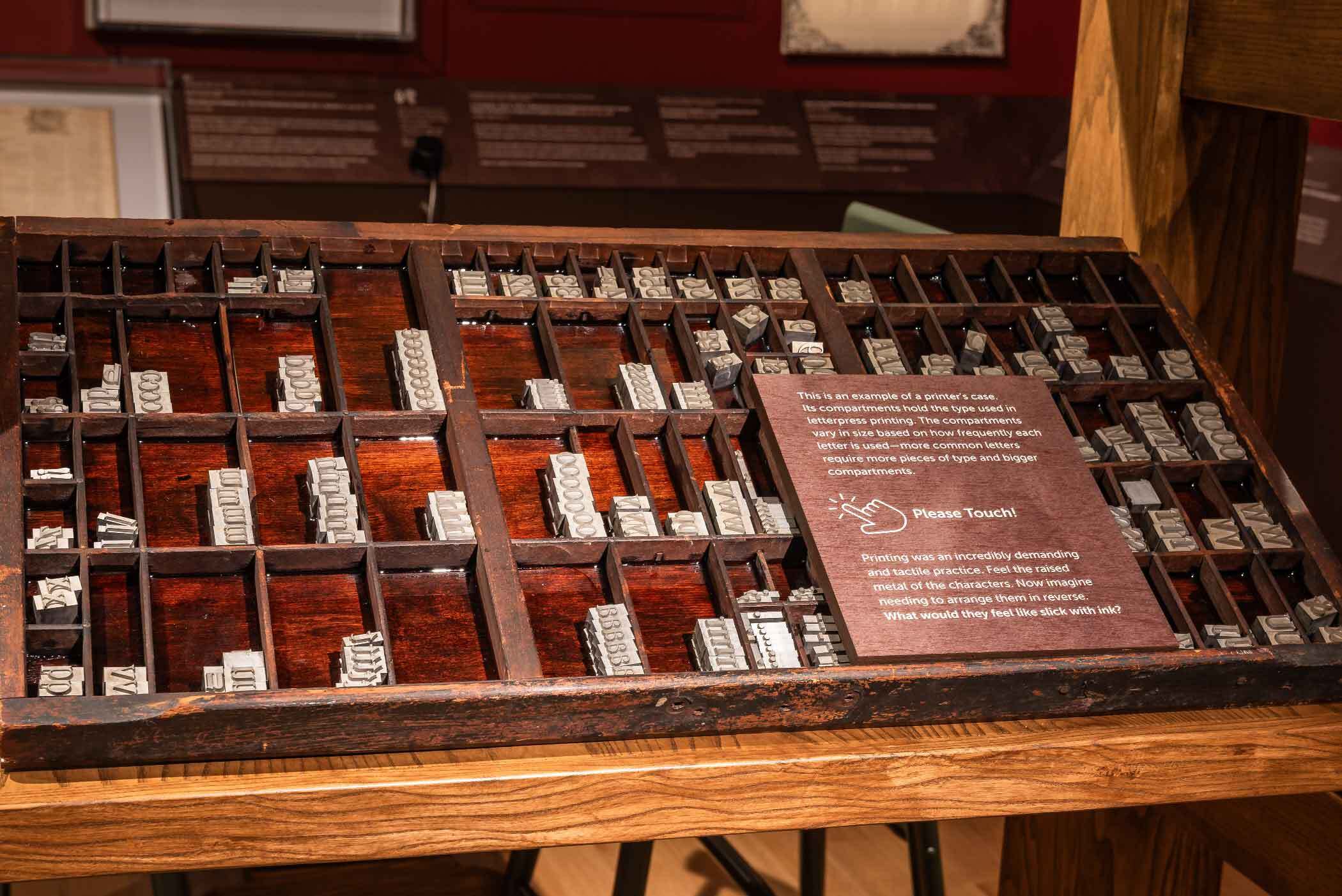
An interactive in the gallery helps visitors get acquainted with the metal type used to make broadsides during the Revolution. Photo by Kim Indresano/PEM.
Q: What are some of the surprises and discoveries that occurred while working on this exhibition?
A: There is an object that I think folks might miss, because it looks really boring and it's hard to read. It's a notice printed by Russell on August 12, 1776. He had partnered with a man named John Rogers, who was an itinerant printer without a press or type. Russell appears to have taken Rogers under his wing, let him print in his shop, worked with him to gather subscription money for the American Gazette, their newspaper. Now, the American Gazette only ran for about a month and a half. What a period to have a newspaper in Salem during the American Revolution, June and July 1776!
But they had some kind of falling out. This pamphlet is essentially this open letter from Russell saying, "This guy, John Rogers, he's printed a notice about me in this Boston newspaper on August 8, a handbill that was inserted into a Boston newspaper. It's all a lie. This guy made off with all the subscription money. I gave him an opportunity for work, and he's run off and he's not trustworthy. By the way, he's operating as this traveling bookseller. Don't trust him. He's also probably a Loyalist."
Because there's so little information about Russell as a person and his relationships with other people, I think this pamphlet is golden as a window into who Russell was. There are very few copies of this pamphlet that are out there and they're very difficult to read. We did have our copy conserved, and so it's a little bit easier. We do have a transcription available for people to look at if they want to read it. It's one object that will be easy for people to skip over, but it sheds some really interesting light on Russell and who he was.
There are two price acts issued by the towns of Wenham and Salem that Ezekiel Russell published in 1777. They're a few weeks apart. These were lists of maximum prices for things like food or other goods or services. The colony and the individual towns in Massachusetts issued these lists as a way to control prices to prevent price gouging at what was a time of rampant wartime inflation, not unlike prices at the pump now.
In between the printing of these two price acts, Russell moves. He prints the Salem Price Act while he was here in Salem. He moves in February or March 1777 to Danvers. At the bottom of the Wenham price list, he has a little tiny woodcut of the Bell Tavern in Danvers, just as a visual reference and a little bit of an assistance to folks to show where he's moved and now he's in this building. That's one of my favorite illustrations of his.
There are a couple of images of paper mills on the back of one of the almanacs, again, to reinforce Russell's plea for rags, for cotton and linen rags. Over and over again, Russell is begging people to bring rags. He will buy your rags. Bring him rags. It's this consistent drumbeat of, "we need more rags for more paper." Paper was very, very hard to come by then. There's one pamphlet called The American Wonder or the Cape Ann Dream. You would think you'd open it and read about some fantastic dream about American independence, but most of it is actually a plea for more paper.
Q: How did printers like Ezekiel Russell influence not just the spread, but the interpretation of revolutionary ideas?
A: Ezekiel Russell is an interesting character. We don't know a ton about him personally. There are very few manuscripts or diaries attributed to him. Not a lot of personal information is out there. We do know that he printed pro-Loyalist materials early in his career in Boston. He was brought before a town meeting in Boston after printing a pro Tea Act broadside, which we have a reproduction of in the exhibition.
He claimed that he had just been paid for it and that his job as a printer was to print what he was asked to print. When he moved to Salem in 1774, he established Salem's second newspaper. It's called the "Salem Gazette and Newbury and Marblehead Advertiser."
The first page of the first issue is filled with him essentially convincing Salemites that he's cool, he's OK. A printer should be impartial. The message is, "I know you may have heard some stuff about me, about the things I printed in Boston, but I'm here to report the news and to advocate for freedom, and it's cool to subscribe to my newspaper."
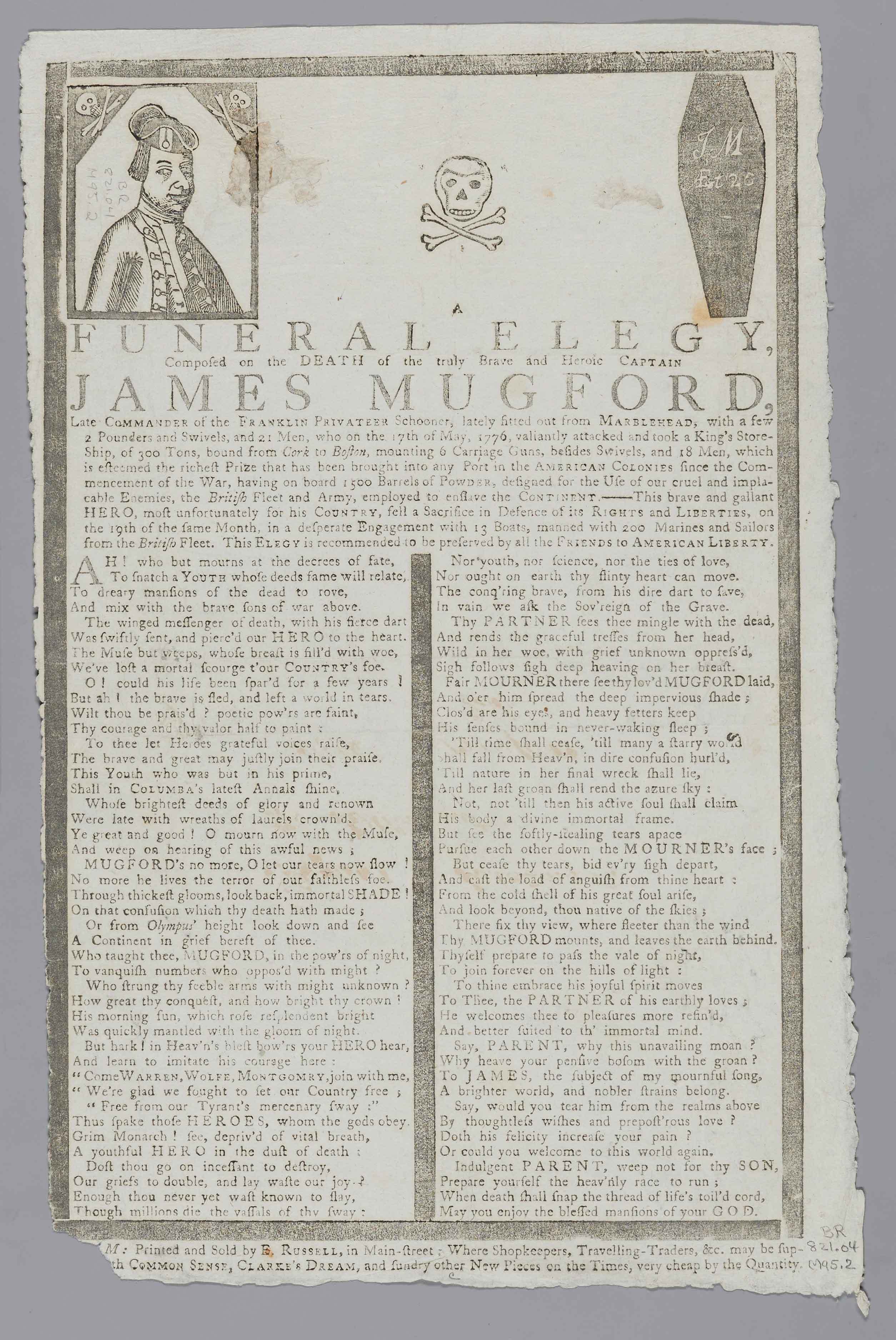
Ezekiel Russell, A Funeral Elegy, Composed on the Death of the Truly Brave and Heroic Captain James Mugford, 1776. Ink on paper. Gift of James R. Baldwin, 1932. Phillips Library, E207.M84 F864.
One thing Russell did really effectively was to pioneer the idea of enhancing his printed works with imagery, to make his pamphlets, his almanacs more attractive to people, to entice more people to pick them up or to purchase them, to draw their attention. He's really good at using large type that you can see from across the room or across the street to draw you in. He's really good at using italicized type or small caps to make various points of emphasis in the paragraphs of text that he's setting. I think those are the mechanisms that he uses to point out what's really important in the messages that he's printing.
Q: What do you hope visitors take away about the relationship between communication and civic action?
A: I hope visitors are able to recognize the power of the printed word in shaping history and in encouraging action. The Declaration of Independence is included in the introductory panel. I call it a press release and a justification and a rallying cry. It is all those three things. It is news of our break from England. It is a list of the reasons why we are doing so. It's a call to action to pledge, as they say in the last line, to pledge our lives, our fortunes and our sacred honor to make this Declaration of Independence a reality. I'm hopeful that these calls to action will inspire people to look at the values and ideals expressed in these documents and think about how they apply to the United States of America today.
Q: In a moment when information moves faster than ever, what can we learn from how revolutionary ideas spread in 1776?
That's a good question. I think revolutionary ideas spread, of course, much slower than typical electronic communications happen today. I do think that revolutionary ideas were passed from person to person through correspondence, through letters, through the publishing of broadsides and pamphlets. We have an edition of Thomas Paine's "Common Sense" that Russell printed early in 1776. Thomas Paine essentially allowed anyone who wanted to print “Common Sense” to print it, which resulted in widespread publication. It was really influential in turning the tide of Americans to think about what independence means and why they should become independent from Britain.
What's interesting thinking about 18th-century communication styles in comparison to today is that people were readers then. People were willing to sit down with a four-page, densely typeset newspaper and work their way through it. A lot of the nuance and detail that a printer or a publisher might have made in the 18th century to make a convincing argument is really hard to fit into a tweet or an Instagram post. I think we could do well to think a little bit more about how we can slow down a little bit and think critically and really comprehend the words that we are reading and even the subtext of what they might be saying.
Q: How do 19th-century reinterpretations and contemporary works extend the story beyond 1776?
A: We have one piece in the exhibition that we acquired just a few years ago. It's a recreation of a 1777 broadside published by Mary Katharine Goddard, who was a printer in Baltimore. She was commissioned by Congress in 1777 to create the official, first unanimous Declaration of Independence. This was the first Declaration broadside that had the word “unanimous” in it. It was also the first to include the names of the signers, who in 1777, were still in the middle of a revolution. That's a risky act. You're basically signing a death warrant if this revolution doesn't succeed. Goddard also put her name at the bottom of it, which was amazing and brave.
Contemporary artist, publisher and printer Mindy Belloff realized Goddard’s edition had never been recreated or reprinted. In 2009, after several years of research, looking at the nine copies of the Goddard broadside that are still in existence, she decided to recreate Goddard's broadside. Space by space, character by character, she used the same kinds of text decorations, laid it out exactly as Goddard had. As she was doing so, she was inspired by thinking about how Goddard must have felt as a woman typesetting the phrase, “all men are created equal.”
Mindy decided to create a second edition in 2010, and that's on view in Pressing Importance. Mindy calls it the second unambiguous edition. She lightly edited the text of the Declaration. In two places she's replaced the word “men” with the word “people.” The idea behind that was to make this edition read closer to the ideals that are stated in the document itself, to be a more inclusive expression of the founding ideals, the founding values of our democracy and our country.
I think it's just a really beautiful moment, where an artist is really thinking deeply about what the founding fathers said and wrote and just ever so slightly tweaking it to apply to our contemporary world and our current understandings of what this country is supposed to be.
Pressing Importance: Salem and the Declaration of Independence is on view until July 25, 2027.
Keep exploring
Press Release
PEM Exhibition Spotlights the 250th Anniversary of American Independence
Read on
Blog
Lynda Roscoe Hartigan and Salem Mayor Dominick Pangallo chat about the importance of arts and culture and Salem 400+
9 min read
BLOG
How PEM plans to celebrate Salem 400+
12 MIN READ

Blog
Celebrating Rev 250 with PEM objects
8 Min read
