PEMCAST | Oct 12, 2026
PEMcast 43: Salem at 400, Part 2
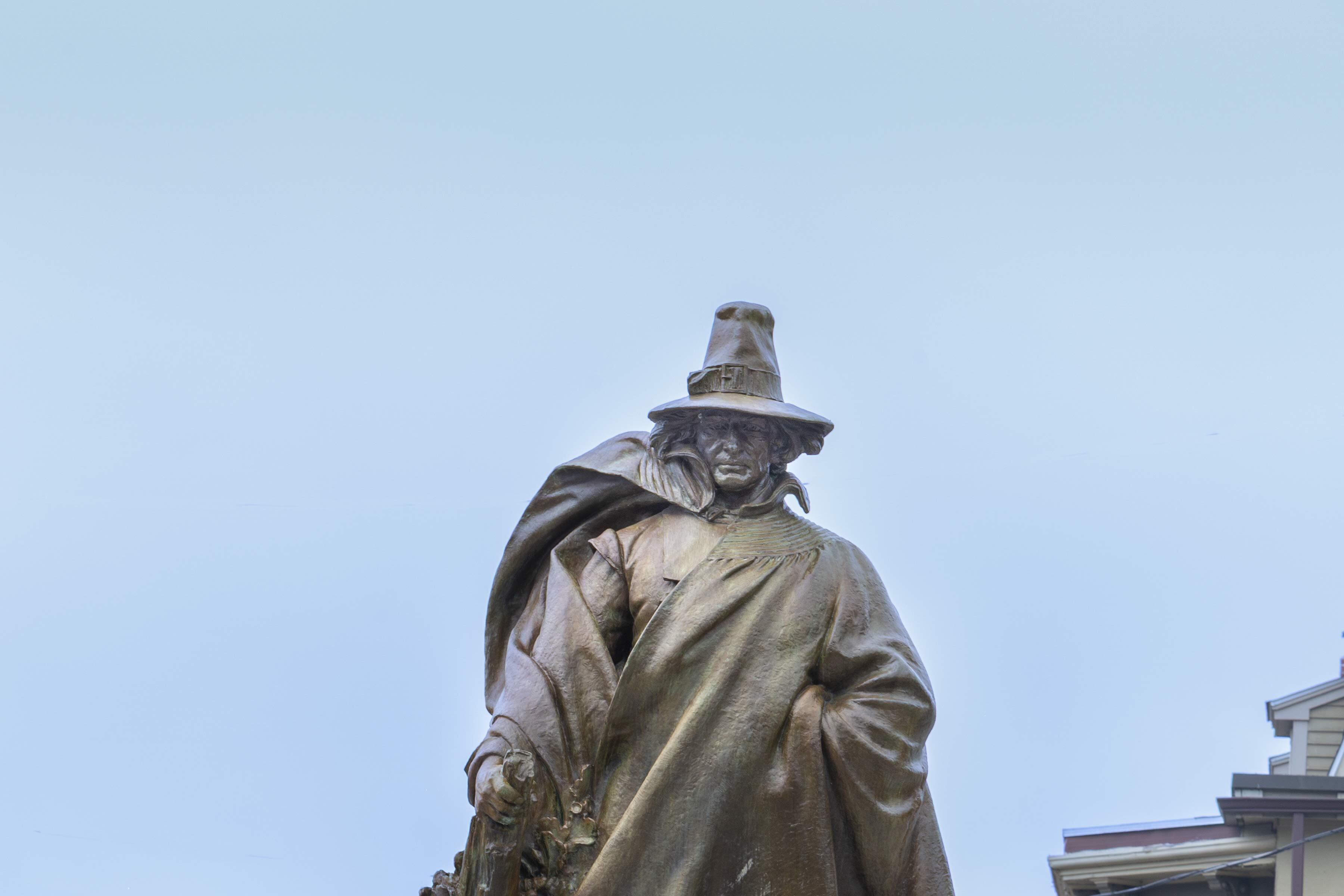
You can’t blame Salem visitors for being confused. The imposing statue – a cloaked figure with a big hat and staff – is positioned in the middle of a busy intersection that, over the years, has become a cross-section of Salem history. It’s where Salem Common, the Witch Museum and PEM’s historic houses all merge. (Find the PEM Walks QR codes outside these houses to learn the compelling backstories of gentrification, greed and even murder, and hear from the people who help steward these remarkable structures today.)
At this intersection, buzzing with traffic and pedestrians, people confuse the statue of Roger Conant for a witch. It’s what they’ve been conditioned to see in modern Salem, also known as Witch City. Just ask Karen Scalia, owner of Salem Food Tours: “When they take a tour in Salem, whether it's my tour or any tour,” she says, “it's our job to explain that it is the statue of the founder of Salem.”
In this episode of the PEMcast, Scalia shares how the founder of Salem, a cod salter and peace-loving community leader, began to mesmerize her, pulling her 400 years back in time. As part of the Salem Food at 400 Festival last summer, Scalia invited Conant’s 13th descendant, celebrity chef Scott Conant. During their time in Salem, Conant and his family visited PEM to see the Conant family Bible.
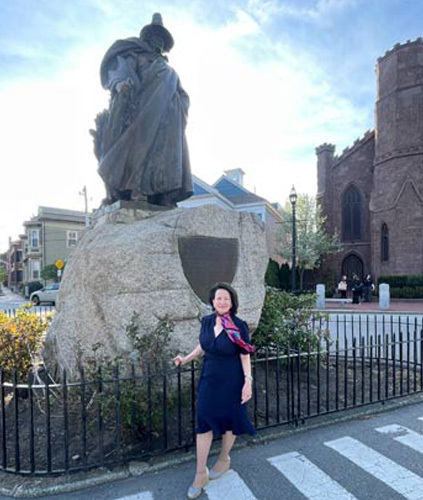
Courtesy photo from Karen Scalia.
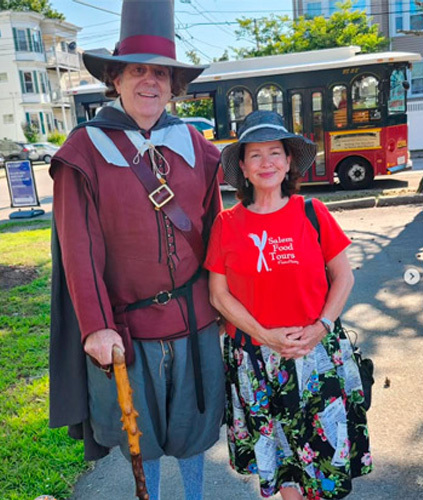
Courtesy photo from Karen Scalia.
As we celebrate the 400th anniversary of Salem’s settlement by English colonists, we look at the story of Roger Conant, and how the anniversary has finally forged a real partnership between Salem and Conant’s village in England. Visitors from East Budleigh joined us in the 400th festivities this summer and we got a chance to chat with them.
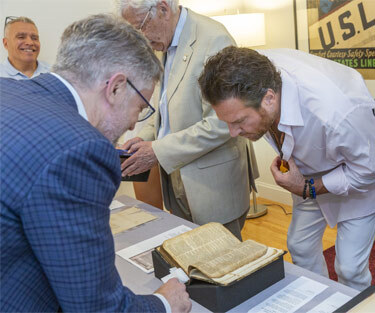
Dan Lipcan, the Ann C. Pingree Director of PEM’s Phillips Library, shows the Conant Family Bible to Scott Conant, a 13th-generation descendant of Salem’s founder, Roger Conant. Photo by Kathy Tarantola/PEM.
Of course, we can’t look at the English settlers without exploring those who came first to the area called Naumkeag, or “fishing place”: the Massachusett, Pawtucket and other Native communities. This episode also features Karen Kramer, PEM’s Stuart W. and Elizabeth F. Pratt Curator of Native American and Oceanic Art and Culture. We discuss how native peoples have been in this area as far back as 10,500 years. “When Roger Conant arrived on these shores, Salem was an Indigenous place,” says Kramer. “It was not empty and there for the taking. Pawtucket communities were living here on the land seasonally.”
In PEM’s exhibition On This Ground: Being and Belonging in America, we look at some object pairings that further the conversation about encounters between Native people and the English settlers. “I think a lot of our visitors and locals don't realize the deeper history of Indigenous peoples in this place,” says Kramer. “I think that often it’s a surprise because contact between settlers and native peoples happened so early on.”
Join us for this glimpse into Salem’s history to a time before the Salem Witch Trials, before the tourism boom and before people whirred past a dramatic bronze statue without ever knowing his name.
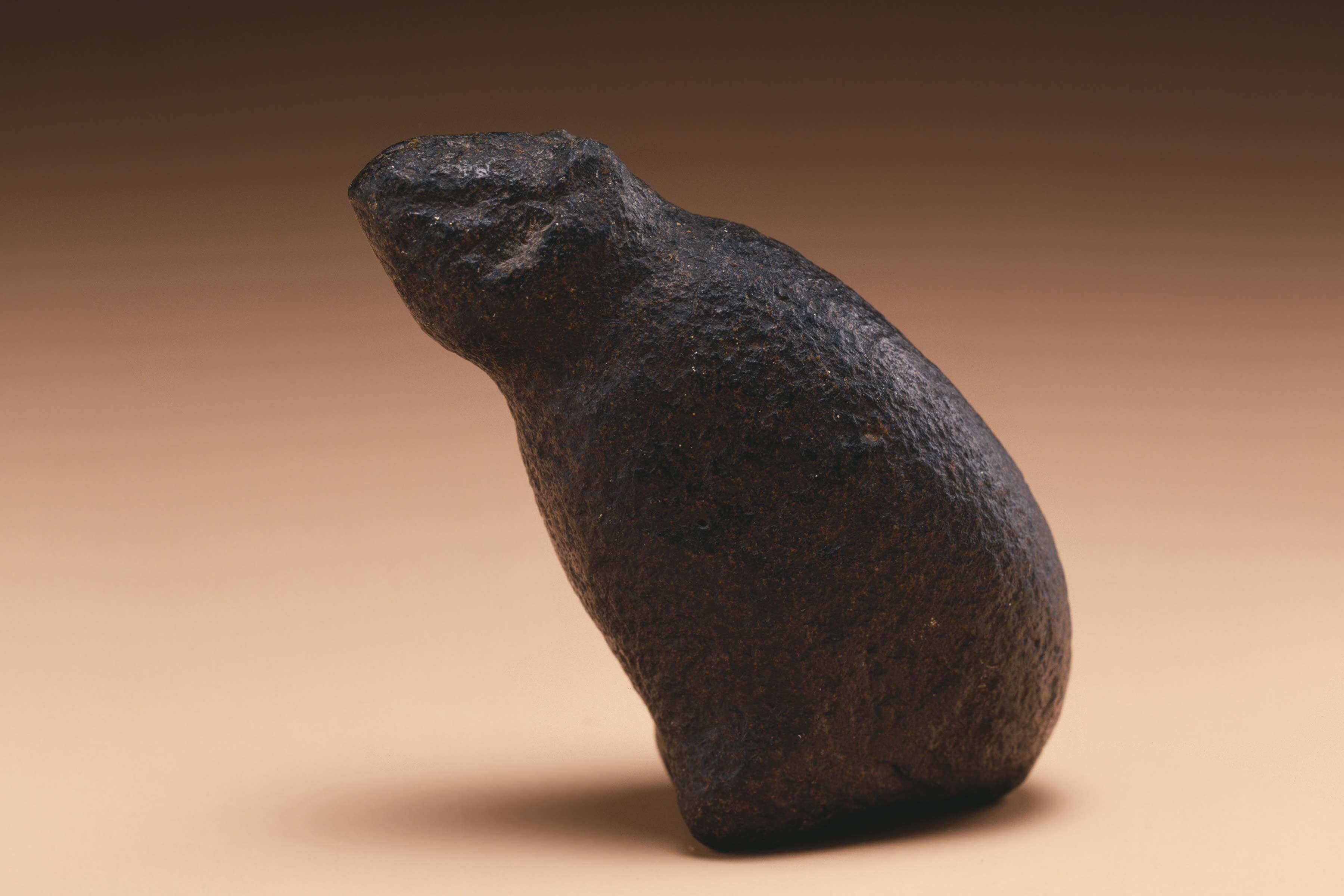
An object found about a mile from what is now the Peabody Essex Museum in Salem, discovered during the digging of a house foundation. Probably Pawtucket band of Massachusett artist, name once known, Sculpture, 1500s. Naumkeag (now Salem, Massachusetts). Basalt. Gift of Miss Bessie Eaton, 1898. E50296. Peabody Essex Museum.
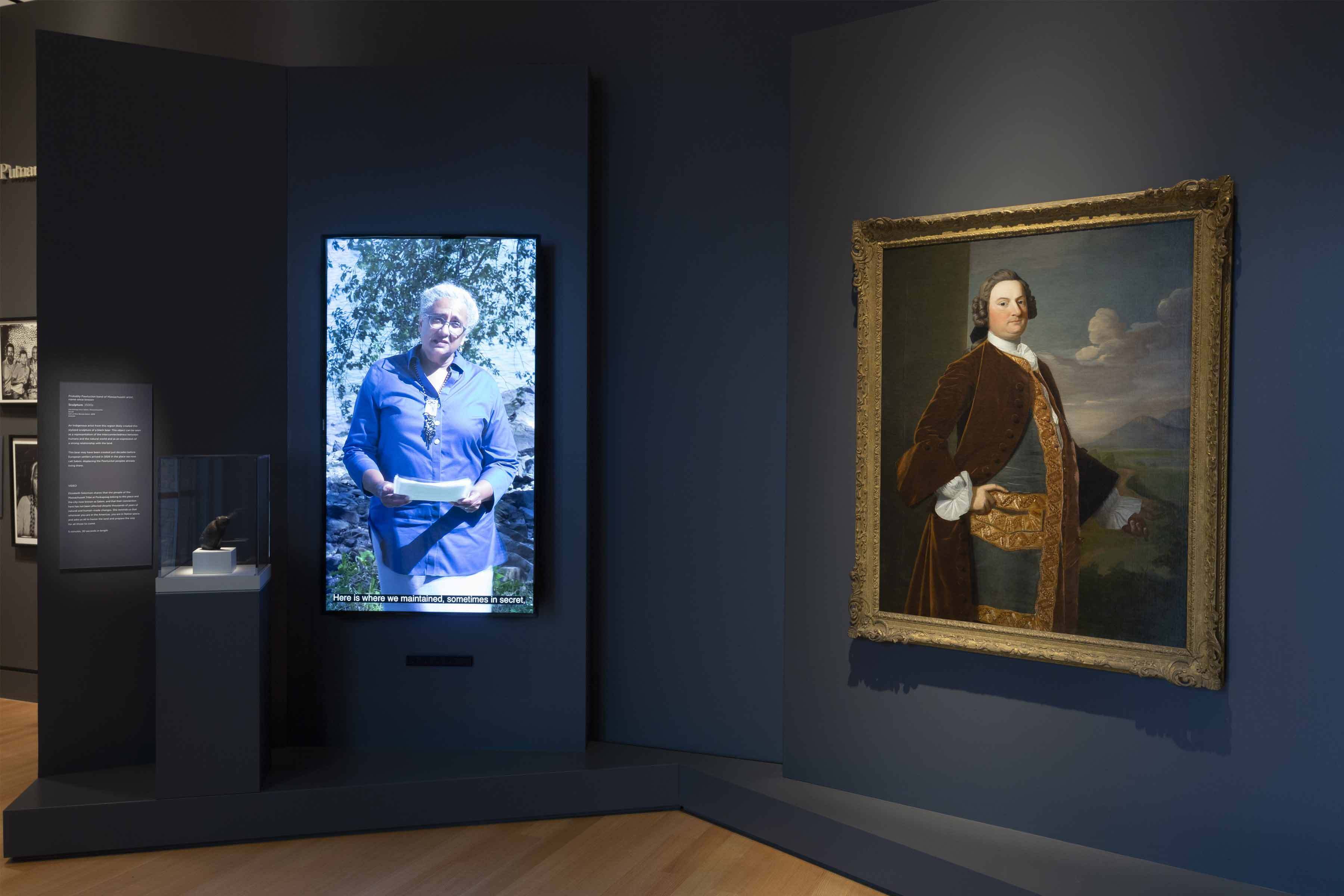
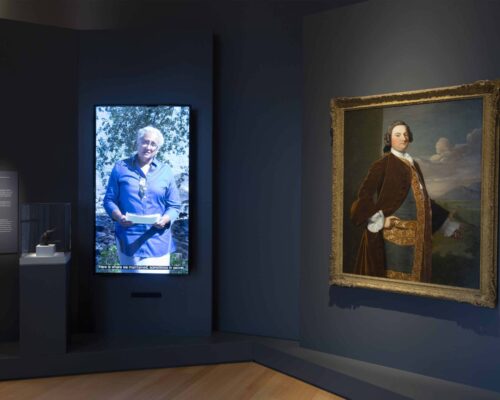
On This Ground: Being and Belonging in America. Photo by Kathy Tarantola/PEM.
UPDATE: As we were editing this episode, we heard from a former East Budleigh resident with another connection to Roger Conant. During her father’s 27-year ministry as the parish priest, her family was involved in the installation of the Conant Stone, an ancient millstone set in front of the village’s church. The stone, purported to be from the Conant family mill, honors Roger Conant as the son of a miller and churchwarden. She and her husband enjoyed a visit to Salem and PEM in September.
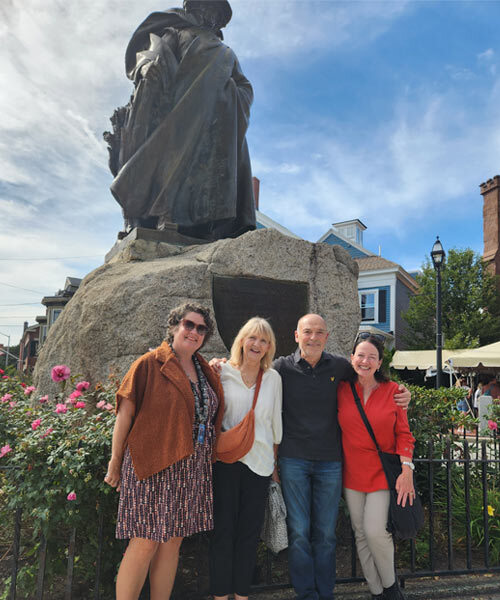
From Left: Dinah Cardin, Bea Annis, Jonathan Annis and Karen Scalia. Photo by Whitney Van Dyke/PEM.
To learn more about how we’re celebrating the 400th anniversary of Salem’s settlement, go to pem.org/salem400. Salem’s 400th coincides with our country’s 250th: Another thing you don’t want to miss is Pressing Importance: Salem and the Declaration of Independence. This exhibition from our Phillips Library is on view now and tells the story of a local printer who printed and distributed the Declaration.
If you missed the last PEMcast episode, go back and listen. You can learn all about how PEM has been celebrating Salem400+ through fashion. It’s well known that Salem has a reputation for costuming. With all the goth, punk, cultural, historical, mystical and just plain individual looks on the street, today’s downtown Salem is something of a runway. Want more Salem stories? Take some time this fall to sit in our pop-up cinema to enjoy Beyond the Broom: Salem Short Films. These community-produced shorts explore the unique character of Salem, its locals, businesses and natural environment.
PEMcast 43: Salem at 400+, Part 2
TRANSCRIPT
Dinah Cardin: So here we are with church chimes and cars going by. Where are we, Karen?
Karen Scalia: We are standing just across the way from the Roger Conan statue.
Dinah VO: This is Karen Scalia, a longtime resident of Salem, Massachusetts, and founder of Salem Food Tours.
Dinah: And what do you think most people, when they're walking by here, think this is?
Karen Scalia: We get that question a lot on the tours. Everybody sees this grand statue, with the cape and the hat and the staff, and immediately they think it's a big tall male witch. You know, we see tourists almost get hit by cars, they're so excited to see this symbol. And so when they take a tour in Salem, whether it's my tour or any tour, it's our job to kind of explain that, nope, that is the statue of the founder of Salem.
MUSIC
Dinah: Right. It is not a wizard. It is not a warlock. It is the founder of Salem.
Karen Scalia: And that is how gentlemen dressed back then.
Dinah VO: Welcome to the PEMcast, conversations and stories for the culturally curious. From the Peabody Essex Museum in Salem, I'm your host, Dinah Cardin. Around here, we've been celebrating Salem's 400th anniversary for months. In part one of this series, we looked at how PEM has been exploring fashion history and traditions as a way to celebrate the anniversary. And in part two, we're going way back in time. We start in 1626, when Roger Conant, the first English settler, came to Salem.
Dinah: When and how did you decide, like, Roger Conant is a historical figure worth looking into?
Karen Scalia: I was given a cookbook by a friend of mine that had it signed by chef Scott Conant of Food Network fame. And it said, say hello to the city where my great grandfather plus, plus, plus, plus, plus founded and settled or something like that.
Dinah VO: So Karen got into Roger Conant through his celebrity chef descendant.
Karen Scalia: And I always had in my mind, knowing in 2026, Salem was turning 400, wouldn't it be cool to bring Scott Conant to Salem?
Dinah VO: To be part of Salem Food at 400, a festival Karen organized as part of Salem's 400th anniversary celebrations, which featured activities in PEM's historic houses.
Karen Scalia: But what really started to make this all come together in a very unique way was when I began to learn more about the founder of Salem, Roger Conant. And we all know Roger Conant's statue outside the Salem Witch Museum. And many of us maybe drive by it and don't give it much of a thought, but he was a very special guy. I've always understood him to be a peacemaker. But it was through conversations with local historians, et cetera, and doing my own research that I began to really get a fuller picture about who he was.
Dinah VO: To further her understanding of this man who lived 400 years ago, Karen invited Scott Conant, the 13th generation direct descendant to Roger Conant, to come to Salem last summer. While in Salem, Scott and his family got to see the centuries-old Conant Family Bible, which is part of PEM's Phillips Library collection. But back to Karen and her unfolding education of all things Roger Conant.
Karen Scalia: So one of the things that he's known for is he actually settles the skirmish with Miles Standish up in the Cape, what we know as the Gloucester area at that time.
Dinah VO: Karen learned that the Naumkeag settlement that became Salem, the city of peace, was founded by someone with good diplomacy skills.
Karen Scalia: It's that, you know, working together process that starts to get noticed. And he was the one who said, I want to go down to Naumkeag. It's a better area to fish and farm and set up. And he brought a group here, as we know, to settle on the North River of Salem. And that same leadership quality, if you will, of being a community builder and a peacemaker started to shine through. And that included also his group working with, collaborating with the tribes that were here, the indigenous tribes that were here on Naumkeag of Massachusetts tribe.
Dinah VO: It is said that here in Naumkeag, which means the fishing place, Roger Conant was nicer to people than most of the European settlers. This was after resolving other potentially bloody disputes. And he worked as a salter of cod. Salem's founder was an early adopter of farm and sea to table.
Karen Scalia: This is a perfect place to settle. It really, the environment gives us everything we need. It's a wonderful place to fish. It's definitely easier to set up small farms and to start to work the land. They really couldn't have picked a better place. You've got the two rivers in Salem that were just teeming with activities very quickly. But really, he saw that and set up here. And understanding the kind of leadership qualities he had, I thought that is a really special thing to highlight for our 400th as we commemorate the founding of Salem through the lens of a peacemaker and a community builder.
Dinah VO: Karen is also something of a community builder. I asked her why she's excited about Salem 400 and why it's important for us to pause and celebrate our founding.
Karen Scalia: I'm a big believer in milestones. As we see at the witch trial memorial, it's reflecting on our history, how we can learn from it, how we can do better. As we commemorate our 400th anniversary and we look towards the future, of course, we reflect back, you know, what lessons have we learned? How can we, again, do better? And I am a very proud, not just small business owner here in Salem, but I'm also a citizen. And I really love the attitude of our city.
Dinah: There are so many stories in Salem. There's the maritime story, the Salem witch trial story. And how does it feel to be adding to the storytelling?
Karen Scalia: Oh, it's really exciting. There are fantastic stories here in the city. I fell in love with the spice trade history. And to be able to tell this story now about Conant, about East Budleigh, to share the stories of our local places, I'm honored and humbled and really, really happy.
Dinah VO: Then Karen got really into it and took it upon herself to connect with those living in the village in southern England where Roger Conant was from, East Budleigh.
Karen Scalia: I had planned on going over to England last spring to do some research and try to get to East Budleigh to prepare for Food at 400.
Dinah VO: Karen was preparing for her 11-day festival, a celebration of the intersection of food and history that included restaurants, distilleries, cideries, and historic houses, including ours here at PEM, where we gave away cookies made from a recipe with historic Salem ties.
Karen Scalia: And I got to this tiny little village, and it's everything you think of in your imagination. Houses in the center of the village, this quaint village, houses that are hundreds and hundreds of years old, thatched roof on some of them that still exists, a little river line that runs through it in the middle of town. And I have to admit, I got out of the car and I had wet eyes. I was in tears. It was really special to stand in the place where Roger Conant is from.
Dinah VO: For some context, Roger Conant was from this town of less than a thousand people, near the home of Sir Walter Raleigh, the explorer who also settled North America. Today you can grab a pint in East Budleigh at a pub called the Sir Walter Raleigh. Conant, by the way, was born exactly 100 years before the Salem Witch Trials took place.
Karen Scalia: And so I looked around a little bit, and then I was taking on a lovely little tour of the village and its area, which was wonderful. We visited the church that is there that actually has the piece where Roger Conant was baptized. What really moved me was they had a plaque as well outside of the church that honored Roger Conant. So here we have this statue here, and now I'm across the pond, away from home, and there is a plaque to their son honoring their peacemaker. So the plaque says: Roger Conant, 1592 to 1679, born in East Budleigh and baptized in All Saints Church. He founded Salem, Massachusetts in 1626. He is remembered for his attitude of tolerance and conciliation among the early settlers of New England.
Dinah VO: And burning in Karen's pocket was a letter from the mayor of Salem asking that East Budleigh and Salem become sister cities, or as the Brits adorably call it, “twinning.” The letter penned by Salem Mayor Dominick Pangallo said: Dear Mr. Tressiter and esteemed members of the East Budleigh Parish Council, I am writing to you today in goodwill with a proposal that celebrates our shared historical heritage and international connection as the mayor of Salem, Massachusetts. I am honored to extend an invitation for our two communities to become sister cities, united by the remarkable story of Roger Conant, a pivotal figure in the founding of Salem, born in your historic village…You get the picture.
Karen Scalia: And I knew that it made total sense that I had that letter in my pocket to ask them to become our sister city, to twin with us, because they are just, you know, celebrating that same, again, that same spirit that he brought, and it was very moving for me.
Dinah: You're such a gal about town, you're a big community person, and now you're across the pond finding a community that, did you find that same thing?
Karen Scalia: Oh my goodness, yes, I really, I really feel like, it really felt like I was at home. On a funny level, East Budleigh is just a small distance away from the ocean, so like Salem being on the ocean, you have the salt in the air, you have the manic seagulls and all of that, you have the changing weather, so you have this wonderful atmosphere around you. I've just met the most warm, lovely people that were so excited for their history, so excited to have us there. I traveled with a dear friend and my niece, and we felt the ocean completely disappear with their hospitality, their kindness.
Dinah VO: But that wasn't all. When Karen connected with the folks in East Budleigh, she discovered that they were planning the first Peacemakers Festival in honor of Roger Conant and the 400th anniversary of his founding of Salem. According to their website, the locals celebrated Conant by enjoying a dinner in the town church with an American menu, period costumes optional.
Market Organizer: Okay, it is time, it is officially 3 o'clock for the 2026 Salem Farmers Market. We have with us today some visitors from Salem's newest sister city in East Budleigh from the UK.
Dinah VO: This June, when Salem kicked off the first Farmers Market of the season, Ian Blackwell of East Budleigh rang the bell.
Market Organizer: All right, go for it! Excellent, you may now shop!
Karen Scalia: I'm very excited to share that Ian Blackwell from East Budleigh, who's a wonderful historian and is actually writing a book on Roger Conant, will be coming over from East Budleigh to represent, and joining him is his lovely wife, Bonnie. And in another stroke of absolute kismet, Bonnie's maiden name was Treadwell. Her family is from Salem, Massachusetts.
Ian Blackwell: The Roger Conant group has been building up the reputation or the knowledge of Roger Conant in the village for seven years at least now.
Dinah VO: But suddenly, a real interest in Salem's founder had taken hold, and the people of East Budleigh are greeting Americans in their small village.
Ian: We got a blue plaque put up saying Roger Conant was born near here.
Dinah VO: Ian Blackwell explains the blue plaques, like the one you might spot in London's Chelsea neighborhood, notifying you that Bram Stoker, author of Dracula, lived in this house. Now there's one of these about Roger Conant in his English birthplace.
Ian: And so when Karen appeared last year with this invitation in her hand from the mayor about becoming a sister city, it fell on fertile ground. Had he done it, sent it 10 years earlier, people would have said, who? What? Why does Salem, with a population of, what is it, 48,000, want to become twinned with a little village whose population is still no bigger than Salem's was in 1630? We've only got 500, 600 people in the village.
Dinah VO: And Americans started flocking to East Budleigh.
Ian: We did a Roger Conant walking tour of East Budleigh, going around and picking out the houses that were there when he was there, which includes the pub, but it wasn't a pub in those days, and the church, which goes all the way back to 14-something or other. If he is a peacemaker, it's because he came here 400 years ago. He convinced, or had enough followers from Cape Ann to come and set up home here and stay here. And when Endicott arrived two years later, the two of them managed to work together. Despite their religious, political differences, and differences of personality, they worked together for 20-something years and made a success of this community. And more than that, they were stickers, they were stayers.
Dinah VO: They were “stayers,” meaning they didn't go back to England like many of the others. Unlike the Blackwells, who, after they got to hang out with the local mucky-mucks and give a talk at Old Town Hall, returned home to England.
Ian: And then we climb aboard the aircraft and go home and meet the next American.
Dinah VO: One of the goals of Salem 400 Plus is to also look forward to the future. But we've learned in this city time and time again. You can't do that without learning some lessons from the past.
Dinah: So what do tourists and locals maybe not realize when they're just walking around the bricked streets of Salem that they might have missed in our history?
Karen Kramer: I think a lot of our visitors – and actually locals – don't realize the deeper history of Indigenous peoples in this place and how Native peoples have been in this area since time immemorial and certainly as far back as 10,500 years ago. I think that's often a surprise. And because contact between settlers and Native peoples happened so early on and colonization hit Native peoples on the coastal regions really, really hard.
Dinah VO: This is Karen Kramer, PEM’s Stuart W. and Elizabeth F. Pratt Curator of Native American and Oceanic Art and Culture. Karen says we know quite a bit about the indigenous communities to the north and south of us, but this area is still working on telling our story, a robust indigenous history that places North Shore communities at the center.
Karen Kramer: It's a very long and complex indigenous history on Massachusetts North Shore. We're just kind of south of where a lot more activity was happening north of us as well. So it winds up being this very interesting place where kind of we lie on the boundary here between what is considered northern and southern New England. I think that we also need to recognize that the federally recognized tribes of the Wampanoag Nation at Aquinnah, at Mashpee, have been stewarding this land, including coastal Massachusetts, for many, many generations, hundreds of years, thousands of years. When Roger Conant arrived on these shores in Salem, Salem was an Indigenous place. It was not empty. And there's for the taking. Pawtucket communities were living here on the land seasonally, moving from the coast in the summertime when in the warmer weather to the inland during the colder months. They also arrived on the heels of an epidemic that hit the South Shore, certainly, but also this region of the North Shore. And this epidemic wiped out as much as 90 percent of the native population. So by the time non-Native people arrived in this place, we now know as Salem in 1626, Native peoples were just recovering. The communities were fractured. I mean, there was mass amounts of death. And so they were just picking themselves up and trying to carry forward when this wave of settlers began coming.
Dinah VO: A wave of settlers, 80,000 Europeans crossed the Atlantic between 1620 and 1660.
Karen Kramer: On the surface, it appears that there's less continuity compared to Native tribes in the Midwest, Native tribes out West. And I think that there is a big misunderstanding because of a perceived absence where, in fact, that is not the case. It just looks different here on the East Coast.
Dinah VO: Every summer, going back to 2010 here in Salem, PEM has brought together students and young museum professionals with our nationally recognized Native American Fellowship Program. Coming from all over, out West, the middle of the country, Hawaii, the Fellows enjoy an intensive museum career training residency. In addition to staying together at a local college and walking or biking around Salem, even taking in the occasional baseball game at Fenway Park, the fellows spend their days gaining direct hands-on museum experience. Our staff is committed to fostering and advancing the next generation of Native American professionals to shape museums and cultural institutions. A community of scholars work alongside our staff across departments such as curatorial, collections and exhibition planning, and go on to do similar work.
Karen Kramer: They're from all over what some people refer to as Turtle Island here in the United States and Canada, and often they want to know the Indigenous history of this place.
Dinah: How do we here at the museum tell this story? What went on here before the settlers arrived? How do we do that?
Karen Kramer: Well, one way that we can do that is by working with descendants of the people, the Native people whose communities were located here. We've been working with the Massachusetts tribe at Ponkapoag and elders in that community to tell part of the story. They have ancestral ties to Salem, and we can also do that in the gallery through some belongings that we have, some archaeological artifacts and some cultural items that we do have here.
Dinah VO: PEM houses the oldest actively growing collection of Native art in the Western Hemisphere. On this ground, Being and Belonging in America is an installation that pairs PEM's Native American art with the American art collection. Visitors are first greeted by a land acknowledgement from Elizabeth Solomon.
Elizabeth Solomon on video: Ten thousand years ago, Salem Harbor was dry land and we were here. One thousand years ago, what is now known as the city of Salem was occupied by a thriving Native community. We were that community. Four hundred years ago, English colonists came to occupy our land and we were here. Today, the city of Salem and the greater Boston area is a major urban area occupied by others. And still, we are here.
Karen Kramer: Now, Elizabeth is an elder and a community member at the Massachusetts tribe at Ponkapoag, and she's reminding everyone that wherever you are in the Americas, you're on Indigenous land.
Dinah VO: Visitors to the gallery then encounter a small but powerful object, a basalt stone bear.
Karen Kramer: That could fit in the palm of your hand. And it's just a stunning piece. It's a stylized bear that was found about a mile from what is now the Peabody Essex Museum in Salem. And they were digging for a house foundation. And this is when this bear was unearthed. And archaeologists have dated it to around 1500, 1600. And and so it was most likely a personal object that was meant to honor a clan ancestor, this bear. But it also kind of looks like it could have been like a grinding stone, like a like a pestle.
Dinah VO: The video and the bear are joined by a nearby portrait of Judge Richard Saltenstall, a signer of the original Massachusetts Bay Charter, who arrived by ship in Salem in 1630. A page of the charter is in a case nearby. These pairings are important, says Karen.
Karen Kramer: What does it mean to belong to a place? And how can we grapple with these two different ways of understanding? And objects in the gallery are one way that we can start to have these conversations.
Dinah VO: That's our show. Thanks for listening. The PEMcast is produced by me, Dinah Cardin, and edited and mixed by Marc Patenaude. Thank you to Karen Scalia of Salem Food Tours, PEM Curator Karen Kramer, and the people of East Budleigh, UK. Our theme song is by Forrest James. If you enjoyed this episode of the PEMcast, please share it with a friend. Needing more Salem stories? Take some time this fall to sit in our pop-up cinema to enjoy Beyond the Broom, Salem Short Films. These community-produced shorts explore the unique character of Salem, its locals, businesses, and natural environment. To learn more about exhibitions, how we're celebrating Salem's 400th, or about our Native American Fellowship program, go to pem.org.
And before we go, Salem's 400th coincides with our country's 250th. Another thing you don't want to miss is Pressing Importance: Salem and the Declaration of Independence. This exhibition, from our Phillips Library, is on view now and tells the story of a brave Salem printmaker who printed and distributed the Declaration of Independence. This printmaker might just have influenced your fate. The exhibition features rare and iconic documents that were instrumental to the founding of this country and reveals the role Salem played in starting the revolution. We leave you with a reading of the Declaration of Independence, which can be found in our gallery.
Dan Lipcan: We hold these truths to be self-evident, that all men are created equal, that they are endowed by their creator with certain unalienable rights, that among these are life, liberty, and the pursuit of happiness.
Related posts
BLOG
How PEM plans to celebrate Salem 400+
12 MIN READ

PEMcast
PEMcast 43: Salem at 400+, Part 1
31 min listen
Exhibition
On This Ground: Being and Belonging in America
Ongoing

Blog
Behind the scenes of the Salem Food at 400+ Festival
6 min read
