CONNECTED | Oct 20, 2026
Fashion Designer Stella Lunardy’s wedding gown goes down the aisle at PEM and into the museum’s collection

It started with a message on Instagram.
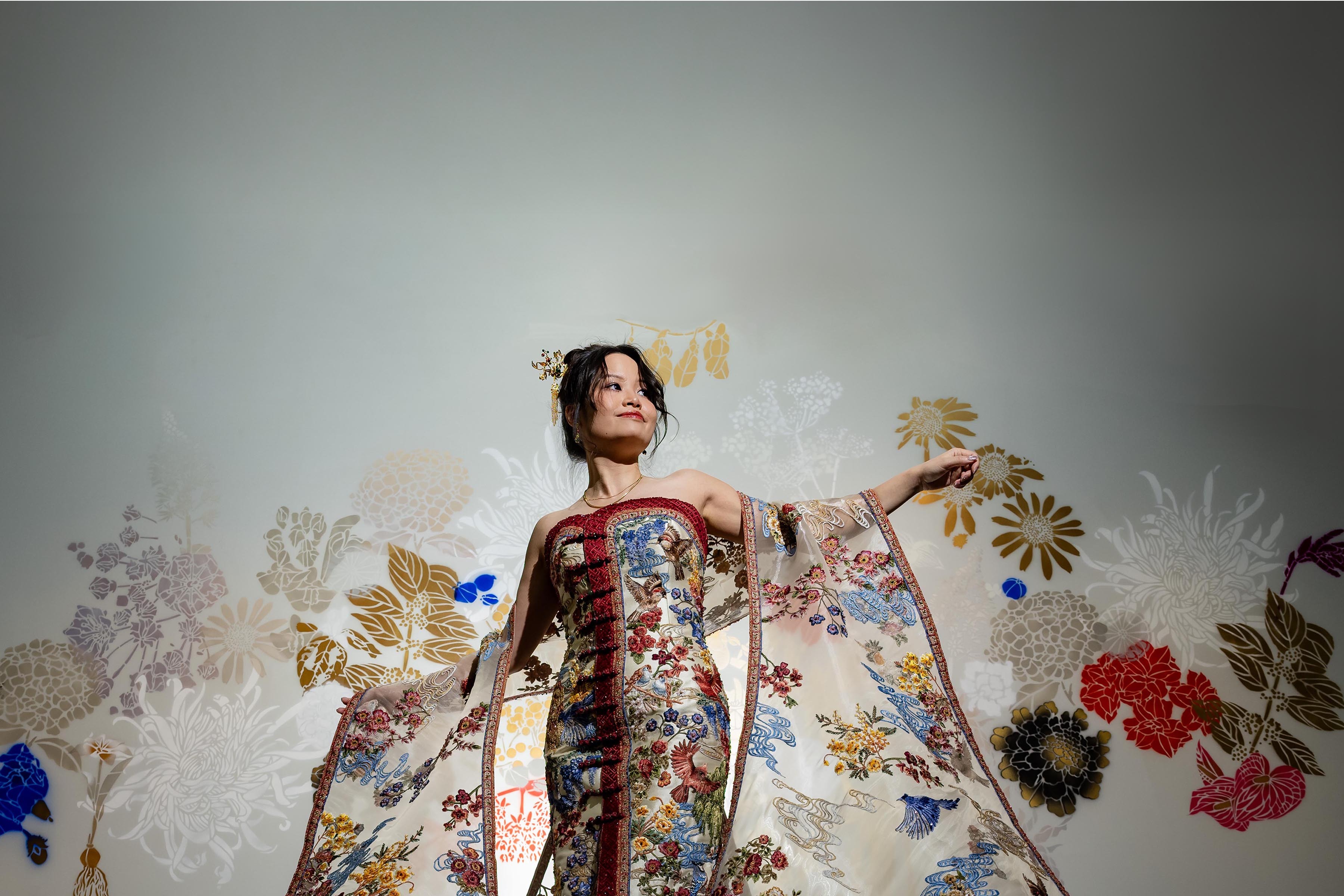
Patricia Schiller (née Tian) a bride-to-be living in the greater Salem area, had been searching for a wedding gown designer who could incorporate aspects of her life. She found her in Stella Lunardy, who is based in Jakarta, Indonesia. When Patricia Schiller and her now-husband, Austin Schiller, were looking for a wedding venue, they chose the Peabody Essex Museum, the location of their first date. But after their wedding took place in the summer of 2025, an unusual twist happened: The museum acquired Schiller’s wedding dress and accompanying shawl for its collection. The two pieces are now on display in PEM's Salem 400+ fashion installation, Salem Gets Dressed.
For Petra Slinkard, PEM’s James B. and Mary Lou Hawkes Chief Curator and The Nancy B. Putnam Curator of Fashion and Textiles, the gown fits perfectly in an exhibition celebrating Salem’s communities and history. “This custom gown satisfies a collecting goal in the area of fashion and textiles, which looks to enhance our global contemporary fashion collection while also highlighting the balance between the global and the local through a very specific personal narrative,” she said.
Photo by Bella Wang.
When Schiller stumbled over photos of Lunardy's sumptuous embroidery, the designer was already a go-to for Chinese Indonesians dressing for Sangjit, a traditional betrothal and engagement ceremony where the couple’s families exchange gifts. Over the past decade, what was once a simple betrothal ceremony in everyday clothes has transformed into a cultural celebration. Many brides now don a custom, contemporary cheongsam or qipao.
Clients especially love the Jakarta-based designer’s intricate embroidery, which makes each piece look like a traditional Chinese painting come to life. Designed in the landscape tradition of shan shui and the meticulous detail of gongbi, the embroidery typically features motifs meaningful in Chinese culture, including those from nature (clouds, mountains, foliage), architecture (bridges) and animals (dragons, phoenixes, swans, cranes).
Studying Lunardy’s past work, Schiller noticed clients tended to embroider something meaningful — a pet, the place they met a partner or where they’d gotten engaged.
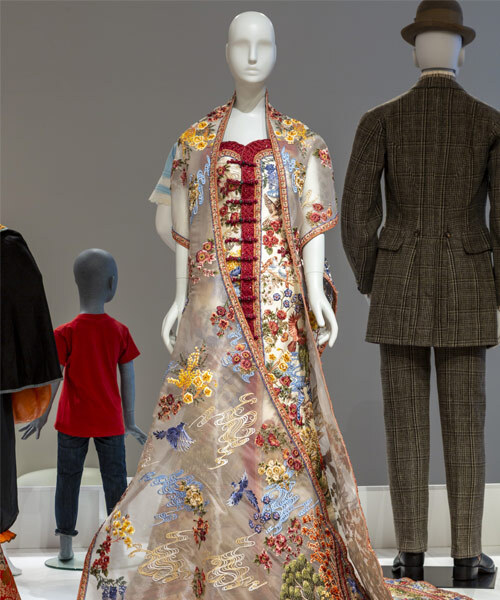
The Stella Lunardy dress, now in PEM’s Fashion and Design gallery. Photo by Kathy Tarantola/PEM.
“I didn’t necessarily have a spot like that in mind — we got engaged at home, so that did inspire me,” Tee said over a video interview. “I spend most of my time at home, so it made logical sense. And there’s plenty of wildlife here, which translates pretty well to this kind of piece.”
So when the two met over Zoom, Schiller proposed her own backyard.
Referencing pictures, Lunardy sketched willow trees, foliage, birds, rabbits, deer and geese alongside a lake, collaging each element together until the train of the dress became Schiller’s backyard. To create a continuous landscape, Lunardy extended the same approach to the sheer shawl, which stretches more than five yards.
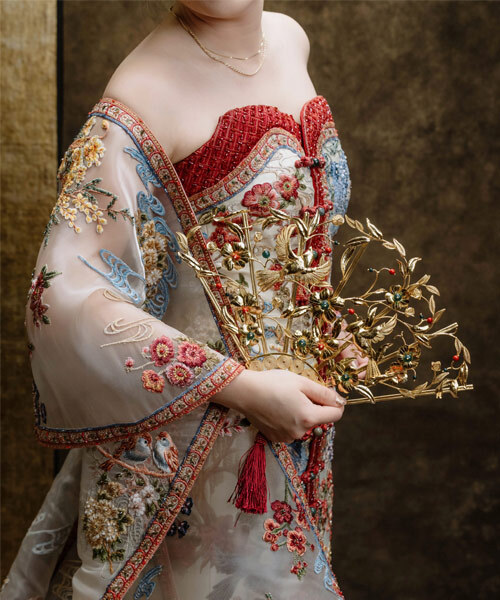
Photo by Bella Wang.
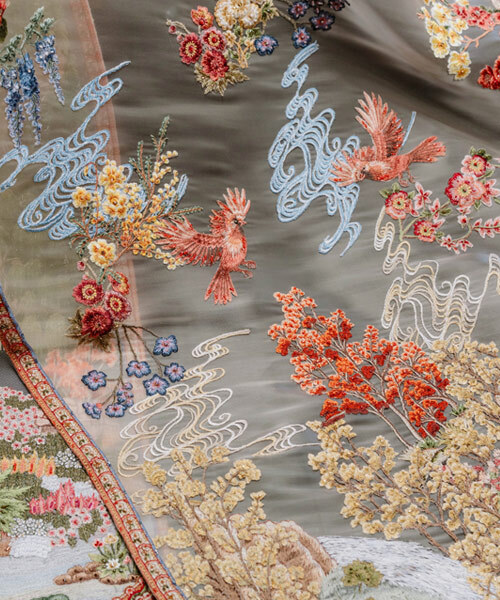
Photo by Bella Wang.
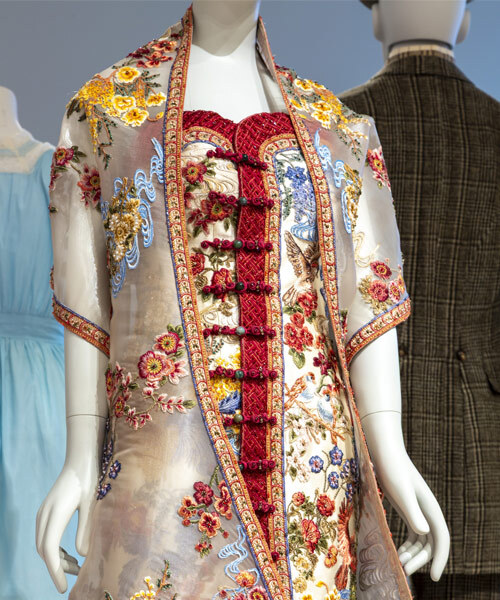
The Stella Lunardy design, now in a section called Salem Gets Dressed in PEM’s Fashion and Design Gallery. Photo by Kathy Tarantola/PEM.
On the dress itself, a squirrel sits near the hem, beside a bush.
“The squirrel has a story, because when my husband proposed to me, he mentioned that there was a fat squirrel that I needed to go check out outside,” Schiller said. “There was no squirrel! He just got down on one knee.”
Lunardy departed from traditional qipaos in the silhouette.
“I try to explore silhouettes we haven't seen before, but I know that usually the classic Chinese attire is with the mandarin collar,” Lunardy said in a video interview. “Since she didn't want a very high neck, we made it a tube cut. So we balance the traditional Chinese influence of the embroidery with a silhouette that still feels modern to her and matches her personal style.”
Though the mandarin collar was left out, the frog closures that typically sit at the center and fasten along the sides of cheongsams were replaced with delicate knotted buttons running down the side of the dress, grounding the modern silhouette in Chinese tradition.
Lunardy incorporated a red border around the dress — a color carrying connotations of luck and prosperity in Chinese culture. The most personal touch came last: the bride’s family name in Chinese, embroidered on the train.
Once Lunardy digitizes the final sketch, she passes it to her in-house team of cutters, embroiderers and beaders, who are each responsible for a different stage of production.
First, the cutters begin by cutting out the fabrics. Next, the embroiderers trace the drawings with threads in the appropriate colors. Like artists with brushstrokes, they fill in respective areas with machine embroidery. To add dimension, the finishing team sews beading on top of the embroidery.
Production began approximately half a year before the wedding, and involved three fittings, with the bride traveling around 9,000 miles to Jakarta for the last two.
Overall, Schiller couldn’t be happier with the dress (and the day). “I was very, very much thrilled with the way it turned out,” she said. “One day we’d like to be able to take our child to PEM. We’d love to take our family and show them just how much this place means to us.”
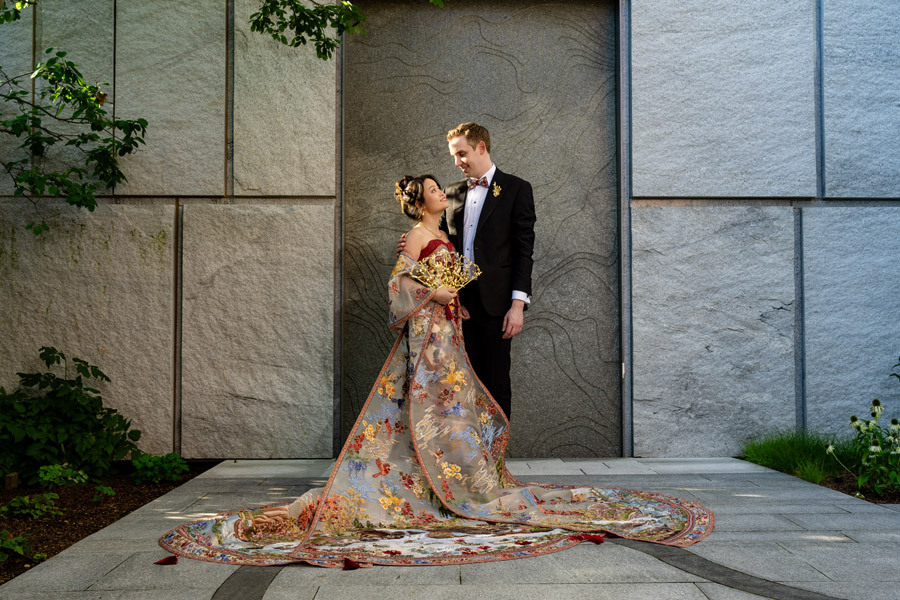
Photo by Bella Wang.
You can see Lunardy’s design alongside a selection of historical wedding gowns and suits from other Salem residents past and present in Salem Gets Dressed on Level 3 of the museum. Explore all of our exhibitions and tours for Salem 400+.
Thinking about your own magical wedding at PEM? Explore our event rentals or email weddings@pem.org.
Related posts
PEMcast
PEMcast 43: Salem at 400+, Part 1
31 min listen
Press Release
PEM reinstalls Fashion & Design gallery to feature Boston entrepreneur Yolanda Cellucci

PEMcast
PEMcast 40: Fashioning the World with Andrew Gn
30 min listen

Press Release
PEM announces exhibitions and programming to celebrate Salem 400+ in 2026
