CONNECTED | Jun 24, 2026
Curator Q+A: Behind the Scenes of East India Marine Hall

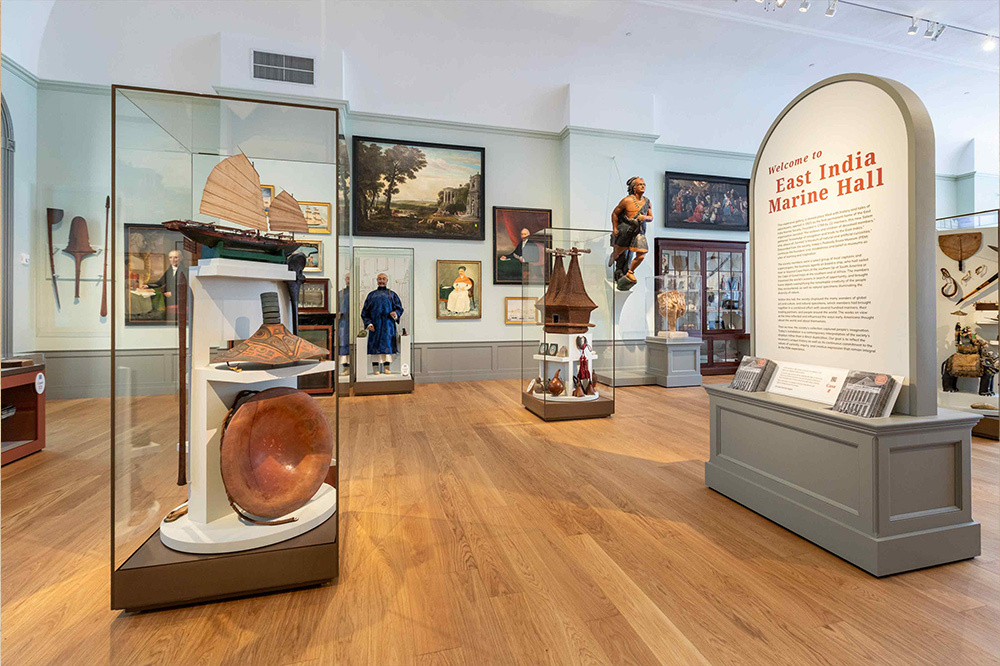
In March, PEM reopened East India Marine Hall to the public with a brand new installation, inviting visitors to reflect upon the global perspective that has made Salem such a distinctive city. As we mark the 200th anniversary of the historic hall, visitors can explore several hundred fascinating objects, representing a sampling of the many collections that were displayed in the museum during its earliest years. These works reflect local and global history, as well as the impact of maritime trade and recenters East India Marine Hall as the heart of the museum. From its inception, this space and the objects in it have elicited empathy, curiosity and wonder and transported visitors to places around the world.
We caught up with Dan Finamore, PEM’s Deputy Chief Curator and Russell W. Knight Curator of Maritime Art and History, to discuss how the reinstallation came together.
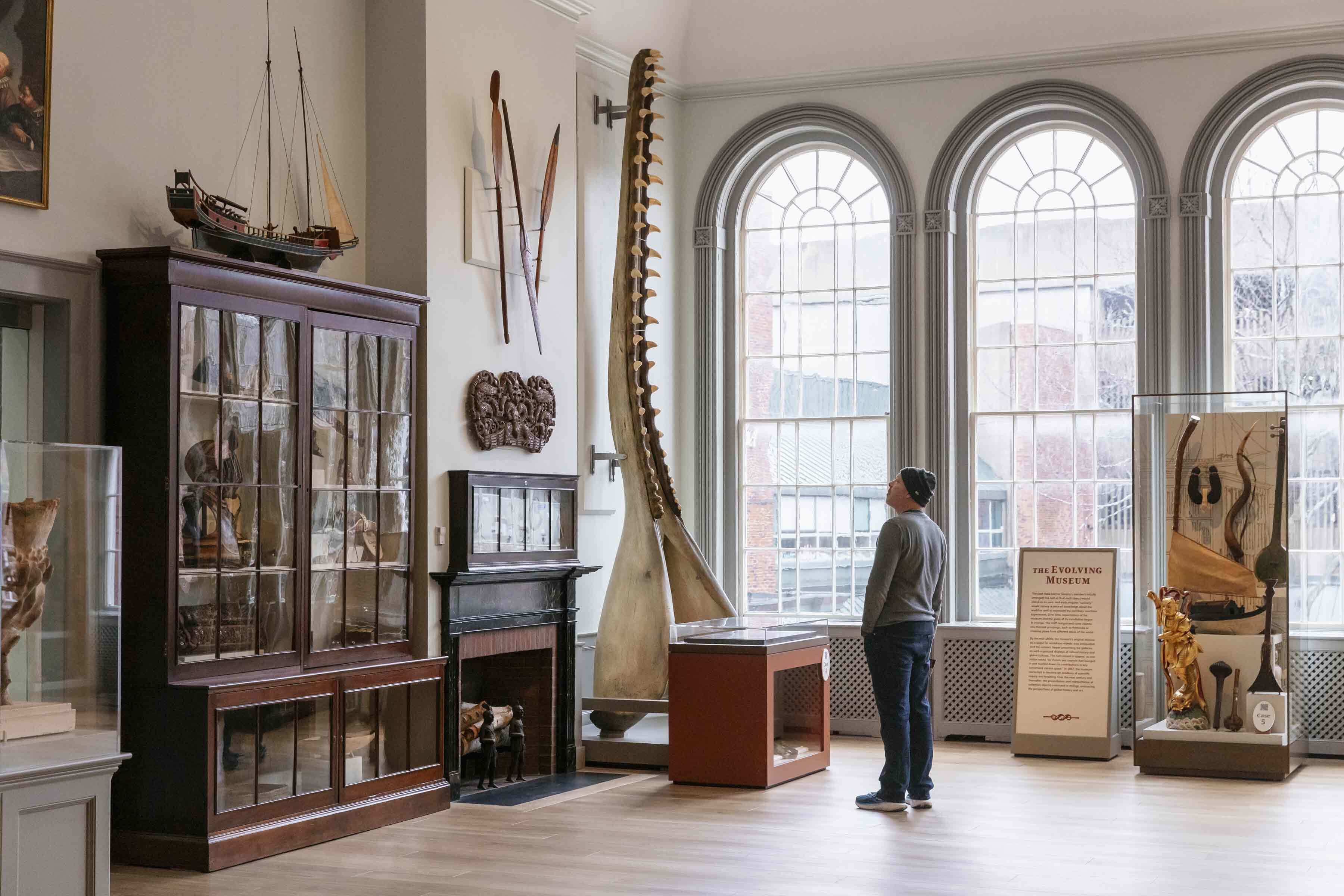
Guests in East India Marine Hall, 2026. Photo by Kathy Tarantola/PEM.
Q: What is the East India Marine Society?
A: The East India Marine Society was founded by 22 mariners in September of 1799, when they realized that they needed to share navigating information for the new places that they were beginning to trade in. Following the American Revolution, their protected trade with certain nations — that had mostly been just to the Caribbean and to Europe — was lost because they were no longer British subjects. They were free to sail the oceans around the world and find new places. That involved new information about the rocks and shoals and watercourses around the world. Also, once you arrived in new locations, you need to record information on who you should trade with and how that negotiation should take place, and just as importantly, you should avoid trading with.
The society was formed with a three-prong effort: to share this navigating information, to protect the widows and orphans of deceased members and create a fund to take care of people who were lost at sea, and then third, critically for us, to form a museum of what they called "natural and artificial curiosities" primarily from beyond the Cape of Good Hope and Cape Horn. They started to bring back interesting things that they thought would reflect their experiences around the world and the diversity of places and peoples that they encountered.
But they quickly found that people around the world were just as fascinated by them as they were by other ways of living on Pacific Islands, on the Northwest Coast, in China, Australia, New Zealand, Japan and so on. Mostly from coastal cultures, because that's where they went in the earliest days.
And so, it was not only members who donated objects, but also the people who heard about the museum in this young country called America: "Here, this is something that you will want for your museum."
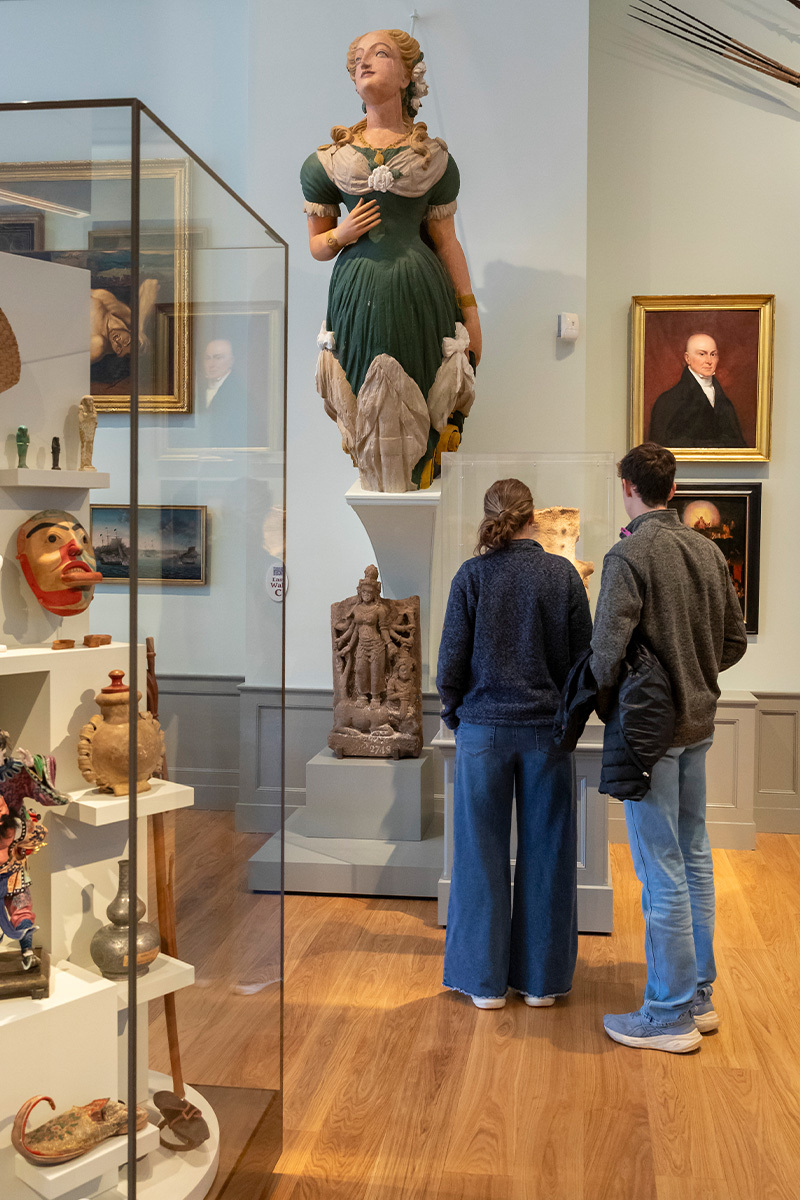
Guests in East India Marine Hall, 2026. Photo by Kathy Tarantola/PEM.
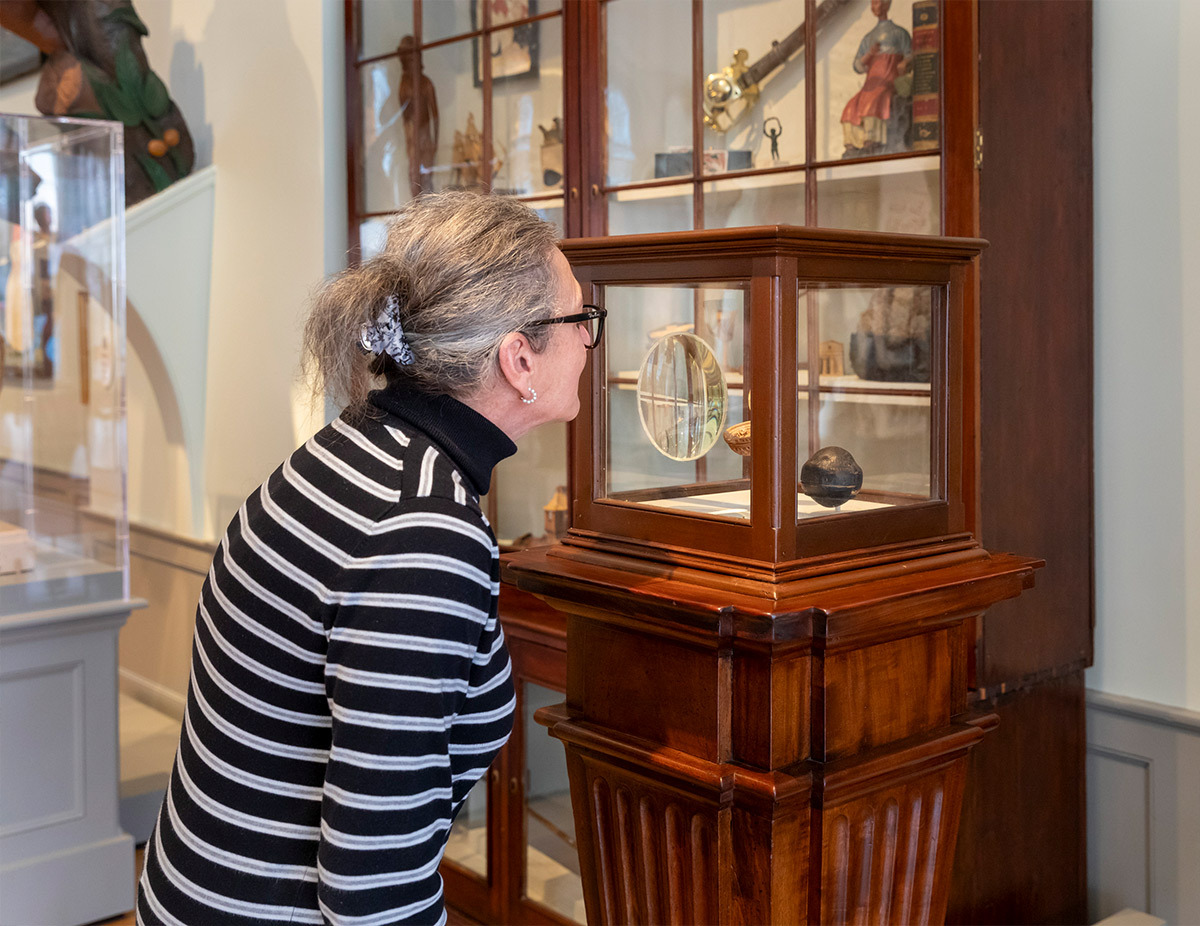
A guest in the newly installed East India Marine Hall. Photo by Kathy Tarantola/PEM.
Q: How did the society lead to the formation of East India Marine Hall?
A: By the 1820s, the members of the East India Marine Society realized that the museum was a success. They built a hall that would be an exhibition place, a meeting place and also a source of income for rentals on the first floor. They decided to open a space for the public to view the collection, which was at that time over 2,000 objects. People would wander the hall, and they would look at individual objects. Every object was a standalone piece to think about, something that imparted a piece of knowledge to the public about something in the world. Whether it's a piece of a rock, a shell, a plant, an animal or a cultural object that was made by somebody elsewhere that reflected the differences in the way they lived, but also some of the similarities, the commonalities across cultures that visitors to the Salem museum could relate to.
Q: What was a visit to the hall like 200 years ago?
A: Those who wanted to see the museum were invited for free, and you would enter through the front entrance of the building, where today we have the anchor on Essex Street. You would enter in the center and walk down a corridor until you encountered the large staircase with a mahogany balustrade. Then you would walk up into the center of the room, where in all likelihood you would be greeted by a wizened old mariner who had seen the world and maybe donated many objects, but whose sailing days were over, who was an East India Marine Society member. This ancient mariner would walk you around the hall and show you things, or you would go and visit your favorite objects that you had seen before and you wanted to revisit. People would bring their friends from out of town, and then you would go and sign the guest book. That's the traditional method of experiencing the hall as a visitor, as a tourist, but the society would also hold its own meetings in that hall. It was also a place where they discussed their finances, new membership and the important business of the society.
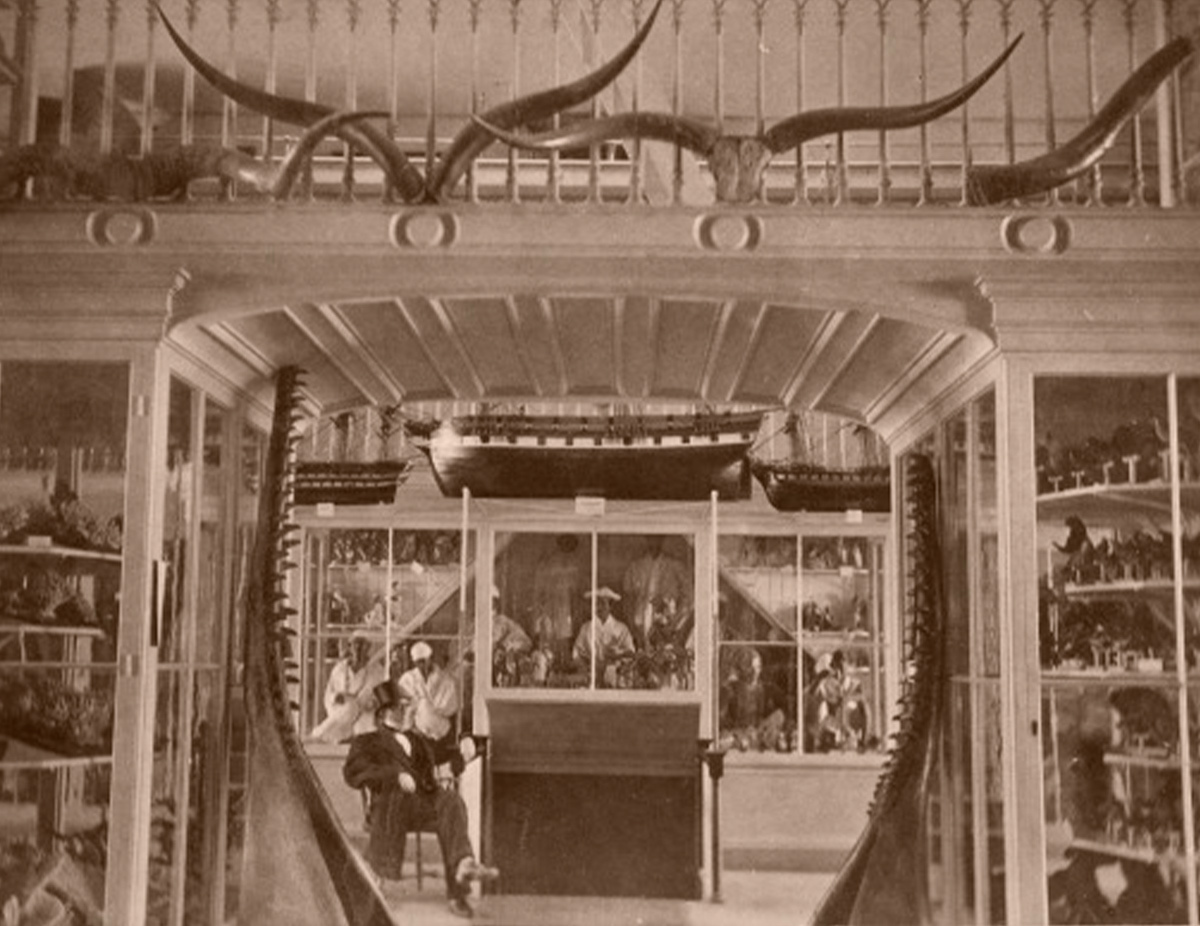
Captain Hammond in East India Marine Hall, about 1876 (referred to as Natural History Hall at the time). Peabody Essex Museum. 2008 Phillips Library Collection.
Q: How does Salem’s historic global network come to life in the gallery?
A: The gallery holds only objects that were collected between 1799 and 1867, the earliest years of the museum. There are objects from most continents and from most waterways around the world. And so, in any individual glass case, you will see a seemingly random assortment of objects that reflect the places and peoples encountered by the mariners. A giant clamshell; an enormous smoking pipe that's five feet long; portraits of Indian merchants who traded with American merchants, who sent their portraits over to Salem for personal connections. You'll see highly decorated spears and paddles from Fiji and the surrounding islands in the Pacific. There's a wide range of things from the Northwest Coast, carved argillite rock sculptures. There's an African drum in the form of a drunken Dutch sailor. An enormous sperm whale jaw that reaches almost to the ceiling. A Māori nose flute intricately carved and inlaid with mother of pearl.
The mariners, when they arrived at these different places, were particularly tuned into objects they could relate to, such as, in the Pacific at least, fishhooks. These are exquisitely crafted things. Most fishhooks, when you think of today, if your line were to break when you're fishing in Salem Harbor, you'd say, "Oh well," and you'd tie on another one, but these things, no doubt, took a lot of work and a lot of planning and are a product of very sophisticated thought to create specific types of hooks for specific types of fisheries. The mariners saw this. They appreciated it. When they collected fish hooks, they could tell that they were made of composite materials and mother of pearl strapped to bone, all carefully wrapped with some hairs that would be a little bit of an attractor. Some of them could easily have taken a day and more to make a single hook.
When they brought them back to the museum, I'm sure that they were reveling in the specificity and the careful manufacture of these things to their other members and to the public, because they were cataloging them within that level of specificity. They didn't just say "a fishhook from Fiji." It was a bonito hook, a halibut hook, a tuna hook, a shark hook. Each one of them has a different form and was used in a very specific manner that, of course, the people who made them knew how to use, because this was their local waters.
In a similar way, when they traveled largely in Southeast Asia, but all throughout the Pacific as well, the mariners collected models of the vessel types that they encountered. They collected ship models in order to bring different kinds of technologies home. There was a very large maritime component here in Salem, of course. Even if you didn't go deep-water sailing, you might be involved in shipbuilding or in supplying the industry in another way. There was a great appreciation. They would expect people to understand the different technologies and maybe even incorporate them into local boat building.
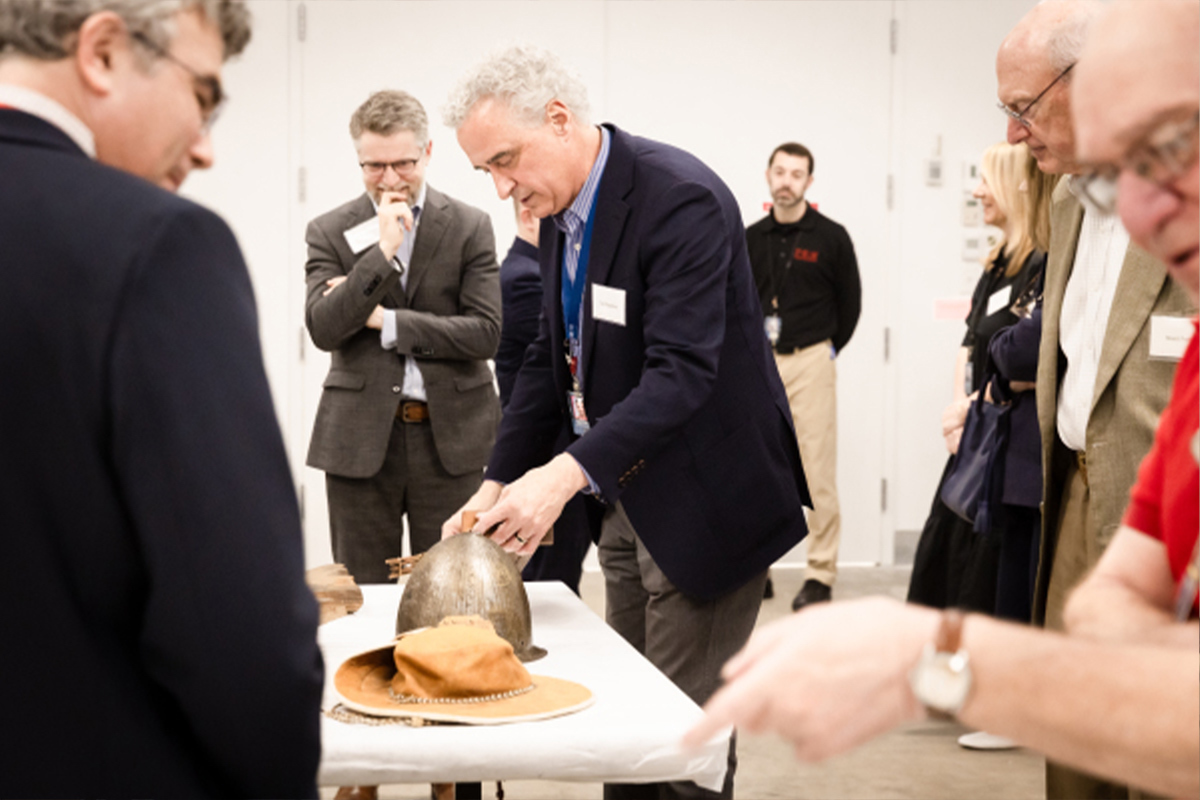
Dan Finamore showing objects conserved for the East India Marine Hall 200 year anniversary installation. Spring gathering of the Maritime Visiting Committee, April 2025. Hawkes Collection Center, Peabody Essex Museum. Photo by David Tucker.
Q: What has surprised you most about this exhibition?
A: Some of these objects are treasures of the collection that have been on display for 200 years, literally. Some of them came into the museum an equivalent time period ago and haven't been on display for a long time. When George [Schwartz, PEM Curator at Large and co-curator of the installation] and I went down the trail of coming up with a checklist of what would be interesting to show, we really reviewed a lot of amazing things. A lot of them showed their age. Once we chose objects, they needed to be prepared and conserved. Then we needed to make sure they could be displayed optimally so people could see them very well.
There was a lot of care in the object handling. They needed new photography and new mounts. In many respects, this was a very heavy lift for the museum. Not only a large checklist of objects in a gallery that needed a lot more work than we had originally realized — because we needed a new floor to be put in — but also, the manner in which it was installed all at once tapped every department in the museum in very significant ways. Everybody rose to the challenge, and it was both a lot of stress and a lot of fun.
Q: As we mark 200 years of East India Marine Hall, how do you balance honoring its past with looking toward its future?
A: It's very common these days for a 50- or 60-year-old to walk into the museum and fall in love again with East India Marine Hall because they remember the penguin or the carved European rosary bead or whatever their favorite object was that stuck in their mind since they visited at age 12. And that's fantastic. We love the fact that it has such an incredible impact on people's lives and memories. Much more important than that is the modern 12-year-old who walks into the gallery today and the tradition that it is now initiating. Fifty years from now, they will have those memories of having visited as a child. That inspiration, at that age, is probably the most important thing we can possibly deliver.
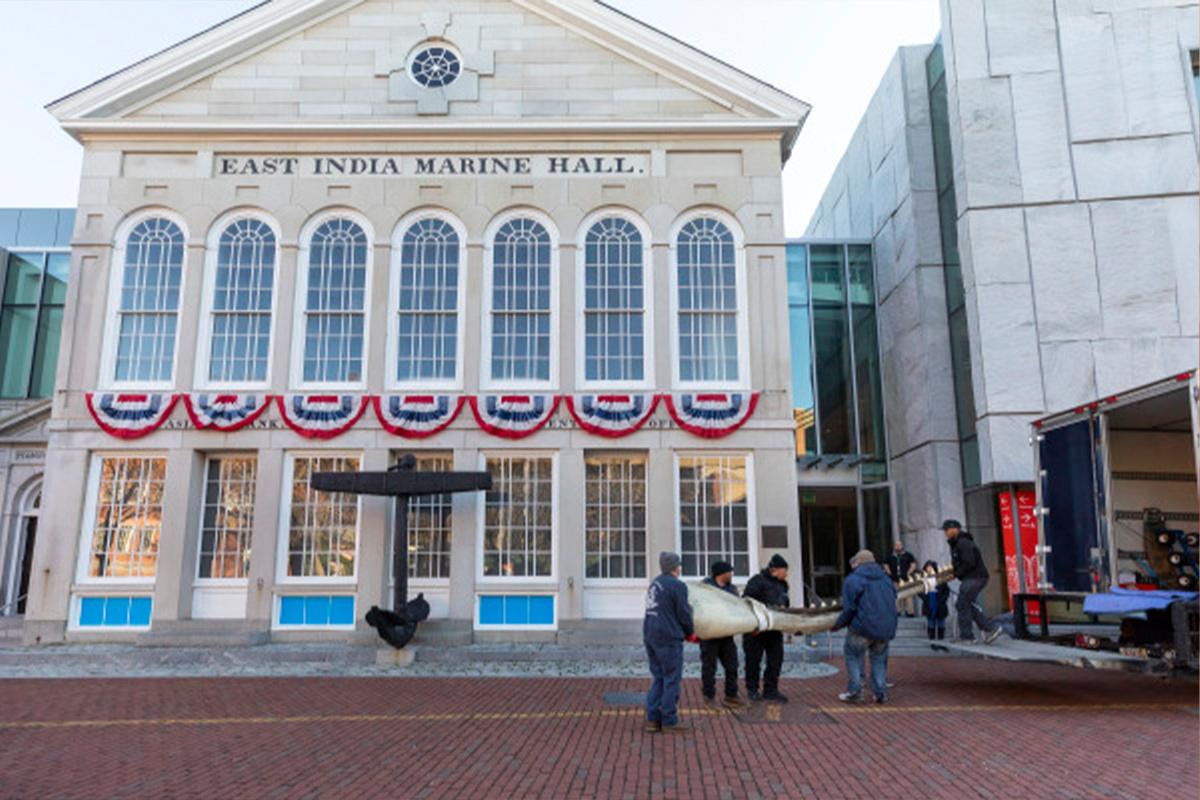
A moving team maneuvers the historic whale jaw into East India Marine Hall. Photo by Marc Pautenaude/PEM.
PEMcast
PEMcast 42: Circumnavigating the globe in East India Marine Hall
25 min listen
PEMcast
PEMcast Episode 038: Oh, wünderkammer, my wünderkammer
14 Min Listen

Blog
PEM members vote on a new card design for 2026
2 min read
Press Release
New Installation Honors 200th Anniversary of PEM’s East India Marine Hall
