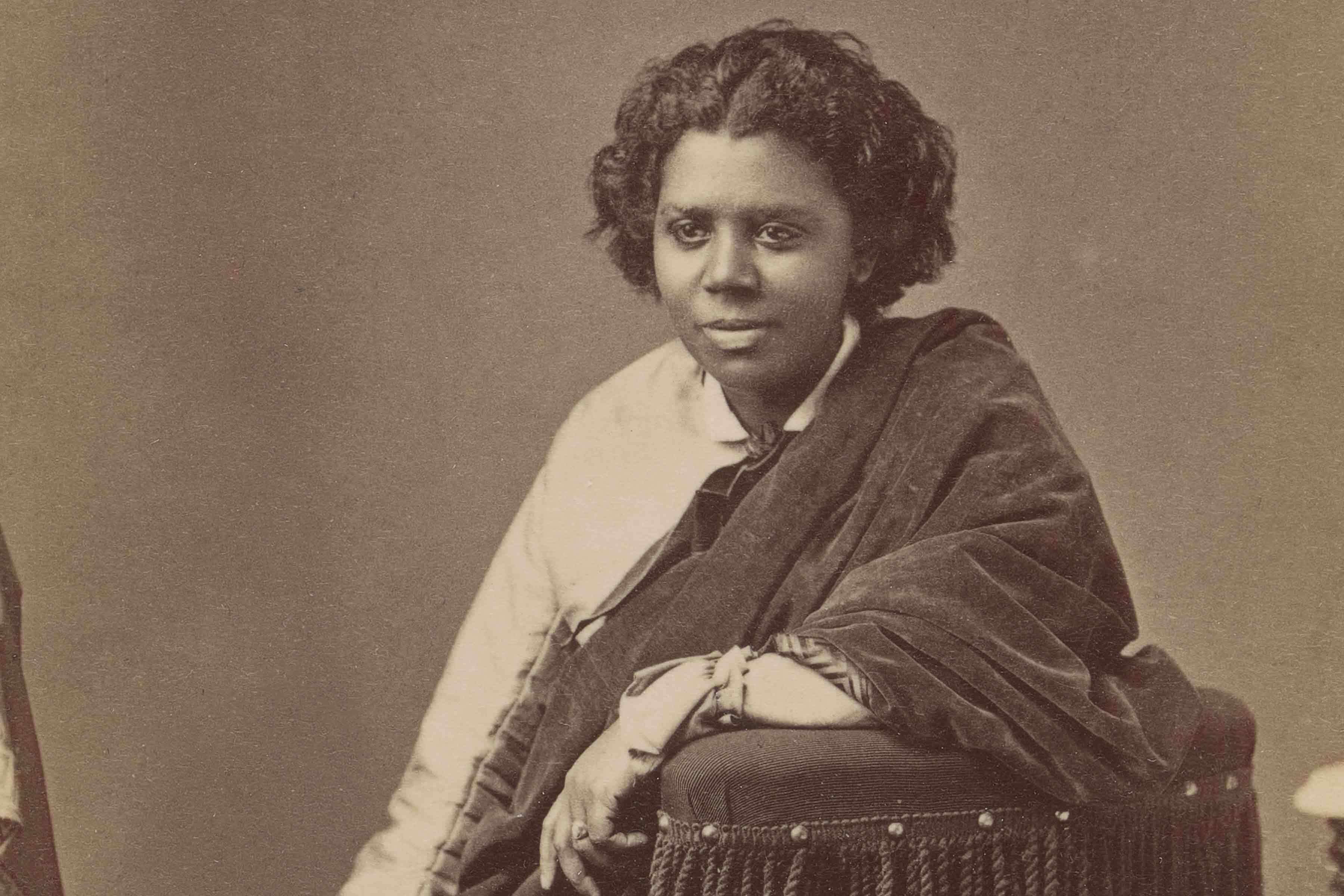
First major retrospective exhibition of acclaimed 19th-century Black, Indigenous sculptor debuts at PEM
Released November 24, 2025
Edmonia Lewis: Said in Stone
On view February 14–June 7, 2026
SALEM, MA — The Peabody Essex Museum (PEM) presents the first major retrospective exhibition of the work of acclaimed 19th-century Black and Indigenous sculptor Edmonia Lewis. 30 sculptures by Lewis from public and private collections across the United States and abroad will be brought together with a number of additional objects in a range of media, giving visitors an opportunity to learn of Lewis’ mastery of marble and her remarkable, storied life. Co-organized by the Georgia Museum of Art at the University of Georgia and featuring newly conserved and never before publicly exhibited works, Edmonia Lewis: Said in Stone makes its debut at PEM on February 14 and runs through June 7, 2026.
Born in Greenbush, New York, in 1844, Lewis became the first sculptor of Afro-Caribbean and Anishinaabe descent to achieve widespread international acclaim. Her mother was a member of the Mississaugas of the Credit First Nation, an Anishinaabe nation in present-day Ontario, and was known for her creativity in weaving and embroidery; her father was a free Black man who may have worked as a gentleman’s servant. Orphaned as a child, Lewis was raised by maternal aunts who profoundly inspired her as an artist, teaching her how to work with birch bark and porcupine quills, craft textiles and moccasins and use a range of materials to tell stories.
At age 19, Lewis met the abolitionist Frederick Douglass at Oberlin College in Ohio. He recognized her artistic talent and encouraged her to “seek the East.” She began her artistic career in Boston, which was a hotbed of antislavery activism when she arrived in 1863. Lewis saw residents across the city actively organizing and gathering to discuss race relations in the United States and the unfolding Civil War. Here, Lewis thought, was a place to stake her claim as a Black artist with a powerful point of view. The young artist quickly set up a downtown studio and connected with the city’s most prominent artists and patrons, forming networks of support with social reformers and abolitionists. Her initial artistic successes came from creating small portrait medallions of famous American abolitionists, artworks that were popular during the Civil War.
Lewis traveled to Rome in late 1865 to join the leading American sculptors of her generation. There, she continued her commitment to the antislavery cause with works like Forever Free, the first sculpture by a Black artist in the United States to celebrate emancipation. Alongside a vibrant community of expatriate women artists, she also helped craft a feminist approach to neoclassical sculpture. Her most ambitious sculpture, The Death of Cleopatra, showed the Egyptian queen defiant in the face of bondage, celebrating female self-determination and the artist’s own fierce independence. Her plaster portraits and vivid, naturalistic stone sculptures depict powerful women, social reformers, Native individuals and religious figures. Through these classically inspired sculptures, Lewis elevated contemporary stories of emancipation, Indigenous sovereignty and religious liberty.
“Edmonia Lewis transcended national, racial and gender barriers,” said Jeffrey Richmond-Moll, PEM’s George Putnam Curator of American Art and exhibition co-curator. “Her body of work asserts a unique voice in the history of American art. This retrospective exhibition places Edmonia Lewis and her sculptures within the context of pressing social concerns of her time and ours. Together with Native and Black scholars, artists and community members, we also explore how Lewis reconciled her art and her identity in the face of prejudicial laws, shifting public sentiment and competing conceptions of what it meant to be Black and Indigenous in the 19th century.”
The exhibition underscores themes of community, reform and resilience and looks at the lifelong impact of both Black activism and Indigenous community on her sculpture practice. "Sometimes the times were dark and the outlook was lonesome, but where there is a will, there is a way,” Lewis recalled in 1878. “That is what I tell my people whenever I meet them, that they must not be discouraged, but work ahead until the world is bound to respect them for what they have accomplished.”
The breadth of Lewis’ life’s work, her wide-ranging networks and her long-standing influence also emerge through photographs, decorative objects, Indigenous belongings, literature, 19th- and 20th-century art and contemporary works, including recent acquisitions by the London-based interdisciplinary artist Gisela Torres and Serpent River Ojibwa installation artist Bonnie Devine. In-gallery videos and digital interactives engage Lewis’ story with a variety of audiences, while collaborations with Black and Native scholars and academic partnerships with Salem State University deepen understanding of Lewis’ life and work through shared storytelling, dialogue and collective reflection.
“Lewis’ legacy looms large for Black artists working today,” said Lydia Peabody, a Curator-at-Large at PEM. “Gisela Torres is an American-born, London-based artist who learned that Lewis was buried in a neighborhood cemetery where Torres frequently walked. Beginning in 2018, Torres has created a series of works inspired by Lewis as an artist-ancestor. Looking for Edmonia (Self-Portrait), on view in the exhibition, is her ongoing project of reclamation.”
The Indigenous Artistic Worlds section of the exhibition is anchored by Lewis’ Hiawatha’s Marriage (modeled 1866), inspired by Henry Wadsworth Longfellow’s epic poem The Song of Hiawatha. This section underscores Anishinaabe artistic traditions as central to Lewis’ creative development, traces her lifelong negotiation of global networks of trade and exchange and reveals how the Native American imagery in her Longfellow-inspired sculptures challenges 19th-century myths of Indigenous disappearance.
A section called The Studios of Rome explores the materials and techniques for carving marble sculpture that Lewis learned in Italy and employed throughout her career. Through sculptures, historical photographs and design elements crafted in collaboration with Skylight Studios of Woburn, Massachusetts, this gallery helps viewers understand Lewis’ studio as a space of making, self-promotion and cross-cultural exchange. A recently conserved sculpture, Cupid Caught, gives further insight into Lewis’ working methods, in collaboration with objects conservator Amy Jones Abbe and the fabrication expertise of Keystone Memorials of Elberton, Georgia. Portrait photographs of the artists by Henry Rocher and Augustus Marshall, along with periodicals, newspaper criticism, portrait busts and other print materials, examine how Lewis publicly asserted her humanity, individuality and determination as an artist.
The exhibition's final section considers religious and mythological subjects, which resonate with Lewis’ activist spirit, her concern for the marginalized and her belief in art and religion as a means of liberation and renewal. These works also reflect the sculptor’s deep ties to Italian and expatriate Catholics after her baptism into the Roman Catholic Church in 1868, and the ongoing support that Christian religious organizations, Protestant and Catholic alike, offered her in the final decades of her career.
Following her death in London in 1907, Lewis’ legacy endured in Black communities, yet her contribution to American sculpture has largely been underrecognized. Some of her great masterpieces were rediscovered decades later, while others remain lost. Said in Stone features several sculptures by Lewis that have never been exhibited before, along with cutting-edge research that brings to light previously unknown details of her life and career.
“Said in Stone is an ongoing project of recovery and rediscovery. My hope is that this exhibition introduces our visitors to Edmonia Lewis’ art and life within the communities that influenced her and vice versa, and within the wider history of American art,” said Richmond-Moll. “There is something for everyone in Edmonia Lewis’ story. We hope visitors will come to appreciate Lewis’ impressive, lasting legacy as an artist who prevailed against all odds.”
PRESS & INFLUENCER RECEPTION
Please join us for a press and influencer preview reception on Wednesday, February 11, from 5–6:30 pm, featuring remarks and a curator-led tour. Invitation to follow.
OPENING DAY PROGRAM: ARTIST PANEL
Saturday, February 14, 2026 | 1–2 pm | PEM’s Morse Auditorium
Whose memory do you carry? Join exhibition curators, contributors and contemporary artists for a reflective conversation on Edmonia Lewis, the subject of PEM’s new exhibition. As the first woman artist of Black and Indigenous descent to achieve widespread international acclaim, Lewis was famous during her lifetime in the late 1800s. However, her remarkable career and marble sculpture have largely remained underrecognized — until now. Join us to hear artist Gisela Torres discuss how Lewis’ legacy inspires her own artmaking, and hear scholar Melissa Ragain talk about her research into Lewis’ transatlantic impact. Themes of memory, absence, endurance and transcendence will guide the discussion to celebrate Lewis’ vision and the worlds she carved into being.
SOCIAL MEDIA
Follow along on social media using #EdmoniaLewisatPEM
PUBLICATION
Edmonia Lewis: Said in Stone by Jeffrey Richmond-Moll, the George Putnam Curator of American Art at the Peabody Essex Museum and Shawnya L. Harris, the Larry D. and Brenda A. Thompson Curator of African American and African Diasporic Art at the Georgia Museum of Art. A richly illustrated 264–page volume accompanying the first retrospective of Black and Indigenous American sculptor Edmonia Lewis. This volume reproduces examples of all Lewis’ known works and shares new discoveries that illuminate her artistic vision of community, reform and resilience. Essays place her sculptures in conversation with abolitionist and feminist movements and consider the themes Lewis’ art addressed, including Indigenous artistry, social and political reformers and religious and mythological subjects. Publication available at the PEM Shop.
PUBLICITY IMAGES
Publicity images available upon request.
EXHIBITION TOURING SCHEDULE
Georgia Museum of Art | August 8, 2026–January 3, 2027
North Carolina Museum of Art | April 3–July 11, 2027
SPONSORS
Edmonia Lewis: Said in Stone is co-organized by the Peabody Essex Museum and the Georgia Museum of Art at the University of Georgia. Major support is provided by the Henry Luce Foundation, the Terra Foundation for American Art, the Wyeth Foundation for American Art, and Carolyn and Peter S. Lynch and The Lynch Foundation. We thank Jennifer and Andrew Borggaard, James B. and Mary Lou Hawkes, The Creighton Family, Chip and Susan Robie, Jeffrey and Karla Kaneb, Timothy T. Hilton, and an anonymous donor as supporters of the Exhibition Innovation Fund. We also recognize the generosity of the East India Marine Associates of the Peabody Essex Museum.
ABOUT THE PEABODY ESSEX MUSEUM
Founded in 1799, the Peabody Essex Museum (PEM) in Salem, Massachusetts, is the country’s oldest continuously operating museum. PEM provides thought-provoking experiences of the arts, humanities and sciences to celebrate the creative achievements and potential of people across time, place and culture. By connecting people through inquiry, empathy and dialogue, PEM encourages an understanding of our shared humanity and fosters a sense of belonging in a complex, ever-changing world. We build, steward and share our superlative collection, which includes African, American, Asian Export, Chinese, contemporary, Japanese, Korean, maritime, Native American, Oceanic and South Asian art, as well as architecture, fashion and textiles, photography, natural history and one of the nation’s most important museum-based collections of rare books and manuscripts. PEM offers a varied and unique visitor experience, with hands-on creativity zones, interactive opportunities and performance spaces. The museum’s campus, which offers numerous gardens and green spaces, is an accredited arboretum and features more than a dozen noted historic structures, including Yin Yu Tang, a 200-year-old Chinese home that is the only example of Chinese domestic architecture in the United States.
MEDIA CONTACTS
- Whitney Van Dyke | Director of Marketing & Communications | whitney_vandyke@pem.org | 617-259-6722
- Amelia Kantrovitz | PEM Publicist | amelia_kantrovitz@pem.org | 617-794-4964
- Kristen Levesque | PEM Publicist | kristen_levesque@pem.org | 207-329-3090