PEMcast 2: Makers
Are you a maker?
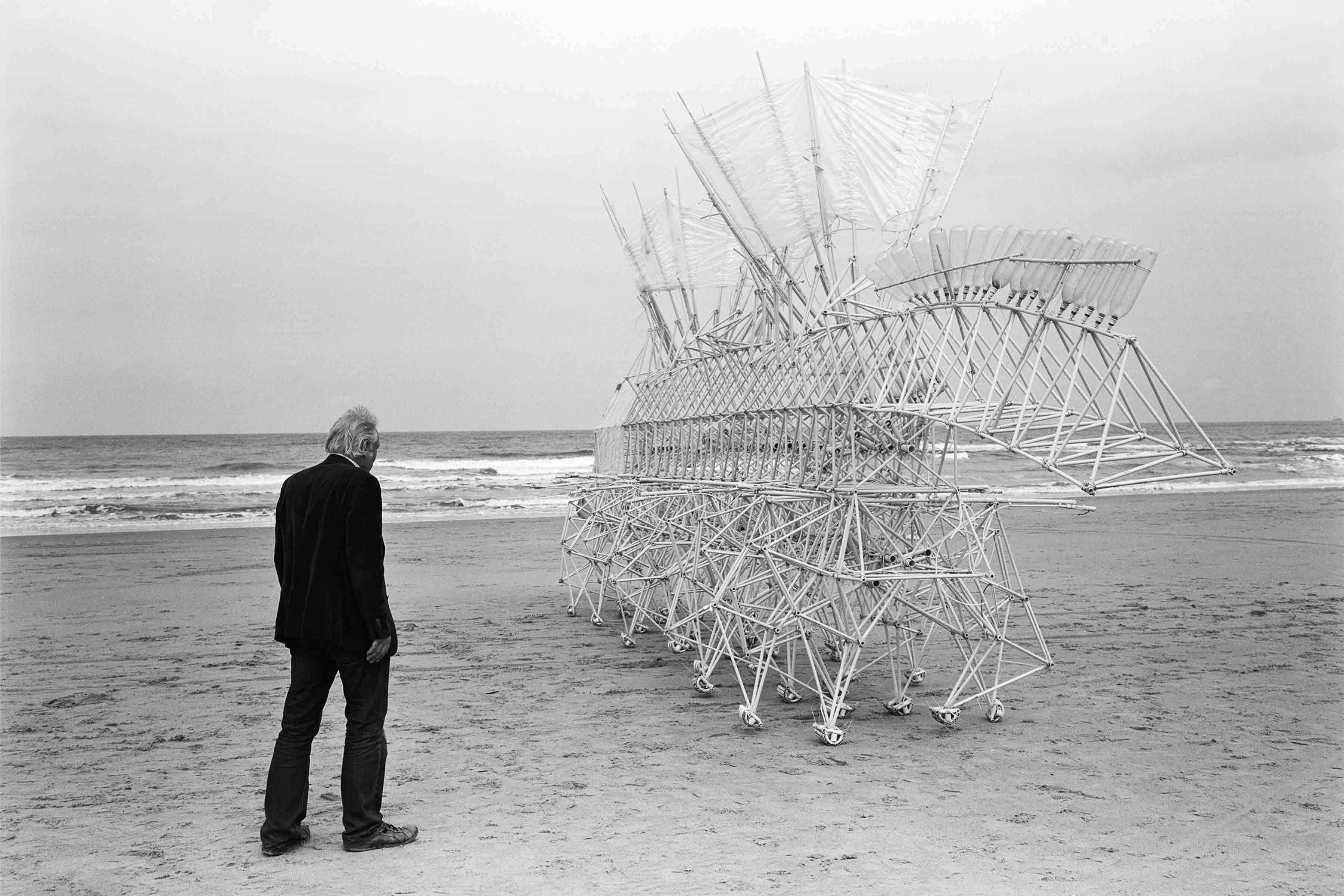
Do you know what a maker is? Dinah and Chip discuss Adam Savage's Rules of Making with Edie Shimel of the museum’s education department. Then, PEM's Curator of the Present Tense Trevor Smith talks about PEM's upcoming exhibition featuring maker-extraordinaire Theo Jansen and his Strandbeests.
[INTRO MUSIC]
Adam Savage: Humans do two things that make us unique: we use tools, and we tell stories. And when you make something, you are doing both at once. You’re telling a story about your desire. You’re telling a story about something that you want. You’re telling a story about something that you see needs to be made. And you are using your tools to improve yourself, and improve the world around you. When you make new things, you are joining in the most ancient dialogue that humans have ever had.
[MUSIC CONTINUES]
Theo Jansen: A normal engineer, he has a plan. He’ll realize his plan by buying everything he needs – transistors, light cells – and probably you have a result pretty quick. Restricting yourself, you work effectively the same way as evolution. There’s a mutation, you try something, and usually it doesn’t work, but you see something happening which is a bit helpful. And you stand on this little piece of hope, and then it grows, putting lots of energy in there, and try again and again. You come on places where nobody has been before.
[MUSIC CONTINUES]
Chip Van Dyke, Host: You are listening to the PEMcast, conversations and stories for the culturally curious. This is episode two. My name is Chip Van Dyke, media production manager at the Peabody Essex Museum, and with me is—
Dinah Cardin, Host: Dinah Cardin, special projects writer in the PR department.
Chip: You have been listening to the voices of Theo Jansen, kinetic sculptor, and Adam Savage of Mythbusters fame. And the reason we’ve been listening to these two voices is we’re going to be talking about makers and making today.
Dinah: Chip, I’ve heard that the maker is the new hacker. Now, I know you have a closet full of all sorts of computer parts, and things…
Chip: Oh, don’t remind me. Dinah: Um, what are you making these days?
Chip: Uh. Dinah’s referring to—I took a class at the Artisan Asylum in Somerville, Massachusetts. A really cool place. Um, it was a class for Raspberry Pi. And, uh, Raspberry Pi, if you don’t know what that is, is a tiny credit-card-sized computer that’s all the rage nowadays with makers and programmers. And, yeah, I took a class like that thinking, you know, this is what I want to do, I want to learn a Python—I want to learn a script, and I want to be able to program this stuff, and truthfully the steam has gotten out of my sails a little bit on this thing. I need a project. As we’ll explain later, this is a very important thing to makers, is you need a project, and right now I don’t have a project.
Dinah: But I understand you have a closet full of parts at home.
Chip: That’s true. Yes, a big, sad closet full of parts that are just waiting for me to play with them. But Dinah, enough about my failed projects. We’ve had—we’ve had conversations before, uh, talking about how you think that you are not a maker. Well, I feel like I’ve got the perfect test to find out whether or not that’s true.
Dinah: Okay. Let’s go. Number one?
Chip: [LAUGHS] Well, hold on. Slow down. We’ll get into that, uh, we’ll also be joined by Edie Schimel, who’s part of the Maker Lounge here at the Peabody Essex Museum. We’ll also be talking to Trevor Smith, Curator of the Present Tense, about the upcoming show of the Strandbeest. Theo Jansen and the Strandbeests. So, uh, let’s begin.
[ELECTRONIC MUSIC INTERLUDE]
Juliette Fritsch: We wanted to have a space where people could play around with ideas. And the Maker Lounge in the museum typically has a very kind of technological edge to it. So at anytime, you can go in and pick up a design challenge, and fulfill it. We have had circuit stickers – being able to create a small circuit on a painting or on a drawing so that it lights up. We are up the road from MIT MediaLab, and their students have been very interested in the project, and they come regularly to show us and show our audiences what they’re doing and for us to play around with their ideas. We have a 3D printer, which we’re very excited about. It enables you to create things you can’t create any other way. And so for artists, this is a really fascinating thing. One of the unexpected and delightful side effects of the Maker Lounge is that it’s become a fantastic recycling playground from our exhibition builds, so we have currently 40,000 ping pong balls that needed a home. It’s all about that relationship between high-tech and low-tech, because Maker movement really is founded on being able to do things with stuff that’s lying around. And we’re happy to provide it!
Dinah: That was Juliette Fritsch, our Chief of Education and Interpretation, and now in the studio with us we have Edie Schimel, who works in our Maker Lounge. Welcome, Edie!
Edie Schimel: Hello. Thanks for having me.
Chip: Edie, how long have we had a Maker Lounge, now?
Edie: Since March 29th. We actually opened it on the same day we opened another exhibition, so it was a busy opening.
Chip: So, Edie, one of the reasons we brought you here today is to go over some of the ‘Rules of Making,’ as described by Adam Savage at his recent Maker Faire keynote speech. Adam Savage, the host of Mythbusters, posted this keynote speech to his podcast the other day. The podcast is called ‘Still Untitled.’ Looking over the list, I noticed that there was a lot of similarities to a lot of different creative pursuits, and I thought maybe today we would look through the list together and decide whether or not we were makers, and maybe the listening audience can play along.
Dinah: And Edie, you can relate some of this back to our Maker Lounge.
Edie: Yes, absolutely.
Chip: Yeah, that would be great. So, why don’t we listen to that first clip? This is the number one ‘Commandment of Making.’
Adam: Make something. Anything! Cook. Weld. Carve. Sculpt. Anything that you need to make, it’s important that you make—
Chip: Okay, so let’s start it off. Dinah, does any of that apply to you?
Dinah: Um, I’m not exactly sculpting or welding. Um, I believe he did say ‘cook.’ I do cook, and I don’t look at cookbooks, ever. I like to just come up with things on the fly. I like to look in my refrigerator, see what I have, and go with it. So, I—
Chip: Oh, improvisational cooking.
Dinah: Very improvisational. It’s a little like jazz.
Chip: Edie, what about you?
Edie: Yes, uh, actually at work and at home I tend to do a lot of making. Since I’m running the kind of everyday operations of the Maker Lounge, I’ve been charged with kind of figuring out how the space can be used, what needs to be made on the 3D printer to keep things going, how to make the design challenges more dynamic. I’m also a visual artist, a photographer, and I tend to build the sets for the things that I photograph, so it’s a little bit like sort of 1920s, 1930s sci-fi set building. So, uh, if I want to take pictures of, like, an outer space volcano, I have to make the papier-mâché volcano, and then I have to figure out how to make the stars.
Dinah: Well, I like to think about why this movement is so popular right now. Um, you know, this whole DIY/making is obviously sort of a backlash to what’s been going on with consumerism and sort of working with the economy we have. Edie, do you have any thoughts on that? Why now? Why is this so popular?
Edie: I think it’s just the fact that it’s so easy to share what you’re making, and—
Chip: Yeah, that’s a big part of it.
Edie: —platforms for 3D printing. It’s like, you go to TinkerCAD and you can take somebody else’s idea. So, the whole remixing of stuff and just the ability to share everything that you’re doing all the time.
Chip: It’s just more accessible now.
Edie: Yeah.
Chip: Are we ready for number two? Let’s listen to that.
Adam: Make something occasionally that actually improves your life, from a toilet paper holder that actually works to, uh, uh, a toaster that’s slightly improved.
Chip: Dinah, I’m going to start with you on this one. [DINAH LAUGHS] Do you do this at all? Do you, um—
Dinah: [BOTH LAUGHING] Well, I just had someone come over who is sort of a maintenance person help me make my windows more open in my old New England house, so I don’t really think I’m that resourceful when it comes to fixing the things around me.
Chip: But you at least know who do call—
Dinah: Yes.
Chip: —when you need something done. That’s helpful.
Edie, what about you? Are you making things useful in your everyday life?
Edie: I tend to be more on the fixing-something-that’s-broken, even if it’s—I guess the MacGyvering side of it. Um, for example, I have a 1998 Ford Ranger, so I’ve gotten really good at WD-40 and gaffer tape, fixing loose hanging things with zip-ties.
Dinah: I had an ‘80s Jeep living on Nantucket, and someone MacGyvered it to start with boat parts.
Chip: Wow. Dinah: And I appreciated that so much. I love that.
[LAUGHS]
Chip: Yeah. Being, uh, at the museum, and working in the A/V department, zip-ties and Velcro are pretty much—and gaff tape! You can do just about anything with those three objects. All right, do we want to move on?
Adam: I can’t learn any skills unless I have a project to learn with. I need a goal. I need something. Well, it’s like I need to need something. I need the thing that I’m trying to obtain. I can’t learn to weld just by someone showing me that it should sound like frying eggs and you set the dials like this. I need to end up with Wolverine claws, or a sword, or a pair of stilts or something like that.
Chip: I feel like, um, what we talked about earlier, Dinah, about me doing a Raspberry Pi class sort of spoke to me this way. It’s like I just gotta, I just gotta do this, and get good at it, because I feel like once I get good at it I’ll have a satisfaction for it. But just the pursuit of learning how to do something is so defeating.
Edie: Yeah, so before I was, I moved to Massachusetts, I was, uh, a college photography teacher. I had an assignment where they had to go to Dollar General. They had to spend five dollars. I didn’t care what they bought, but they had to have the receipt, and they had to make a photography project out of whatever they purchase. Some kids, you know, they bought snacks, took pictures of the wrappers. Some kids went and got dinosaurs and all kinds of fun toys and set up these scenes. Doing things like that, like in teaching—and I try to do it here with my younger kids in workshops—like, okay, well you want to make an iPhone case out of stuff in the Maker Lounge. So, what do you need to do that, and how are you going to figure it out? They get better at it.
Dinah: Yeah, all three of us in here have taught. I’ve taught writing and certainly have to get people out of their comfort zone.
Edie: And getting them comfortable with being able to access the space. To be kind of okay and aware that, you know, there’s a community of people doing this and you can come to the museum and do this.
Chip: Let’s listen to another one.
Adam: Ask for advice. And, when you find someone you trust, ask for feedback. I’ll tell you, it’s very funny among adults, we very rarely actually turn to each other and say ‘What do you think of the work that I’m doing?’ And it’s because that places us in a very vulnerable spot. But again, if you can find a teacher or a mentor, or someone whose opinion you really respect, asking them very specifically about how they think you’re doing can give you incredible insight.
Chip: Edie, why don’t we start with you on this one? What sort of ways are you helping Maker Lounge people with this idea?
Edie: Well, children will ask you for help. They will ask you how to do something. They’ll show you what they’re doing. They want your feedback. If you’re giving constructive feedback, and helping them answer their own questions, it’s really useful, and it happens all the time. But it’s pretty great to see, especially some of our youngest visitors, get excited about it. A little boy came in yesterday. He hadn’t been to the museum. He wasn’t one of our regulars. His grandmother lives in Salem. And he just looked at the shelf of all the stuff that people made, and he was just like, ‘Oh my God, who made all these things?’ Like, ‘I can’t do that, I don’t know how to make stuff!’ And so, you know, we kind of got started, and by the time he was done, he has sawed a bunch of cardboard with a safety saw, and had done all this stuff with pipe cleaners. You know, he was very proud of what he’d done.
Chip: Do you feel like at a certain age, kids have to re-learn how to ask for help?
Edie: Yes. Something happens between [LAUGHTER] nine and twelve, maybe thirteen. Twelve they’ll still, if they trust you or think you’re cool, they’ll ask. But yeah, kind of leaving middle school they get into that ‘I don’t want to ask for help’ and—
Chip: Suddenly, the culture shock of older kids surrounding you at high school or junior high school level…
Dinah: And suddenly our society says ‘now you should know everything.’
Chip: Right.
Edie: Well, and the response to not knowing or being embarrassed to ask is ‘this is stupid, I don’t like this.’ And so as an educator, you know, we have to, kind of, get them—
Chip: Get them talking.
Edie: Yeah.
Chip: That’s interesting. Dinah, what about you? Do you feel encouraged by peoples’ input on your own creative endeavors?
Dinah: Yeah, I definitely find it useful. As the—I’m the editor of our blog here at the museum, and obviously there’s just a give and take all the time with us working on that.
Chip: I for one am a huge proponent of it. Getting that feedback, and not necessarily using it to change or redirect your work but to just absorb it and take it in for what it’s worth. I think it’s a real, real key aspect of at least what I think to be good creative work. This rule is, I think, applies to a lot of different walks of life—makers, artists, whatever. I think it’s a real key point. Shall we listen to another one?
Adam: Share. That is really, really important. There is nothing that makes me angrier when somebody does something beautiful, and you ask how it’s done and they say it’s a secret. No secrets! What are you protecting? [APPLAUSE, CHEERING] Nobody’s going to take your technique and then steal your— nobody has a monopoly on being you. So share your techniques, because when you do, someone’s going to come back to you with a better way of doing it and you’re going to learn something from them.
Chip: Edie, you were talking about this earlier, weren’t you, about sharing, and how that’s sort of part and parcel of the maker movement?
Edie: Yeah. It’s the great thing about being able to maker and tinker and prototype. Like, someone just took your model or whatever and built on it or you’ve made a little computer program and someone made it a little better. You know, you can kind of see everything evolving. I know it’s hard sometimes to feel like you can give away your techniques and secrets. It’s hard if someone steals your idea, but if you can kind of turn that around, like he was saying, and have the opportunity to make your little seed of an idea, someone takes it and makes it a little better, then you can actually come back to it and do more with it than you could originally.
Chip: I’ve been so grateful to have the amount of access to tutorials online for the programs that I need to use for my work. I do a lot of video work here at the museum. If you didn’t have that, you’d be spending, like, thousands of dollars on classes. Not a lot of people have that kind of money to do that kind of stuff. So, the people that are doing it, I think, are just earning serious karma points.
Edie: Yeah, I agree with that. I learn a lot of things from free online tutorials. That people are willing to take the time and share is impressive, I think.
Chip: Let’s talk about some of the tutorials that are out there online for makers.
Edie: Um, I’ve used Skillshare quite a bit. There’s some pretty basic—you know, how to take a simple drawing and make it smart and then make it into a 3D printing file. I’ve actually taught that already in the Maker Lounge. Skillshare is definitely a good one. There’s always Instructables. And then, you know, there’s always the usual suspects. YouTube is good—
Chip: For any project that you’re looking for.
Edie: For any project, ever.
Chip: Ask YouTube.
Edie: Yeah, yeah. [LAUGHS]
Chip: It’s such an important thing. I do that all the time.
Edie: Yeah.
Chip: I guess we'll just play one, yeah.
Adam: Please recognize that discouragement and failure are part of every single make project.
Edie: I could say a lot about this. I don't know how much everyone tunes in to, uh, what's going on in public education, but the test-based system is really crippling what teachers can do with their students, what students are actually able to learn. Having the maker space and being able to bring groups into it where they can try a prototype and, you know, if the way that they fasten the materials together and the little house model, or whatever it is, collapses, it's failure on such a small scale that they can just start over. The project-based learning model that—
Dinah: I was just going to say, projects are probably just going away, so the more, the more it's about exams and tests, you know, then the idea of ‘failing is okay’ goes away.
Chip: Yeah, I don't think anybody explained to me in school that failure was okay.
Dinah: I was an incredibly bad math student. Uh, incredibly bad.
Chip: It's confession time.
Dinah: And I definitely had lower standards for what success and failure was, for myself in that way.
Edie: I was not okay with being bad at things.
Chip: No, me neither.
Edie: And I so, yeah, just, just scarring algebra homework.
Dinah: Yeah. Yes.
Edie: Hours. In my mind, I just could not do it.
Dinah: Tutors. I had tutors.
Edie: I had tutors, too. And my brother was, like, Mr. Math Genius, so that didn't help, because, you know—
Dinah: Mm. And here we all are at the art museum.
[ALL LAUGH]
Edie: Yay. Yay!
Chip: So, Edie, how do people approach the Maker Lounge? What do they do once they're there? Do you have anything that you can sort of provide for them that sort of gets them in the door?
Edie: Well, if you're, if you're in the museum, you can actually…especially if you're a Salem resident, you know, it's free anytime to come into the museum.
Dinah: Or if you work in Salem.
Edie: Or if you work in Salem!
Chip: Oh yeah, that's new.
Edie: And if you're under 16, and it doesn't matter where you live. So, you can just come into the museum. There's cushy ottomans and a couch and books about making and inventing, and you can just kind of hang out. There are the design challenges on the wall. There's also, um, folks in there right now. This summer, I have four interns who are all art students or artists. They're in there most afternoons during the week and even on the weekends doing something, making something. The other day, they all decided they were just gonna start building camera obscuras.
Chip: Camera obscuras—those are just the, like, pin-hole cameras.
Edie: Kind of. It's like the pin-hole camera minus the place to put paper. And if you ask any four-year-old, you know, what to do with a bin full of pipe cleaners, I'm sure they'll have a thousand different answers, and so that's there too.
Dinah: Thanks for coming by, Edie, that was so much fun. And you out there in the listening world, stop by and make something here in the PEM Maker Lounge.
Chip: Thanks, Edie.
Edie: Yeah, you’re welcome. Thanks.
[MUSIC INTERLUDE]
Theo: Every environment creates its animals. It will be a special animal, and we must try to make an American Strandbeest. I think it's possible.
[MUSIC CONTINUES]
Theo: Well, of course, I've kept more inside, in evolution kind of processes. It gives the feeling that you're more part of the whole life project, which we're living in.
[MUSIC CONTINUES]
Dinah: Since 1990, Theo Jansen has been creating new forms of life. The Dutch kinetic artist has been making skeletons that walk on the wind, and he will be here at PEM in the fall of 2015. And today we have with us Trevor Smith, our Curator of the Present Tense, who has just come back from visiting Theo near Delft. Welcome, Trevor.
Trevor Smith, curator: Thank you, Dinah.
Chip: Trevor, uh, what were, what were you, what was, um… [ALL LAUGH] How was your trip to the Netherlands?
Trevor: It was a really, really exciting trip because I had seen his latest Strandbeest under construction, and this was the first time that I got to see it on the beach with the sails on it, moving its nose up and down, feeling for the texture of the sand. Um.
Dinah: We've got videos here on, on Connected, on this blog post where this podcast is appearing because—
Chip: Yes, if it hasn't, if you haven't actually seen these Beests before, our descriptions are really not enough; you have to go see these things. They’re just wild. I mean, some of them have sails that flap back and forth. Some of them have these spikes that they drive into the ground to position themselves in strong winds, against tipping over and being blown down the beach.
Trevor: Or that they can change direction when they're getting too close to the water, and they can tell when they're getting too close to the water. Or they can change direction as the wind direction changes. All of that, in the abstract sense, doesn't sound that much, but Theo's project is working with this one specific material, which is these tubes that are mostly used as conduit, electrical conduit, in Dutch homes. And to realize that he's making all of that happen, or almost all of that happening just with simple PVC tubes, it's no wonder that he's huge in the Maker community.
Dinah: Originally, they were sort of created to help with beach erosion. Is that still going on when you visit Theo?
Trevor: Well, the origin story of the Beests was that Theo for many years wrote a weekly column for a Dutch newspaper, and one day back in 1990, he wrote a article that, you know, sort of imagined that there might one day be this, this creature, or these beasts that would wander the beach and, um, pile up the sand on the dunes to kind of protect against coastal erosion, and Theo thought, hm, that's a strange but very interesting idea, and he gave himself six weeks to work on the idea.
Dinah: We know this exhibition is kind of a little ways off, but what can we expect to see? What sort of ideas are being thrown about on how to sort of present this inside a museum space?
Trevor: It's very much our goal to give the visitor to the exhibition kind of a 360, if you will, on the Strandbeest— helping to flesh out an understanding of the other kinds of disciplines and implications that the Beests connect to, from sort of utopian literary ideas to connections on the edges of art, science, and technology, to thinking about the ideas of evolution and what's the difference between, let's say, evolution and innovation. So the idea is, is that the show is going to be set up in a number of experience zones. One being, of course, the strand, which is Dutch for ‘beach,’ and the strand would be the performative expression of the Beests. You would get to see the Beests in motion doing their thing. Then we want to do a section that kind of looks at this idea of evolution vs. innovation. I mean, a kind of a hall of fossils, if you will, that will allow visitors to see how these Beests have evolved over time, not only the kind of massive amount of labor that has gone into this, the kind of just the physical sweat equity, if you will, but also, you know, the way that certain parts change over time as he improves and kind of perfects the Beests. And then a third section would be kind of centered on the idea of the artist's workshop, and it would allow us to kind of look at how Theo makes the Beests, perhaps invite people to, in some way, participate in the show physically, whether through the making of a Beest or the offering up of images or ideas that relate to the Beests, but very, very definitely an emphasis on experiential hands-on experience.
Dinah: So there's all this, you know, rage now to make the tiny Strandbeest that you can order online, and Adam Savage, who we featured on the show earlier—we have a video of him making a tiny Strandbeest as well. But this is actually opportunities for making here in the exhibition, which is really cool.
Chip: Funny side story, I was actually in a bar in Salem, Massachusetts the other day, hanging out with a friend of mine, and he said, oh, you've got to see this Japanese robot that the bartender’s making, he was just telling me about. I’m like ‘Japanese robot, what is he talking about?’ And so when he comes out, he starts to describe the thing, I'm like 'You're talking about Theo Jansen's Strandbeests, aren't you?'
[ALL LAUGH]
Dinah: They're already here.
Chip: It's hitting us from every side. Trevor: You know, Theo is taking, you know, a very open source approach to the Beests, and their evolution. He has published the numbers, the ratios that drive the legs of the Beests, and this enables people to download that information and build their own Beests, if they want, or come up with their own innovations. He's work, he's working with a couple other people who make 3D prints of the Strandbeests. You know, he kind of talks about how the Strandbeests almost acted on him like a virus and took him over.
[LAUGHS]
Chip: And that's kind of happening now with other people.
Trevor: And that's, and that's, and that's now happening with other people, and maybe we should have a competition for, you know, the best Strandbeest innovation. I mean, people are making Strandbeests out there. People are kind of participating. So, I think, I think we're really just at the start of that whole arc of evolution, and it will be fascinating to see how this project that we're working on inspires other people to get involved.
Dinah: Trevor, in that small place in the Netherlands where he is, do they consider him sort of a mad scientist? Is it just Theo, average ordinary person? How do they view him?
Chip: Is he 'Crazy Guy on the Beach' or is he a dignitary?
Trevor: These days, he's very much the dignitary. I mean, I sense that he always was a dignitary. I mean, in the sense that anybody who writes a weekly column for the local newspaper is a dignitary. So, you know, he's been known for a long time.
Chip: Trevor, thanks for coming in today.
Trevor: Thank you.
[MUSIC INTERLUDE]
Adam: All right, who's the next question? Yes, ma'am? Yes?
[WOMAN ASKING QUESTION, INDISTINGUISHABLE]
Adam: What is the first project I was really proud of? That's a great question! I have to say when I dragged two refrigerator boxes home, uh, and cut them up, and build a spaceship cockpit in my mom's bedroom closet. [CROWD LAUGHS] And I, I actually separated the windshield of my cockpit from the back of the wall by about four feet, and I put a light underneath, and I painted it black and put stars in there so I could sit there. I cut out holes in the cardboard dashboard and put acetate and colored gel and a light under that so my dashboard was lit up. And I still remember feeling deep pleasure, and sitting there for hours pretending that I was flying through space. I think I was maybe nine-years-old. That is—I, I really like that feeling of deep satisfaction. [APPLAUSE, CROWD WHISTLING AND CHEERING] Yes, it's still something I chase every day. I swear.
Chip: Well, Dinah, that's our show for today.
Dinah: That was a lot of fun.
Chip: That was a lot of fun. I'm really excited about the Strandbeest show.
Dinah: I cannot wait for Strandbeest. It's so interesting to think that, you know, here we’ve opened our Maker Lounge just in time for Strandbeest and, um, we've, you know, identified that we're all makers today.
Chip: Yeah, I think you've passed the test, Dinah. I think you are a maker.
Dinah: Thank you. I did not fail. This whole idea of making and the maker movement actually sounds incredibly progressive, but really we've been doing this at—here at the museum at PEM since our beginning back in 1799. And the person who put this best was Dan Finamore, our Maritime Curator. Let's listen to what he has to say, Chip.
Dan: There's, there's this continuity within the museum, and actually it's not just taking place outside of the museum where people are thinking about it and bringing it in. We're actually doing it. And we've always actually done it. What we were doing then, we're doing now. We're experimenting. We're trying to find interesting creative solutions to problems in ways that mean something to current populations. And we can look at some of these early 19th-century objects that—they are really arcane today, but they were pretty populist at the time. I mean, anybody would walk into East India Marine Hall in 1825 and understand what they were looking at in these rig types and these different kinds of ship models, and it’s the same thing with what's going on today with people doing 3D printing and trying to create objects that they have had a harder time doing in the past.
Chip: Thank you all for joining us today on the PEMcast. Music for the podcast is provided to us by Forrest James. You can find his music at forrestjames.bandcamp.com and at SoundCloud, search for Forrest James. That's Forrest with two R's. Go out there and find him and buy his records. Thanks.
[MUSIC OUTRO]
[END]
Keep exploring
PEMcast
PEMcast 14: Be here now
10 min listen

PEMcast
PEMcast 20: Just breathe
20 min listen

PEMcast
PEMcast 12: Immersive experiences | Part 3
8 min read

PEMcast
PEMcast 18: Alterations
14 min listen
