PEMCAST | Jul 29, 2026
PEMcast 43: Salem at 400+, Part 1

Four hundred years is not old for most global cities. Still, after four centuries of European settlement (and several hundred years prior to that as a gathering place for Native American communities), Salem looks at the United States celebrating its 250th and says, “You’ve still got some growing to do.”
In this two-part episode, we look at Salem’s 400+ years of history through fashion. It’s well known that Salem has a reputation for costuming. With all the goth, punk, cultural, historical, mystical and just plain individual looks on the street, today’s downtown Salem is something of a runway.
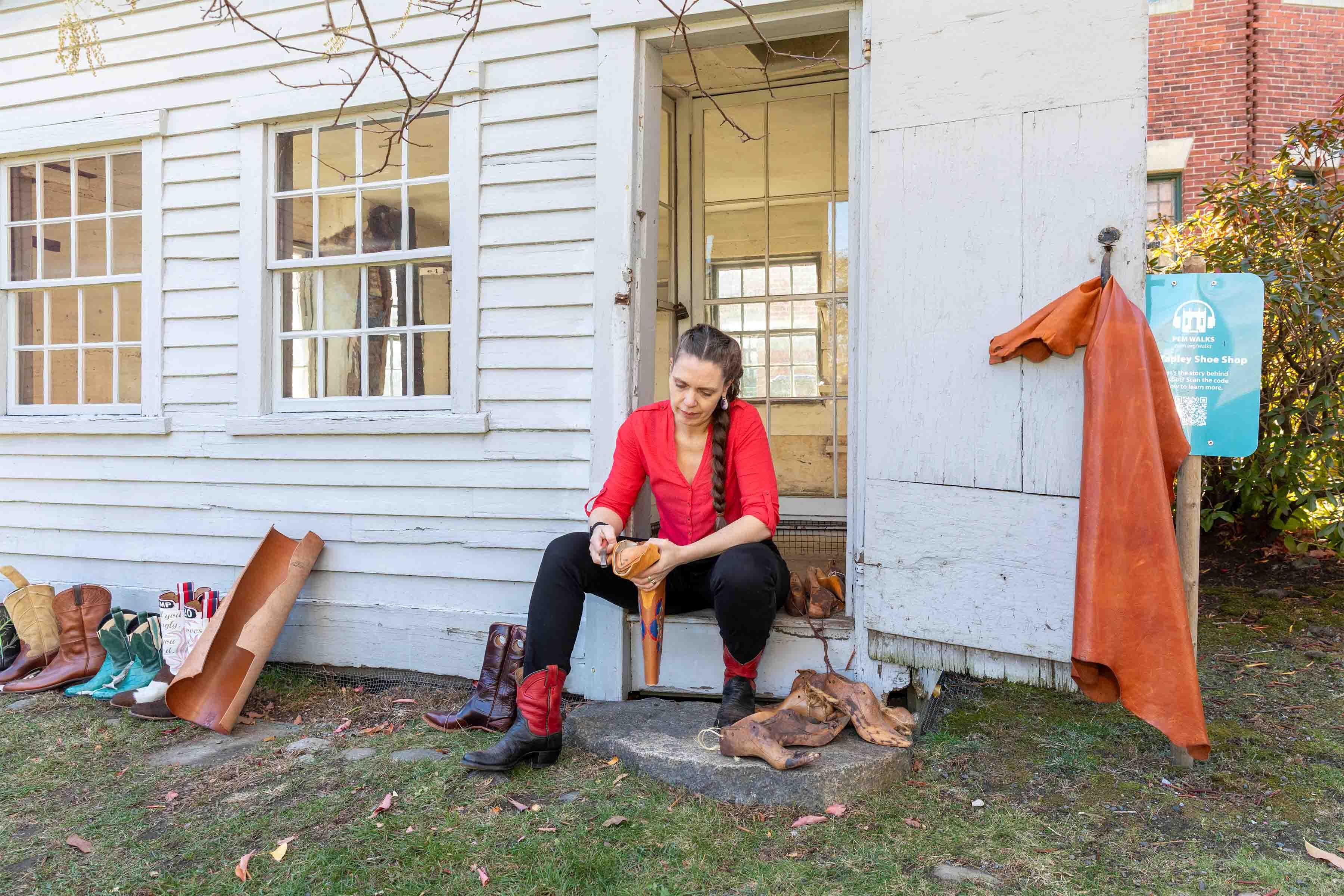
Sarah Madeleine T. Guerin at the Lye-Tapley shoe shop, 2025. Peabody Essex Museum. Photo by Kathy Tarantola/PEM.
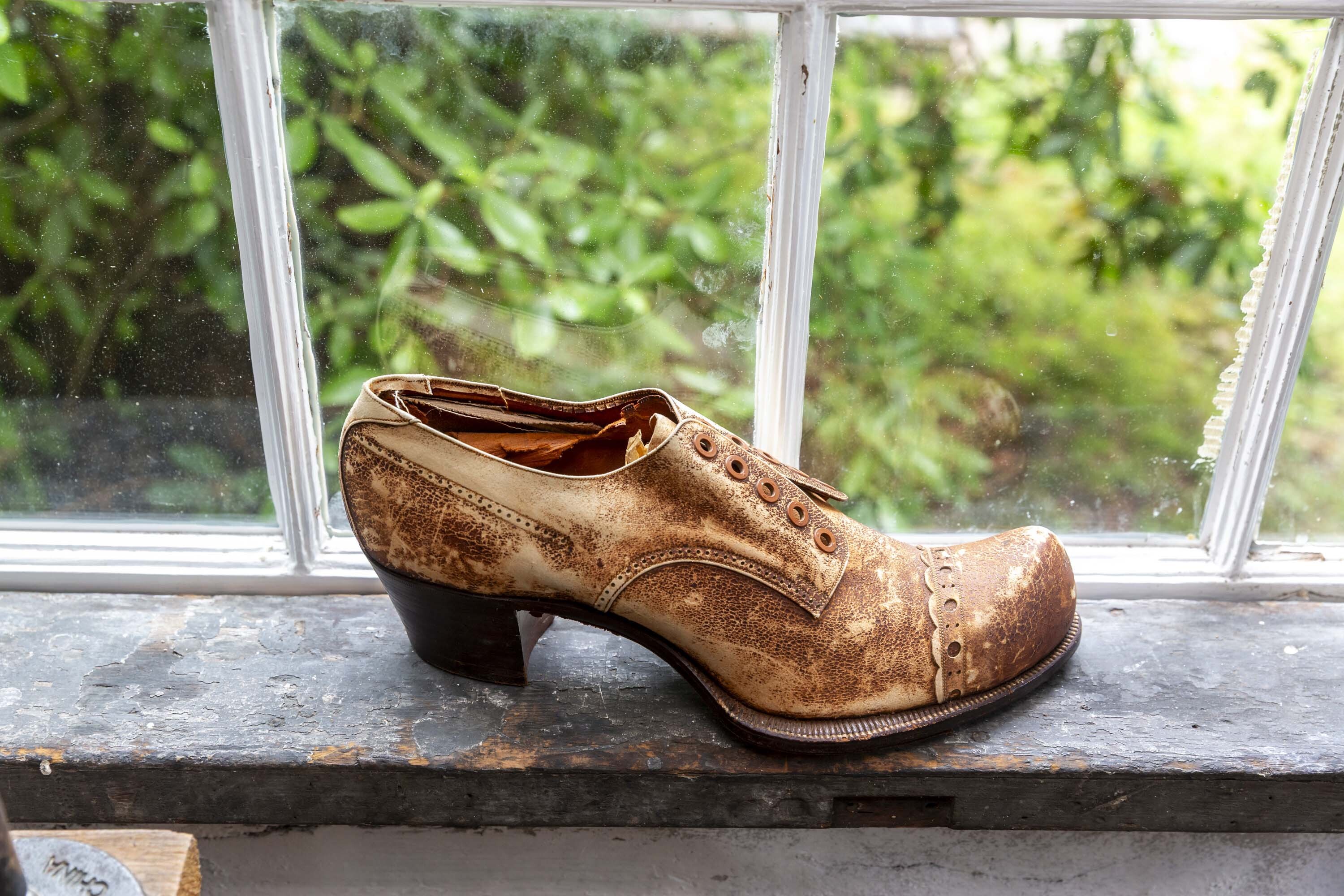
In the Lye Tapley Shoe Shop on PEM’s campus. Photo by Kathy Tarantola/PEM.
Together with Petra Slinkard, PEM’s Chief Curator and Nancy B. Putnam Curator of Fashion and Textiles, we look at several generations of fashion from PEM’s collection. We pull out a vintage firefighter’s uniform, some high-end couture and a selection of costumes demonstrating how Salem’s Puritan history was brought to life by reenactors in the 1930s. We dive deep into closets at PEM’s James B. and Mary Lou Hawkes Collection Center, bringing out clothing that reflects this city’s storied history. These pieces will be on view in Salem Gets Dressed, our new installation of the Fashion & Design gallery re-opening to the public on August 1. Stop by to see centuries of Salem’s history unfold through fashion.
Like a good runway show, fashion needs the accessory of music. Salem’s history is also celebrated this summer in our gallery with a commissioned soundtrack. Sound artist James Errington is the perfect person to capture 400 years of life in Salem: He’s been creating a time capsule with a monthly podcast called Centuries of Sound. Each of these mixes is about three hours long and represents one year through music and archived sound, going back to 1859, the year of the earliest recoverable sound recording. Have a listen to our interview with James and then spend some time in the gallery and see if you can pick out familiar sounds of Salem.
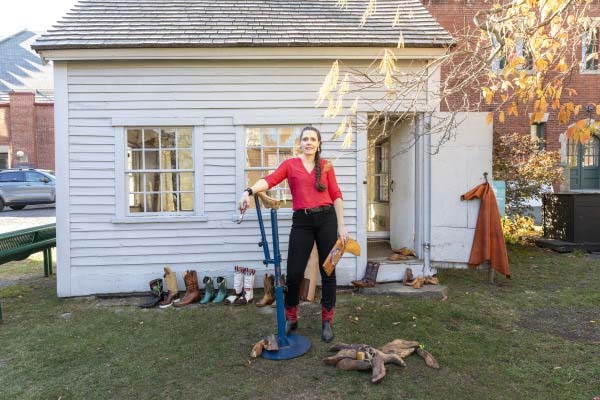
Sarah Madeleine T. Guerin at the Lye-Tapley shoe shop, 2025. Peabody Essex Museum. Photo by Kathy Tarantola/PEM.
We also bring you to someone who is spending the summer doing a residency in our traditional ten-foot-long shoemaker’s workshop. As a bootmaker, Sarah Madeleine T. Guerin enlivens PEM’s 19th-century Lye-Tapley Shoe Shop into an active space for storytelling while sharing traditional shoemaking techniques and the distinctive footwear-making legacies of Massachusetts.
These ground-level, neighborhood workshops previously connected everyday people with the process of shoemaking and shoe repair. Inside, shoemakers — almost always men — collaborated with women upper-makers, or "binders," who worked from their home. When she’s not in residence at PEM, Guerin works out of her own replica ten-footer in nearby Wakefield.
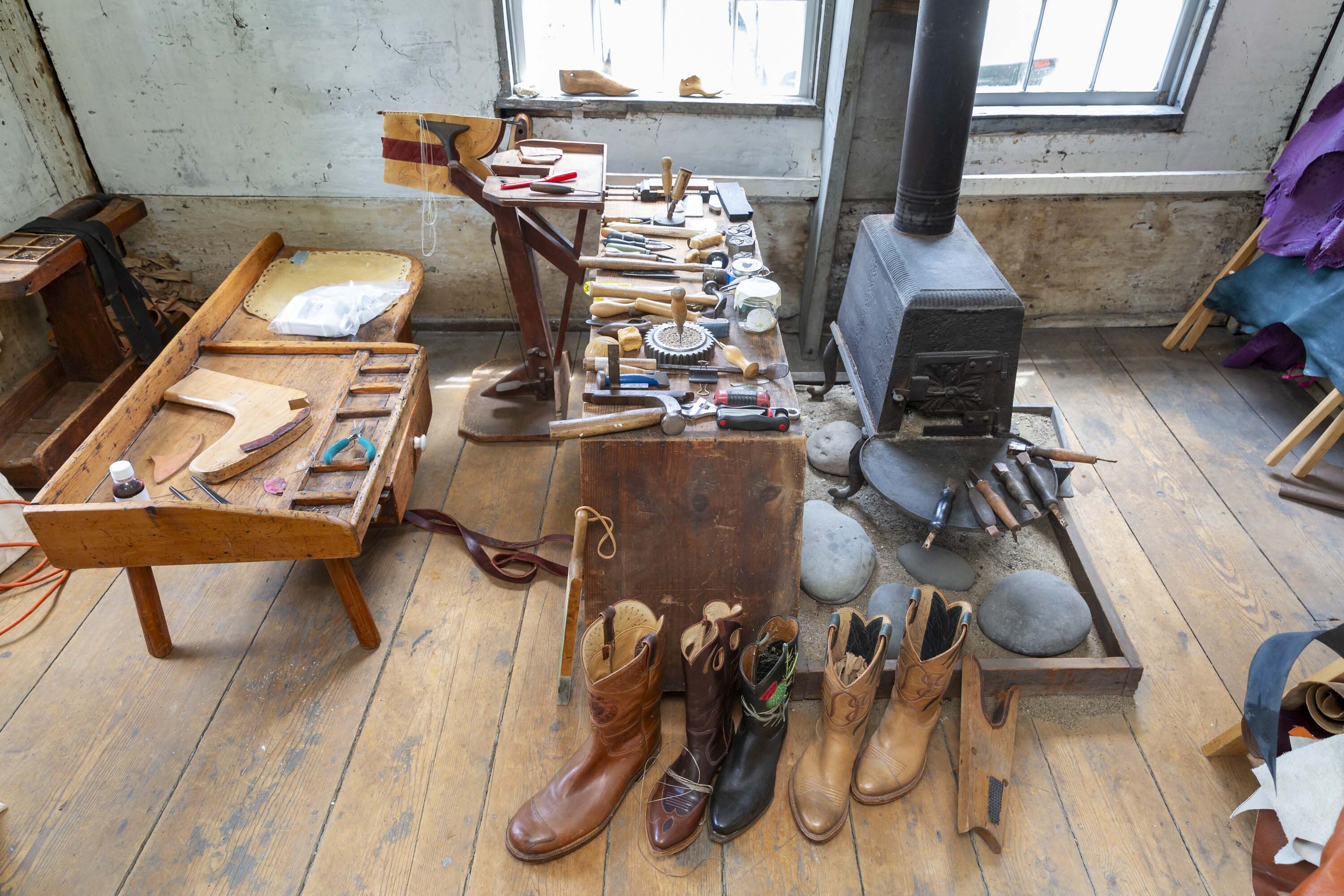
Tools in the Lye-Tapley Shoe Shop. Photo by Kathy Tarantola/PEM.
Listen as Guerin shares her creative process, what led her to bootmaking and how America’s shoe industry has changed since it began here on Boston’s North Shore.
Soon, a pair of cowboy boots decorated with an embroidered map of Salem and green leather sourwood leaves will enter our collection. This pair will be made to fit PEM Curator-at-Large Paula Richter, who has worked for decades with PEM’s world-renowned shoe collection. Stop by the Lye-Tapley Shoe Shop this summer and say hello on Fridays and Saturdays. Or take in a talk on August 6 between Guerin and Petra Slinkard as part of our "Salem as Muse" lecture series. We’re celebrating Salem 400+ all year long with more events later this fall!
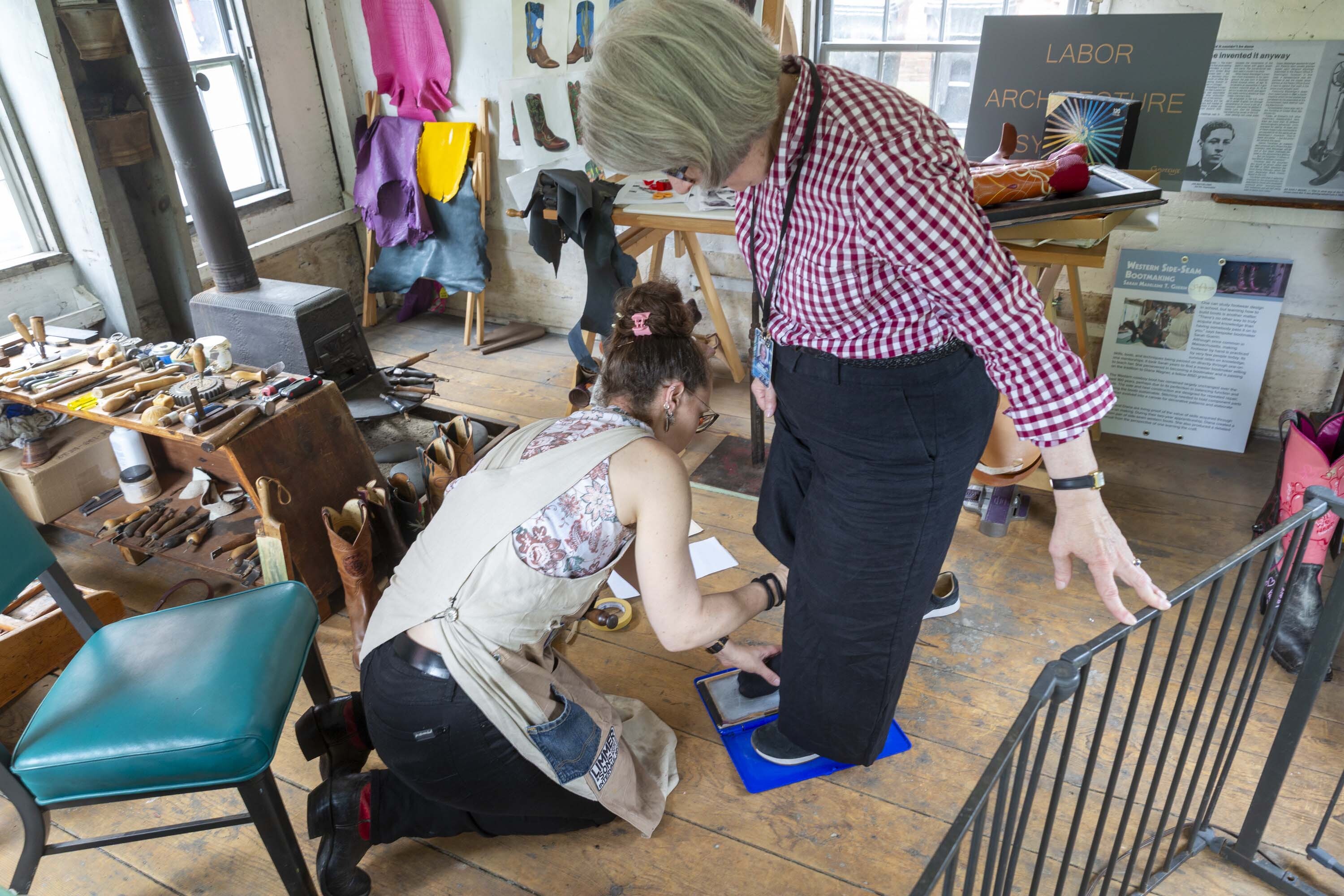
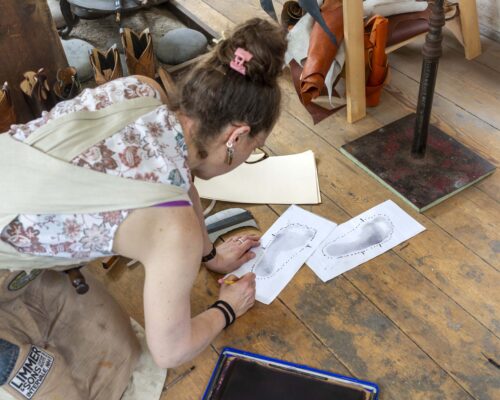
Sarah Guerin measuring Paula Richter’s feet. Photo by Kathy Tarantola/PEM.
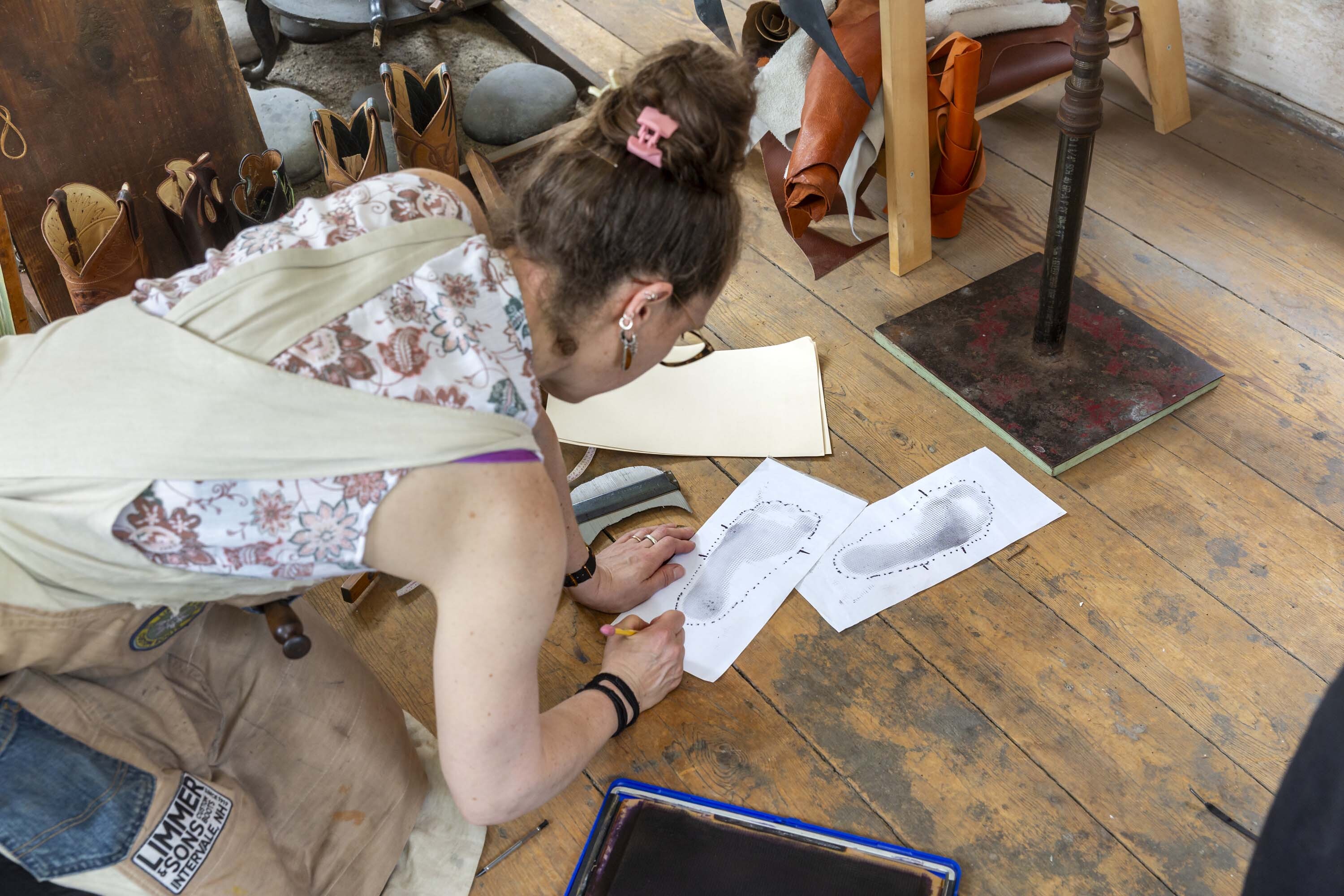
Sarah Guerin preparing drawings to make boots to fit Paula Richter. Photo by Kathy Tarantola/PEM.
Learn more about how PEM is celebrating Salem 400+ at pem.org/salem400. And look for Part 2 when we look at Indigenous Salem, those who were here more than 400 years ago and the settlers who came here in 1626, including Salem’s founder, Roger Conant. Thanks for listening to the PEMcast. Like the episode? Share it with a friend.
PEMcast 43: Salem at 400+, Part 1
TRANSCRIPT
Dinah VO: Welcome to the PEMCAST, conversations and stories for the culturally curious. From the Peabody Essex Museum in Salem, Massachusetts, I'm your host Dinah Carden. In this episode, we're exploring a few different ways the community and the museum are celebrating Salem's 400th anniversary. We begin at a Massachusetts architectural phenomenon, once common here on Boston's North Shore, a 10-footer.
Sarah: My name is Sarah Madeline Thierney-Guérin. I am a bootmaker. My artist name is Saboteuse, and I'm also an artist who uses bootmaking skills to say the things I need to say in life.
Dinah VO: Salem 400 Plus asks us to reflect on the city's layered histories, its commerce, its creativity, its people. And Sarah is stepping into that conversation this summer. She's been educating the public by going back and forth between the 10-footer and the kitchen of our 17th century John Ward house, because the processes of shoemaking done by women historically took place in the home. Meanwhile, these 10-footers, ground-level neighborhood workshops, previously connected everyday people with the process of shoemaking and shoe repair. When Sarah's not working from hours here on PEM's campus, she has a handcrafted 10-footer in her own backyard.
Sarah: What's happening in a 10-footer is really public, right? These buildings are everywhere. They're architecturally accessible. They have huge windows out of necessity for light. You can walk by and peek your head in. It was really important that I did work in a 10-footer for all those years because my neighbors were able to see. All the people on my street understood how shoes and boots were made in a way that your average American doesn't.
Dinah VO: While 19th century people would watch shoes being made in their communities, the average person living today is disconnected from the global footwear industry. At PEM, people will see Sarah working with leather and other raw materials, using hand tools.
Sarah: I am a 2026 cowboy boot maker.
Dinah VO: That's right. Though Sarah grew up in Lynn and Swampscott, communities known historically for shoemaking here on the North Shore, she's a maker of cowboy boots, something that sometimes confuses people.
Sarah: It's totally understandable because we associate the cultural iconography of cowboy boots to the West or the middle of the country or Texas or the West of the country, the Southwest, and not necessarily to New England because they're identifiable to everybody as this symbol of the American West and that they represent the ideas and visions of the American dream. Westward individualism and strength of character and all the things that we tie to Western symbols.
Dinah VO: Being from the community that housed America's first shoemaking factories, once known as the shoe capital of the world, made Sarah want to know more.
Sarah: This disconnect of growing up in a place that has this profound history that is incredibly important and not having it be a part of my daily life was the catalyst to make me want to know more, to dive more, to spend more time researching this and finding out why. Why did that completely disappear? Why is there only little echoes of it that maybe you happen to talk to somebody who went into a tannery when they were younger? And if you didn't, you could go through your whole life growing up here without knowing that shoes were made here. And the more I made the effort to investigate in libraries and archives and historical societies and museums, the more I learned that we were the center of shoemaking, not just in the United States, we were the primary producer of shoes, but we happened to be the spot where this innovative jump from handmade systems to machine-made and mechanized industrial scale happened because there were so many shoemakers here.
Dinah VO: As a child, Sarah became obsessed with shoes.
Sarah: I was cutting shoes apart and I couldn't put them back together, yet we all have shoes on and there was nobody to ask. I'd never seen a shoemaker. I didn't know any.
Dinah VO: She went on to study architecture. And I just never shut up about shoes. For every project we had, I turned into shoes.
Sarah: I just was quite obsessed and always thinking about the foot and structure and all the things we were learning in architecture school, I kept zooming in on scale to the human body and how we were grounded and how a foot worked and thinking like, if I can't figure those things out, how can you start talking about larger spaces and how larger things are constructed? So I kept pushing and pushing and pushing, thinking I just hadn't found it myself, like that this was my problem and that it was in Europe, it was somewhere else and we didn't have that opportunity here, but I could find it somewhere. And I did end up going to a shoemaking school in England after art school. And this journey, getting to be a bootmaker, has made me want to use my practice, not just to make boots for people, but to change those systems, to heal these problems, put in place a better, more stable system for somebody who was in my position back then to have a better route or an understanding of a route to get there.
Dinah VO: Visitors to the shoe shop have watched Sarah work on a pair of boots to fit PEM Curator-at-Large Paula Richter. Paula has worked with PEM's world-renowned shoe collection for many years. These custom boots will add to PEM's collection. They'll reflect conversations Sarah had with Salem residents and others who visited her when she was artist-in-residence at Salem's Artist Row. These locals shared memories of Salem's part in shoemaking.
Sarah: During that residency, over eight months, I spoke to almost 2,000 people. Some started sharing very specific stories of their lives, like firsthand primary accounts of when I was a child, I played hide-and-seek behind the pallets of salted hides in a tannery on the North River. And I worked in a shoe factory on Proctor Street and I was doing the heels and I was writing down and keeping track and for the most part, people that work in shoe factories or people that had exposure to shoe factories and tanneries are working-class people and not necessarily the stories that we preserve even when we talk about shoes.
Dinah VO: Those personal stories sometimes involved the local tanneries.
Sarah: This tie between footwear and the production of leather, tanneries, taking animal hides and turning it into this material that then will stop decomposing in a way, are part of the bigger story too. It's part of the Salem story. The John Ward house, he was a leather worker in some way. It's also tied to footwear craft. Like as shoe factories were being offshored and or just changing to different locations within North America and then eventually to other continents, the leather industry also suffered because it was so intricately tied to shoemaking. Forever, footwear was tied to leather because it was the longest lasting material that we had through wear. And most of our shoes now have moved to petroleum-based products or fabrics that are long lasting in the environment. They take a really long time to break down. So if you, your shoes are made to be disposable and they are going to either be thrown into a landfill or incinerated pretty quickly because they don't last a long time with wear. Sort of the opposite material considerations from leather. Leather was long lasting with wear. We haven't really developed another material to replace those conditions, even though we're always trying, right? We're always innovating and trying to do those things.
Dinah VO: Sixty-five million shoes are produced in this country every day and end up in landfills. But shoemakers do exist and they're trying to change this miserable statistic.
Sarah: I hope that someone who's coming into the Lie Tapley 10-footer shoe shop is understanding that this is not a craft of the past. This is not an artisanal practice of the past. That there are shoe and bootmakers today working all among us invisibly for the most part. We are keepers of knowledge. This is a valuable human skill set to carry on. There are larger systems that must be changed but it's not the consumer that's going to do that. And that we all have different roles that we might be able to shift those systems.
Dinah VO: But how did we get here? How were shoes made in the past?
Sarah: If you look back at the 1700s, a shoemaker would go from community to community with this bag of tools and kind of make very crude work shoes. Do it from beginning to end but more repair work of shoes that were there that had been brought in from Europe. Then as we started to get this organic system of shoe production like American colonists were saying we want to make our own shoes for different reasons. We started getting this really sophisticated division of labor system where women were doing two-thirds of the footwear making process in their homes where they're sewing and cutting and putting together the top like the upper part of a shoe because it's very similar to garment making. It's soft leathers, it's fabrics and linings and they were able to stitch things first by hand and then with sewing machines which were the first mechanized tool to be introduced into shoe making. They were doing all that in a house.
Dinah VO: Women then sold these shoe parts to make a bit of money.
Sarah: They were passing those uppers to men who were then turning them into a shoe by stretching that around a last attaching it to a foundational insole in a way and putting a sole and heel on. That was the work that was happening in a 10-footer. So only those final processes which are technically called making were happening in there and women's work tends to be invisible in many different disciplines but because they were doing it in homes which were private it's lost in the story.
Dinah VO: To watch the handmade process of this thing that we all wear every day is so very cool. Sarah holds a wooden foot-shaped object in her hand. For almost all types of shoes you need a solid form around which to build.
Sarah: This here is the last that I have adapted to Paula Richter's foot and her feet are going to serve as the negative space that these Salem as Muse boots are going to have. So I measured Paula's feet. I took a lot of information. I recorded her footprint and where the point loads of her feet are and so I could understand the bones and it's really a foot in motion. So it's the negative space inside a shoe or a boot that the foot needs while walking.
Dinah VO: The final boot design for Paula was still in the works when Sarah and I talked, but she laid out her plan to create a map of Salem on the boots pinpointing the locations of the personal stories she collected about Salem's shoemaking history.
Sarah: The bottom would be in a dark blue that somehow will tie in the water with this map and that I will be pinpointing the locations on the Salem map of where these personal stories were gathered and then tying to those stories. And part of the legacy of cowboy boots that I really fell in love with as I learned to be a bootmaker was that the tops reflected place in some way of the maker. So the maker in West Texas was doing a stitch pattern that reflected the plant life there or we would do small maps with a star of Lexington, Kentucky to show that that was an important part. Like there's this long legacy of using the decorative patterns on these boots to record place.
Dinah VO: Shoemakers across the globe are connected, says Sarah.
Sarah: We're all connected through social media in a way that artisans really never were before and we all have the same problems that we face as far as continuing our traditions whether we're in the United States or Japan or England or Africa we have the same problems. In the end, Sarah believes that the production of our shoes will change. If you look at the human condition this is how things change. That's my mission. That's how I use my craft and my artisanal practice and my public engagement to really shift our system somehow. You can visit Sarah the Bootmaker through August 29th on Fridays and Saturdays.
Dinah VO: Also, Paula Richter has put together a self-guided audio tour that recognizes handmade artwork here at PEM. This tour is part of Handwork Celebrating American Craft 2026 a national celebration showcasing the breadth of handmade artwork and its impact on American culture. The Lie Tapley Shoe Shop is a featured stop on this tour. Learn more at PEM.org.
Salem is a city known for costuming and so when celebrating 400 years of our city's existence we turn to the stories that can be found in our fashion collection. Our new fashion rotation created for Salem 400 explores the city's history through clothing and textiles tied directly to Salem's past and present. More than 40 garments and ensembles date from the early 1700s to the present. These include costumes, uniforms, wedding attire, and enduring everyday wear. The installation traces how generations of Salem residents have expressed identity, status, and belonging through what they made and wore. I recently joined Petra Slinkard PEM's Chief Curator and Nancy B. Putnam Curator of Fashion and Textiles. We met at the museum's Hawks Collection Center where dozens of garments and accessories were being prepared for installation. For Petra, these objects together tell a broader story about Salem, one shaped by resilience, creativity, reinvention, and global connection across four centuries.
Dinah TAPE: When you think of Salem 400, you don't necessarily think obviously we're going to do fashion rotations. How did you come up with that idea?
Petra: Well, PEM was fortunate to have a gallery that is dedicated to the study and the reveal of fashion and design throughout the museum's collections. And because of the nature of the material, fashion and textiles in particular are quite light sensitive. And so we're always thinking about future rotations for the collection. And it seemed like an opportunity that we didn't want to miss to celebrate the commemoration of Salem's more than 400 years of engagement. And so my colleague, Paula Richter, Curator-at-Large, and I decided to take a new look, a fresh look at the fashion and textile collection at the museum and pull forward pieces that you might not normally see on view that had a specific connection to a moment in time or a significant person in Salem's history proper.
Dinah VO: Drawn from PEM's nationally significant collection, this presentation in PEM's Fashion and Design Gallery features pieces associated with New England figures and families. We see a sense of pride in a city defined by an intense and varied history, a profound maritime heritage, and vibrant communities and culture. The exhibition spans centuries of Salem history, connecting us to major moments in the city's past. One of these objects is a Salem firefighter's dress uniform tied to the Great Salem Fire of 1914.
Petra: So the first work that I'll talk about is, I think, a really special ensemble. And that is a Salem fireman's uniform. It is actually a dress uniform from 1914. And this uniform, you know, belonged to an individual who was a volunteer firefighter in that really significant and pivotal event in Salem's history. You look closely at the buttons and then also the emblem on the lapel. It's really wonderful to be able to see, you know, those signatures of the fire department as well. So on June 25th, 1914, the Great Salem Fire ignited at the Corn Leather Factory on Boston Street. And the blaze really spread quickly. And it was sort of voracious in its overtaking of the city, mostly due to drought and strong winds.
Dinah VO: The blaze destroyed more than 1,600 buildings, forcing thousands to live in tents. The fire left so many jobless that the tragedy influenced the creation of the U.S. Employment Service.
Petra: Here you have an individual who participated in fighting the fire. He went on to become the assistant fire chief. And this is Edward Webster Hay. He did fight the inferno, but he went on to donate this uniform, I think, as a reminder and as a symbol of this important moment in Salem's history, but also by 1921 when rebuilding efforts were well underway. I think also as a symbol of the regrowth and the strength of the city as they pulled together as a community to rebuild.
Dinah VO: As Salem transformed from a thriving port to a retail hub and later a center for cultural tourism, fashion reflected and helped define its changing identity. Another object in the rotation is a simple handmade reenactor costume from the 1930s tied to Salem's historic pioneer village.
Petra: So what we're looking at is a costume that was worn by a teenage reenactor at Pioneer Village in the 1930s. There's some sun damage. And typically in an art museum context, this is the kind of ensemble that wouldn't be put on view because it's not pristine. It's a reenactor's costume of the period. But I think given Salem's history and its tie to Pioneer Village, it was a really important piece to include in this rotation. Pioneer Village was really conceived as a living history museum by the historian George Francis Dow. And it was also the set for a play reenacting the 1630 arrival of Governor John Winthrop on the ship Arabella. And so while original 17th century garments of early Massachusetts Bay colonists are lost, we have this as an example, even though it is in its own right historic, dating to the 1930s, it serves as this link between Salem's 400th anniversary and also the tercentenary anniversary of 1926 into 1930 and the celebration of the colony's founding.
Dinah VO: So in a way, it's a reenactment of a reenactment.
Petra: It's fantastic. And you know, it's homemade, worn by a teenager. And also I think that the responsibility of a young person participating in the reenactment of this important moment in time at Pioneer Village. And the other piece of the history that I think is interesting is that Pioneer Village was actually intended, as I understand it, to be temporary. But it was so popular and so significant as one of the first of its kind in the country that the city continued to preserve it to this day.
Dinah VO: With its thatched roofed houses and things like that, it's so powerful to be in that atmosphere. Fashion also reimagines history. From commemorative costumes to contemporary designs inspired by Salem's past, these works show how each generation interprets and reshapes its inherited stories. This invites us to consider how we express ourselves and what we choose to carry forward. The final piece, Petra shared, connects Salem history to global fashion culture. A dramatic gown designed by Alexander McQueen.
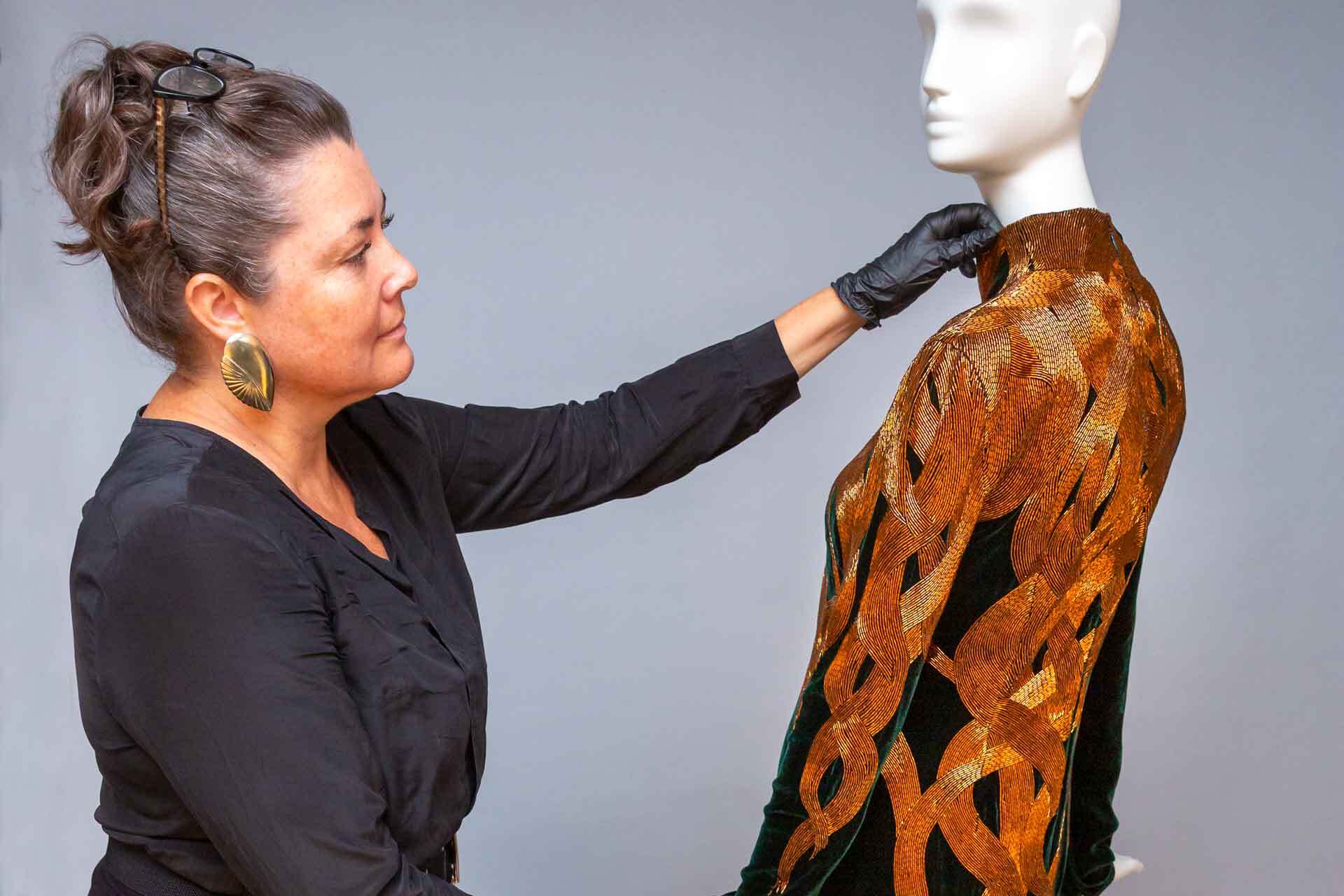
Petra: So the third work is one that is a really exciting new addition to the museum's collection. And it is a work designed by Lee Alexander McQueen for his collection in memory of Elizabeth Howe, Salem 1692. McQueen learned that his ancestor was Elizabeth Howe, who was one of the innocent people tried, convicted, and unfortunately murdered in the Salem witch trials. And so he traveled to Salem in 2011 and he visited the Peabody Essex Museum, he visited the memorial site behind the museum, he visited the Rebecca Nurse House, all in an effort, I think, to draw closer to Elizabeth Howe and to learn more about her story. The dress is a sumptuous, gorgeous evening gown that was worn on the runway. It is made of a deep green velvet. But I think in this case, this particular collection as its connection to Salem and his own family history is sort of bone chilling in a way because it is so layered.
I think just with these three pieces, and there are maybe 30 or so going on view, that Salem is a really complex and interesting place that has a really deep history that brings people together. Through the uniform, for instance, I see that as a symbol of a community who faced hardship together and overcame it together. With the reenactor costume, I see a place that is still, even in this year, looking backwards to look forwards, to celebrate achievements and moments in community history that are worth uplifting and, again, bringing people together. And through the McQueen piece, I see the reinforcement of Salem's global position as a place that draws people in from all corners of the earth, those who are interested in celebrating, those who are interested in mourning, those who are interested in understanding more about their own history and this city's history as it really helped sort of birth our nation.
Dinah TAPE: What fashion can you imagine would represent the next 400 years in Salem or even the next 50? You know, 50 years from now, looking back now, what would be on a mannequin in the gallery showing people 2026?
Petra: That's a great question because Salem, I think, has so many different identities. Obviously, we have a very healthy tourism industry and so I think, you know, there are some stereotypical or sort of classic ideas of what a tourist may dress like on a visit to Salem. But then also I'm thinking about all of the internationally renowned fashion designers who have also been a part of Salem's history, who have shown their work here. Ashley Rose Couture, Hogan McLaughlin, and others who have their homes elsewhere but are drawn to Salem time and time again as a point of reference and inspiration. And I think that that really kind of speaks to that sort of global and local and regional elasticity that I think Salem is so proud of and also known for. I think that there's a tremendous amount of creativity that you see on the streets of Salem, particularly when we're at the height of our tourism. People come from all over. They have matching ensembles. They have very detailed ensembles. And because Essex Street is a pedestrian walkway, it really does lend itself to the notion of a runway where you can just truly sit and watch the world walk by and all of the ways in which people are kind of bringing a little piece of themselves with them, but also, I think, taking home a little piece of Salem with them as well.
Dinah VO: In this exhibition, you will discover garments that reveal Quaker traditions and connections to abolitionist histories. You'll feel the influence of local businesses along Essex Street and the lived experiences of families who built their lives here. Starting in August, you can experience this Salem 400 fashion in PEM's Fashion and Design Gallery, where you can also go on a sonic journey of 400 years in Salem.
(Salem sound mix)
Dinah VO: Sound artist James Errington seems just the perfect person to capture 400 years of life in Salem. This is because he's been creating a time capsule with a monthly podcast called Centuries of Sound. Each mix is about three hours long and represents each year through music and archived sound going back to 1859, the earliest recoverable sound recording.
James: I think it's just been my special interest forever, really. I was making mixtapes, mix cassettes in the 80s before I was 10 years old. I was always kind of trying to put together sounds and experiment with sounds. Centuries of Sound itself was, I was going to make a mix with one song from every year of my life. And then I thought, what about the 20th century?
Dinah VO: And then, James says, he went down a rabbit hole.
James: I was living with my wife's parents and my older son in a place called Tongzhou outside Beijing. And I was kind of the only non-Chinese person there. At least it felt like it. And I didn't have anybody to listen to music with. If I put music on in the house, it would be turned down to almost zero by my wife's dad. And my obsession needed to become kind of personal, like a world of headphones at that point. So I just kind of immersed myself in it.
Dinah VO: Now from his home in Cambridge in the UK, the passion for this project can be felt around the world. With its meticulous research and mixing, you lose yourself into a new time and place as you travel on a wave of multiple layers. The Financial Times called Centuries of Sound a museum piped straight into your ears.
Dinah TAPE: I heard Western swing country music, bebop, R&B, big band.
James: I do have some Japanese music in there, Indian music, African music, South American, Central American. But I want to get as wide a kind of variety and as authentic a feeling as possible. So I use lots of things like advertisements and radio broadcasts. I think that's more like the feeling than... I don't want it to be the greatest hits. It's been done is one thing. And it's also, it's just kind of plain nostalgia. I'm trying to get away from nostalgia.
Dinah TAPE: So what inspires you about celebrating Salem's 400 years?
James: When I first had the request, I didn't know that much about the place. But I had a week or so looking through history, looking through different things. Obviously, I know about the witch trials. I watched the film The Crucible before. But just reading, looking through the history, there were lots of different things through the years that I wanted to kind of bring to life. Different kinds of material, fictional and, you know, real events.
(Salem sound mix)
James: There's quite a bit of speech from the 1940 version of the House of Seven Gables because that covers quite a bit of history as well in a fictionalised kind of way. Type machine. There's Laurie Cabot on the Oprah show in 1987. I've got samples of clocks from the last 500 years, which are playing there and gradually turning into each other.
Dinah VO: And even though he's spent so much time travelling the world, James has never been to Salem. But now he's inspired to visit.
James: I went on a Google Street View travel around and I didn't realize that there were towns that were so well-preserved from so long ago. In the USA, I kind of assumed that it would be a modern kind of a town with skyscrapers and the like, but it's not like that at all. It's interesting to think about a place like that because that's a very relatable thing from a UK point of view.
Dinah VO: In fact, despite his interest in all kinds of American music, he hasn't been to the States at all.
James: I have never been to the USA. I've been to 50 countries or so, but I've never been to the USA.
Dinah VO: But this isn't the first time James' sound mixing has been the backdrop for fashion.
James: I did some work for a fashion show in the Victorian Albert Museum. I think it's kind of a natural fit in a way because it's not high art. It's not something kind of separated or intellectual. It's everyday life.
Dinah VO: Learn more about how PEM is celebrating Salem 400+ at pem.org/celebrate-salem-400. And look for part two when we look at Indigenous Salem and the settlers who came here in 1626, including Salem founder, Roger Conant. We leave you with more of the Salem 400 sound mix. Thanks for listening.
(Salem sound mix)
PEMcast
PEMcast Episode 038: Oh, wünderkammer, my wünderkammer
14 Min Listen

Blog
Celebrating Rev 250 with PEM objects
8 Min read

Learn
Salem 400+
PEMcast
PEMcast 17: Life at Sea
11 min listen
