PEMCAST | Apr 01, 2026
PEMcast 42: Circumnavigating the Globe in East India Marine Hall
The first collected object was a curious one. A pipe with two stems. It conjures an image of friendship, community and mutual trade. It was given to the museum by Jonathan Carnes, who traveled to Banda Aceh in the North Coast of Sumatra (now part of Indonesia) in 1797. And so a museum was born.
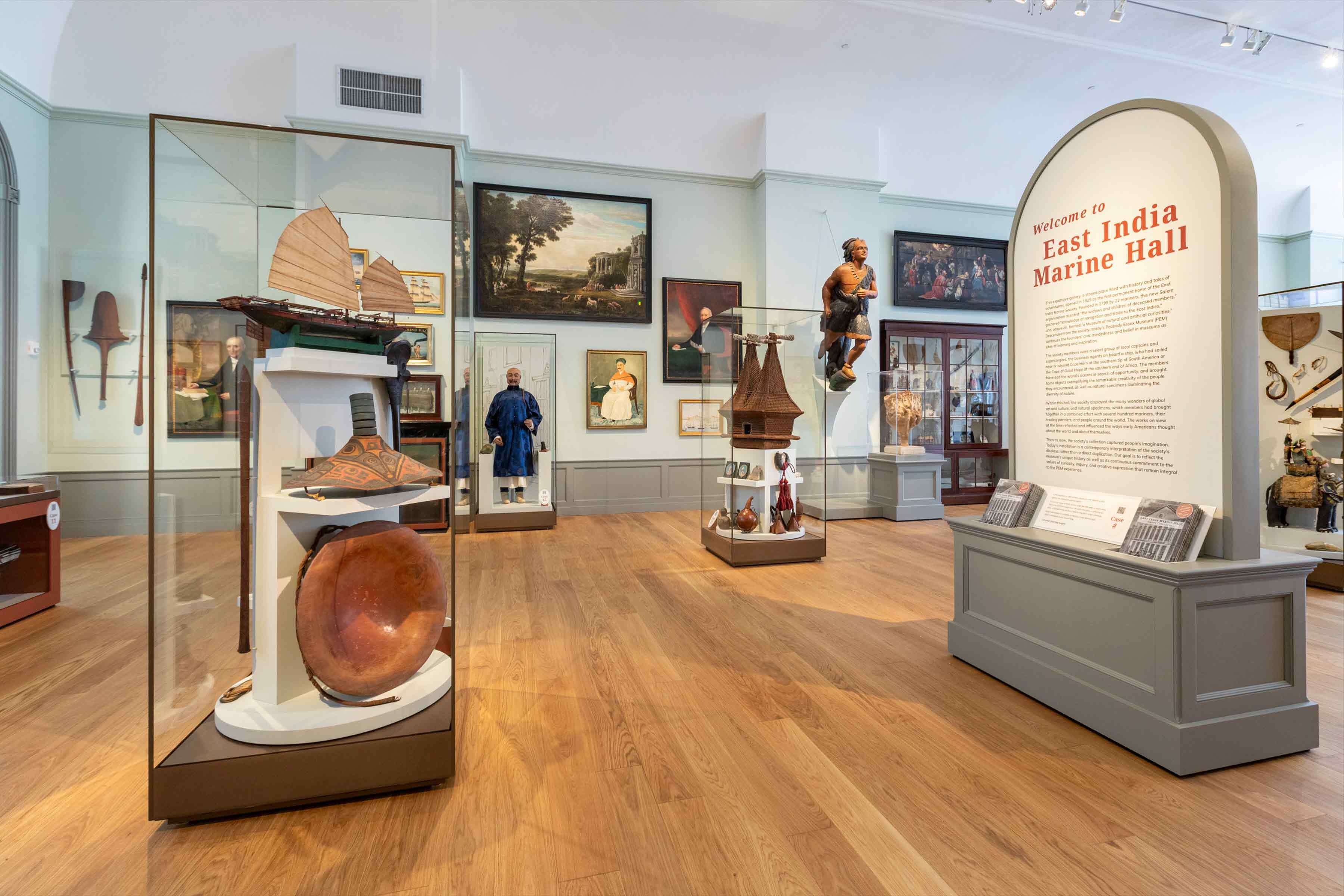
East India Marine Hall reinstalled with some of the museum’s earliest objects. Photo by Kathy Tarantola/PEM.
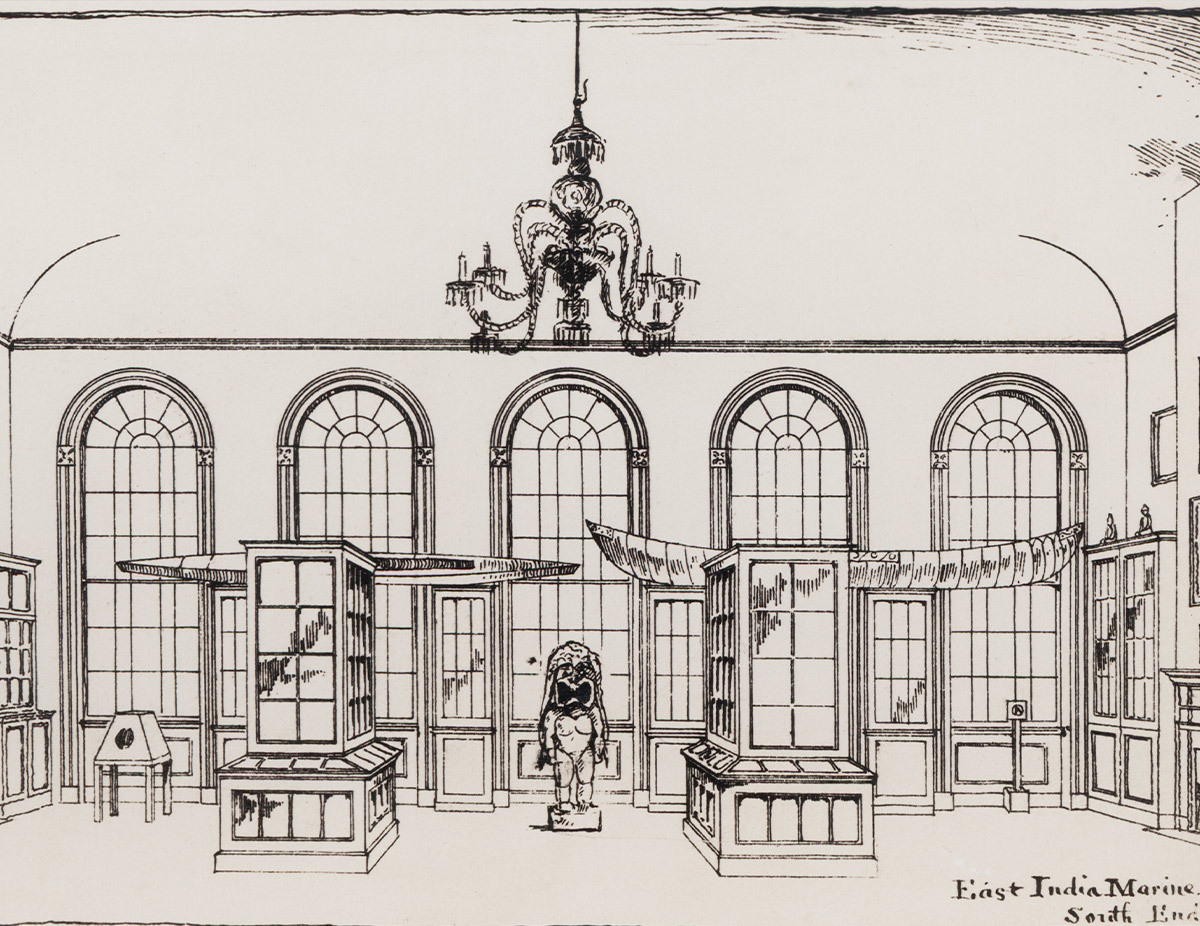
Attributed to James Henry Emerton, East India Marine Hall, 1824-1867, South End, 1879. Ink on paper. Museum collection, 1879. M303.2. Peabody Essex Museum.
The object would have been displayed in East India Marine Hall, the oldest part of the museum, where mariners gathered to tell tales of the sea and toast to their successes. In March, PEM celebrated the 200th anniversary of East India Marine Hall by welcoming visitors into the space shaped by global exchange and rooted deeply in Salem’s multicultural history.
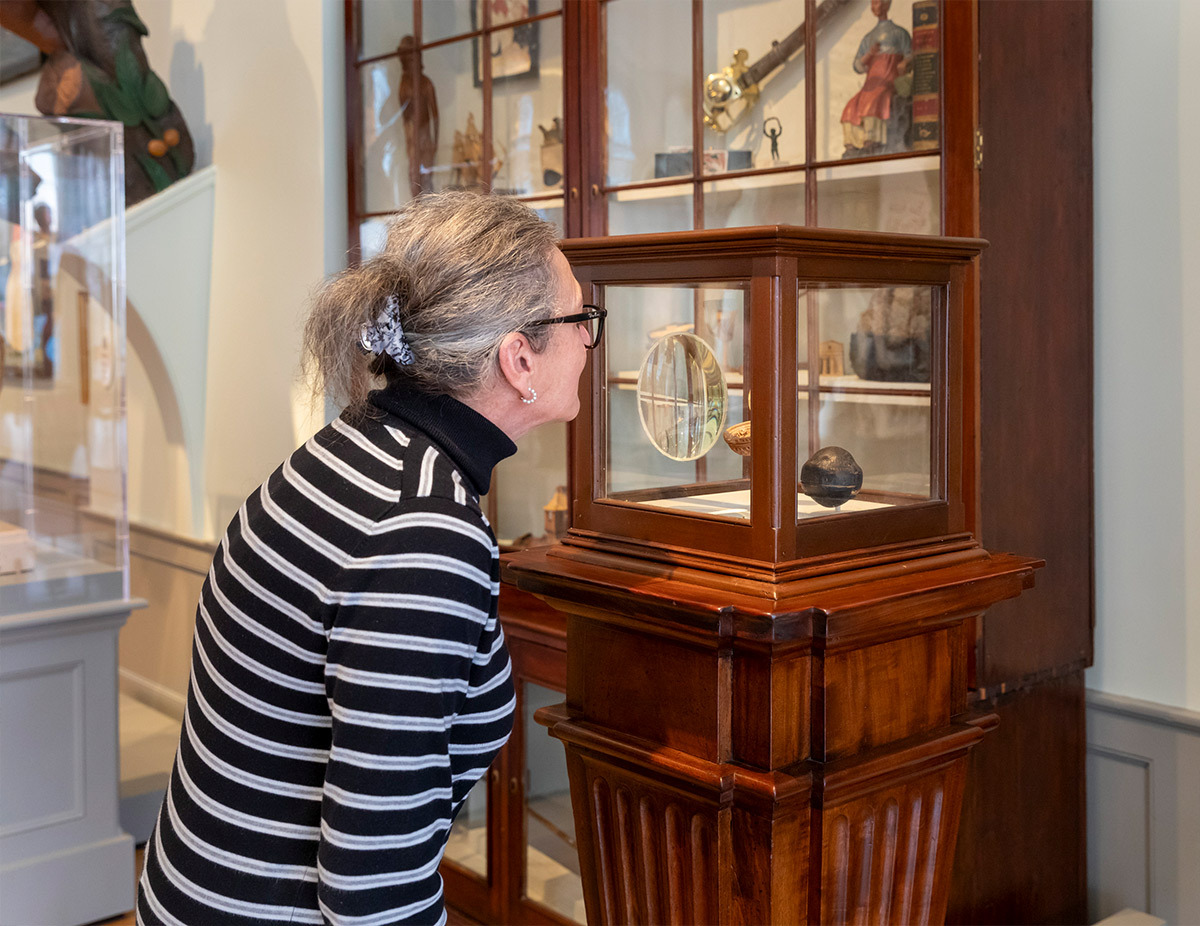
A guest in the newly installed East India Marine Hall. Photo by Kathy Tarantola/PEM.
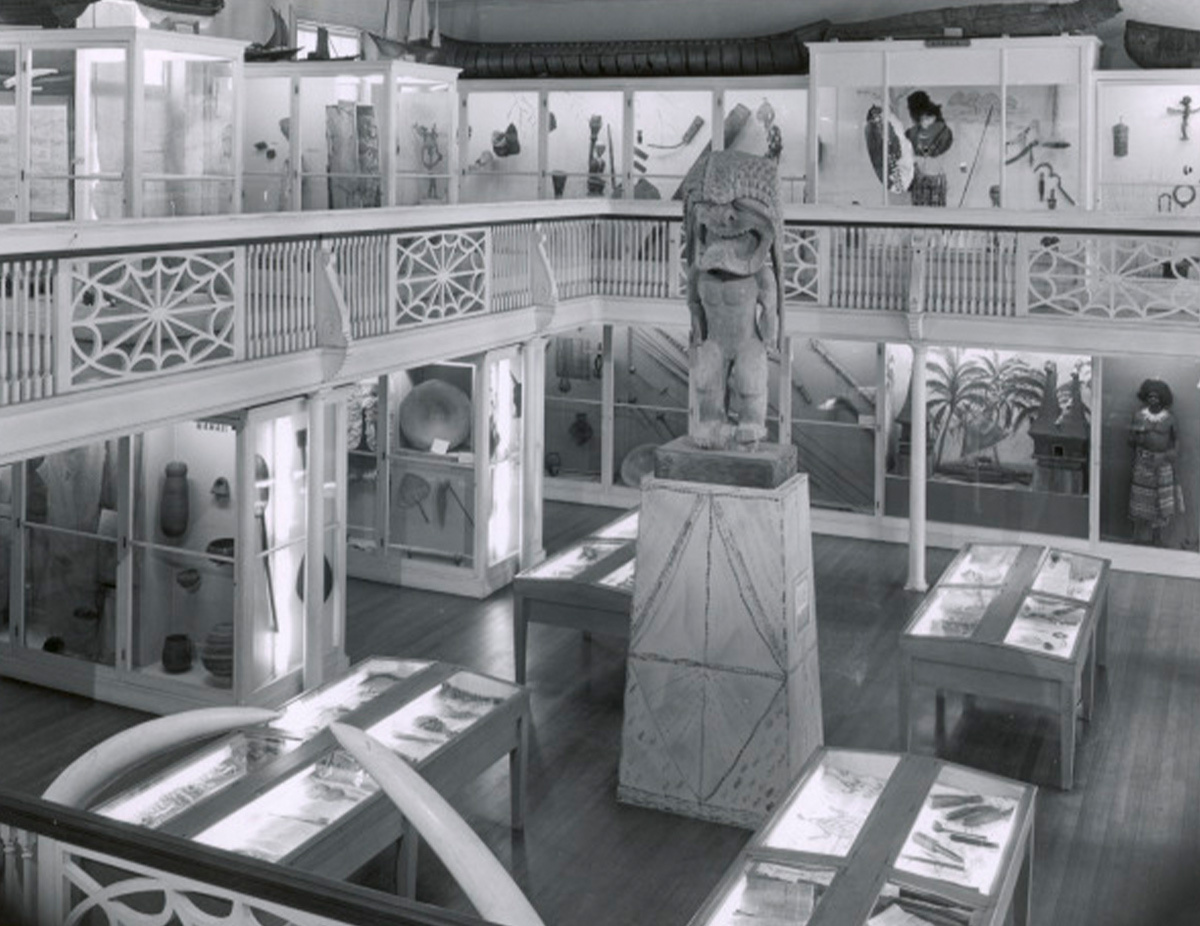
The Peabody Museum of Salem's East Hall in the mid-20th century. Peabody Essex Museum.
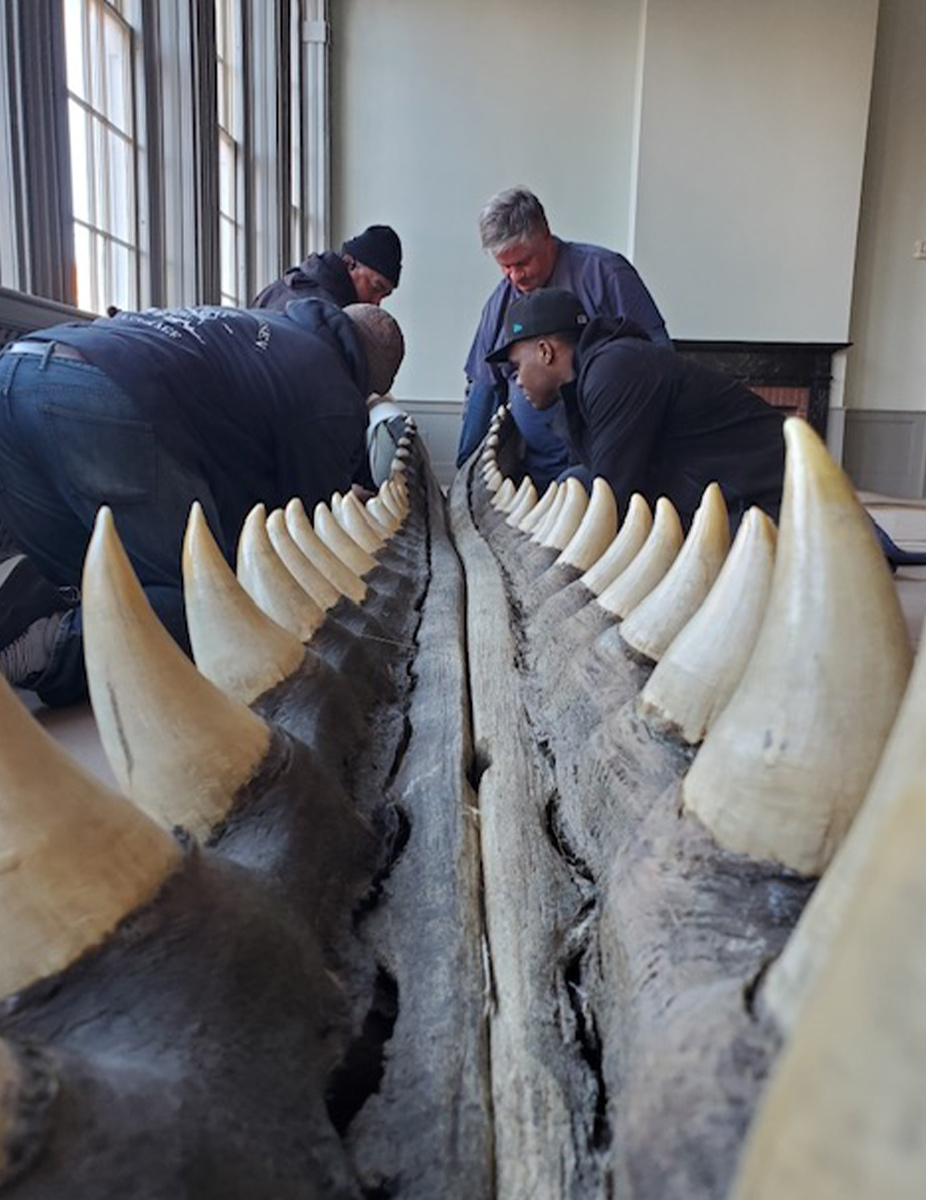
A historic work from PEM's collection on its way to a new home in East India Marine Hall. Lower jaw of a very large sperm whale (Physeter catodon), collected about 1832. Gift of Captain John B. Osgood, 1837. M19079. Photo by Angela Segalla/PEM.
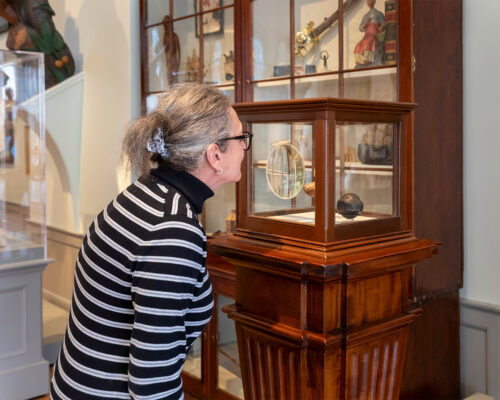
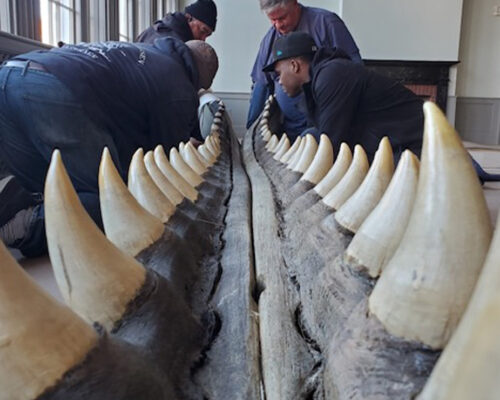
For generations, East India Marine Hall and the objects in it have elicited empathy, curiosity and wonder and transported Salem residents to places around the world. Now, an installation and digital tour inside the historic hall will give voice to early collectors, trading partners and museum visitors, and share perspectives from a range of people living today.
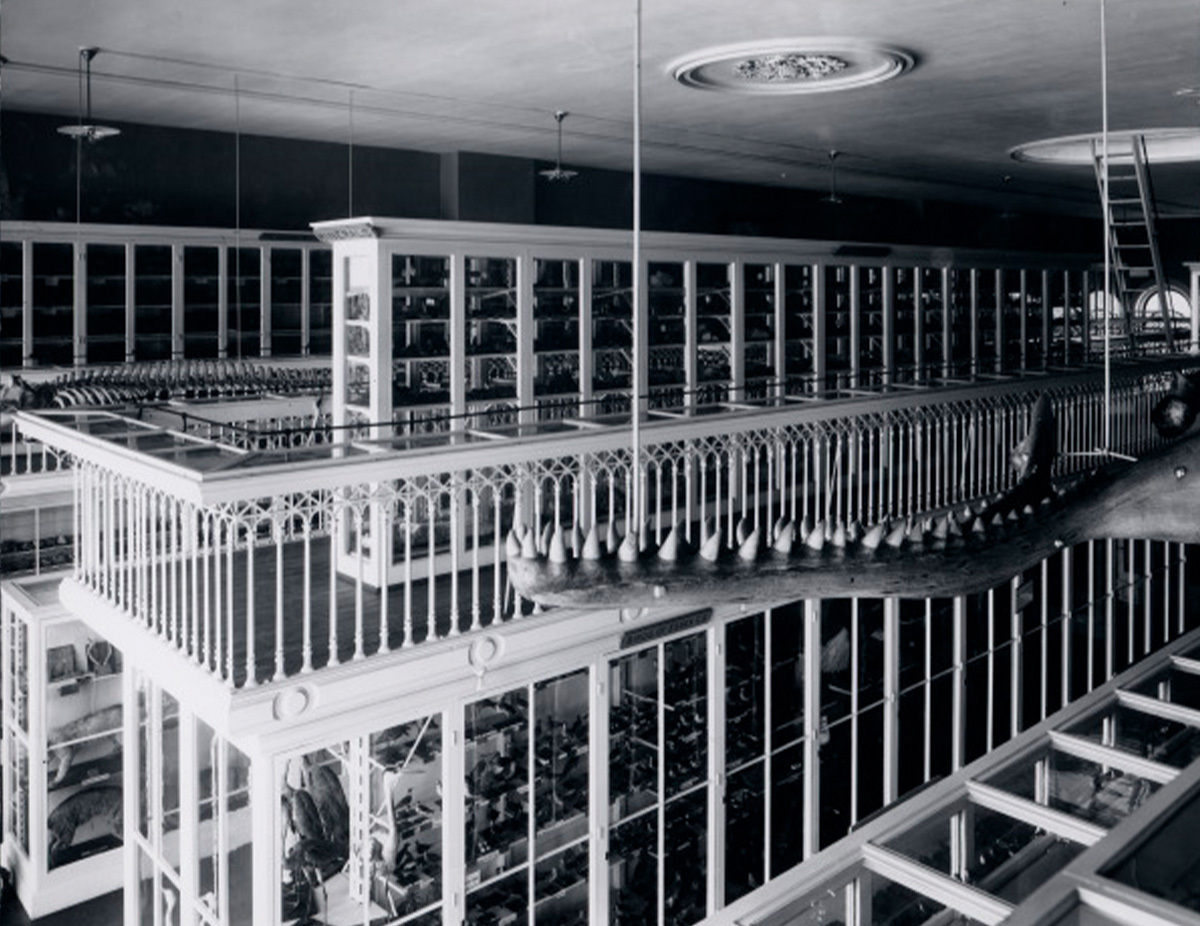
East India Marine Hall EIMH (Natural History Hall) 1908, looking Southeast. Phillips Library Collection, Peabody Essex Museum.
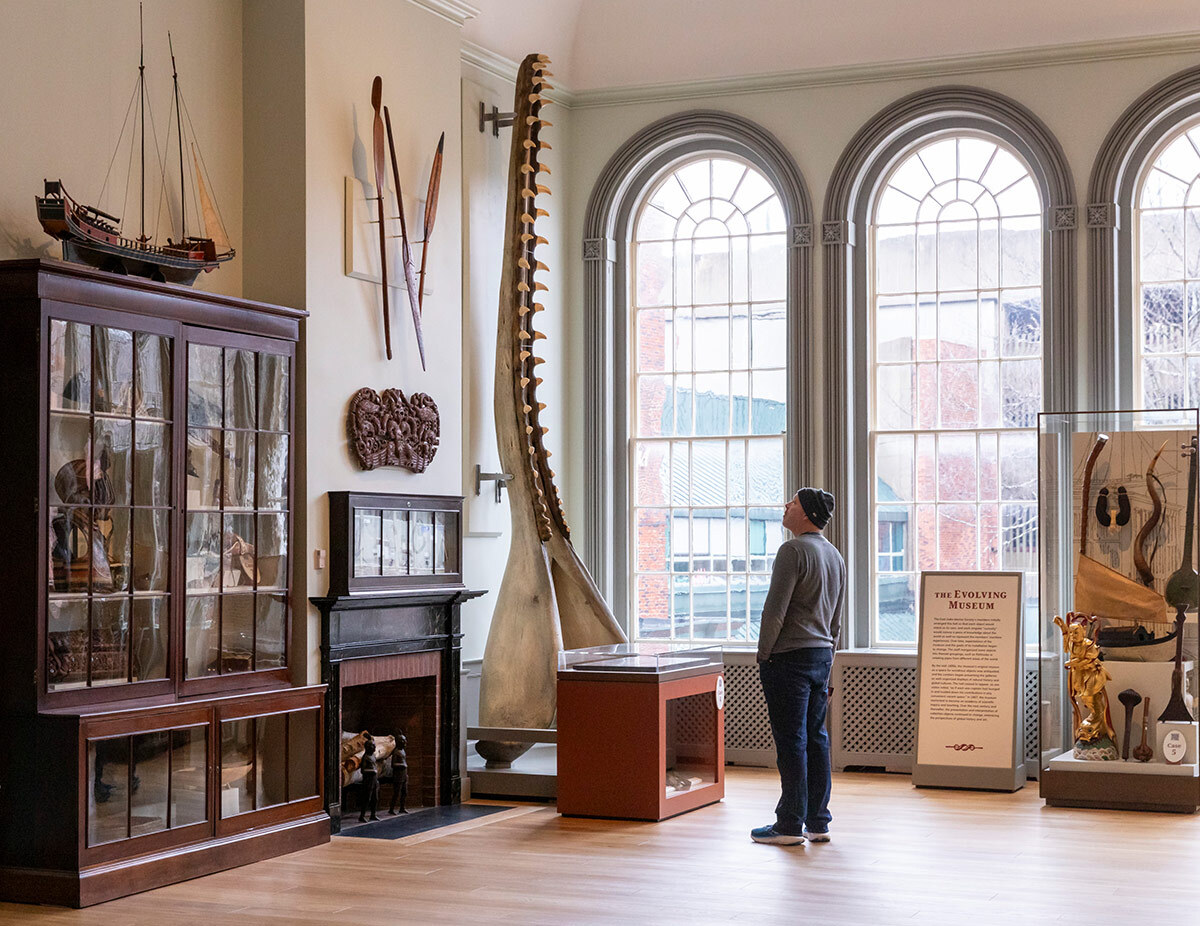
A guest examines the newly installed whale jaw in East India Marine Hall. Photo by Kathy Tarantola/PEM.
For this episode of the PEMcast, we take you into storage with Dan Finamore, PEM’s Deputy Chief Curator and Russell W. Knight Curator of Maritime Art and History. The room is filled with ship models, shoes, teacups and musical instruments from around the world, as well as the jaw of a giant sperm whale suspended from the ceiling. We look at this curator’s task of whittling down so many objects to just more than 400 to represent cultures around the world and reflect the curiosity, and complexity, of PEM’s earliest collectors.
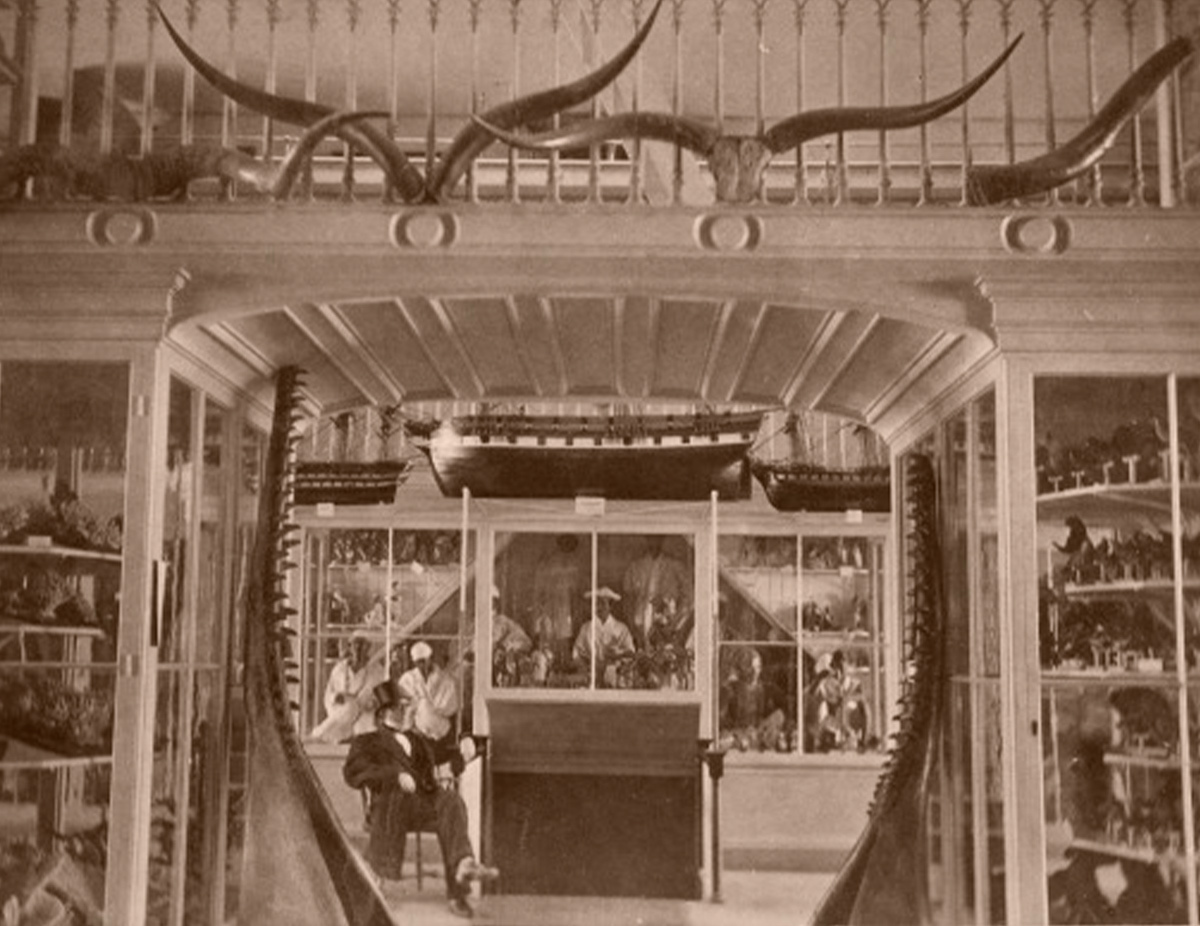
Captain Hammond in East India Marine Hall, about 1876 (referred to as Natural History Hall at the time). Peabody Essex Museum. 2008 Phillips Library Collection.
Finamore is absolutely bursting with stories about these objects. During the making of this episode, I had the feeling of being escorted around these storage shelves by “a wizened old salt,” as Finamore says would have been the experience of visitors in the early days of the museum. (Though he’s younger than that, and full of energy.)
Older locals will wander the hall, remembering what it looked like when they were children. But Finamore wants new fans to also take an interest in these objects, such as one of the first animal specimens collected by the museum: the first penguin to ever be exhibited in North America. The big idea of this new installation is to get people to see these objects in a contemporary light, but also imagine the reactions to them by local people in the 19th century and beyond who had most likely never traveled, who had never seen such things.
“When you may never have even traveled as far as Boston, much less Hawai’i, this is a taste of these places and this worldwide perspective that I think the Salem mariners were investing in for a very specific purpose: to make sure that Salem was a global city with a large-scale perspective,” said Finamore.
In the late 18th century, Salem was the sixth largest town in the freshly independent United States. The country’s federal revenue was greatly helped by the income streaming through Salem’s Custom House. The hulls of ships docking at the wharf were filled with spices and linens and 14-foot-long spears from Fiji and sea sponges from Southeast Asia. Mariners were interested in things that reminded them of home, like a kava bowl that reminded them of their own punch bowl made in Liverpool, England.
“I think one of the great insights to be gleaned is that the Society was fascinated with not only the different ways of living around the world, but also the commonalities of the human experience,” said Finamore. “No matter where you went, there’s the idea of having a communal punch bowl. It didn't take much for a Salem mariner to recognize the beauty of it, the utility of it, and how it expressed a certain value of the culture that it came from.”
Historically, someone would wander the gallery, see "Object Number 4509" and then flip in a printed book to read: "Kava bowl donated by Captain Eagleston in 1833.” Contemporary booklets will still be available in the hall, but so will a digital guide that offers perspectives through recorded interviews with scholars, collectors and curators. Visitors will be able to take a deep dive, learning from a range of experts and researchers about the journey of how the object came to be at PEM, and maybe even about the local family who might have donated it.
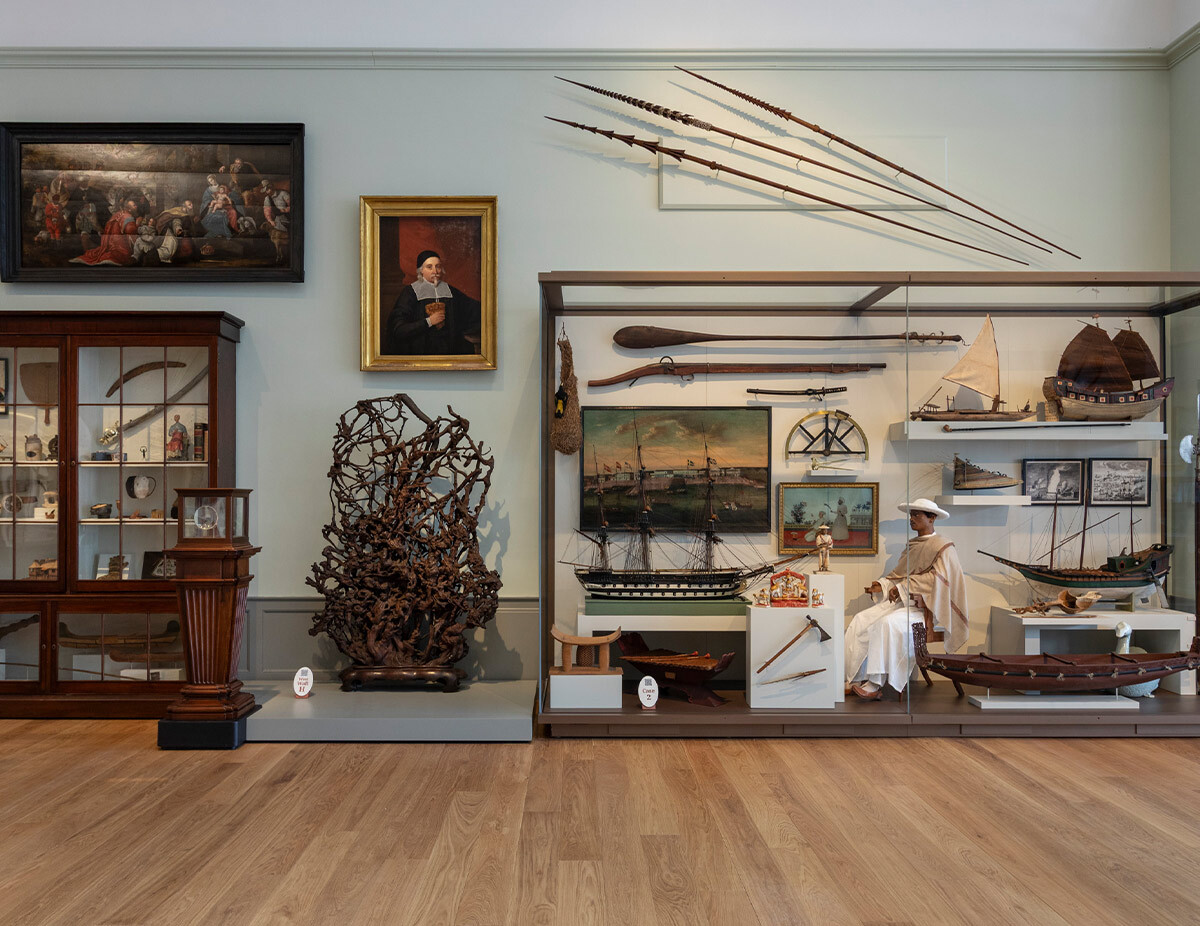
East India Marine Hall reinstalled with some of the museum’s earliest objects. Photo by Kathy Tarantola/PEM.
Finamore makes the point that the museum’s founders created a public collection, made for public access and public education — "the idea that we're not just going to acquire these things, we're going to display them so that the farmer from Danvers and the young student in the Salem schools in 1810 can come and look and learn about the outside world,” he said. “I am just like any member of the museum or any other person in Salem who's proud of the museum. I didn't grow up here. One day, I walked into the museum and it changed my life. I think anybody has the potential to have an experience like that, and we should make it as accessible as possible.”
The newly installed East India Marine Hall is now open to the public. This episode of the PEMcast was produced by Dinah Cardin, and edited and mixed by Marc Patenaude. Our theme song is by Forrest James. Until next time, thanks for listening to the PEMcast.
PEMcast Episode 42: Around the World in East India Marine Hall
TRANSCRIPT
Angela: We have seven people here to hold it. The entire piece weighs over 550 pounds. What we’re
going to do is kind of watch and make sure it’s not rolling forward and rolling back.
(knocking sound)
Dinah TAPE: Fossilized bone. And it’s how many teeth, do we know?
Angela: I don’t know how many teeth, but we can count them.
Dinah VO: What you’re hearing is preparation for the move of the lower jaw of a large sperm whale. This natural specimen has been part of our museum’s collection since the 19th century and has been in museum storage, suspended from the ceiling, for over 25 years. And this huge object is being relocated from storage to an installation of some of the museum’s first collected objects.
(Sound of group moving whale jaw) Ready? I’m in front. I’ll be here. Watch the teeth, gentlemen. Through the door. Going to the stairs, here. Keep going down. It’s so close. There we go. You got it. You got it. Whoo!
Dinah VO: Welcome to the PEMcast, conversations and stories for the culturally curious. From the Peabody Essex Museum in Salem, Massachusetts, I’m your host, Dinah Cardin. Today we’re going behind the scenes—into storage, into planning, and into the big question of how you bring the museum’s earliest collected objects to today’s audience.
Dan Finamore: There'll always be something new to investigate or explore among the great diversity of the human experience, which early Salem was so fascinated by, there are commonalities. We all may go fishing, but we do it in different ways.
Dinah VO: Fishing, among other human pursuits, is what we’re looking at in this episode of the PEMcast. That is, through some of the earliest objects to come into our collection. In this episode, we meet up with Dan Finamore, PEM’s Deputy Chief Curator and Russell W. Knight Curator of Maritime Art and History. Together, we explore objects that are returning to the museum’s first exhibition space, East India Marine Hall —objects that range from ship models to ceremonial vessels to natural history specimens.
Dan: To get people to look at some of these objects and say, "Hey. Wait a minute. Wow. People have loved this before. Somebody in 1850 in Salem walked in and saw this object. It's the same object."
DINAH (VO): East India Marine Hall is one of our most iconic spaces —an early 19th-century gallery built to share a global world with a local public. It’s the intellectual, historical and physical heart of the museum. People remember floor to ceiling cases and those whale skeletons suspended from the ceiling. It’s a storied place filled with history and tales of adventure. The founding members of the East India Marine Society would drink and dine in this space, celebrating the success of their voyages. President John Quincy Adams attended the opening festivities when East India Marine Hall opened here on Essex Street. Today, the Greek Revival building is listed on the National Register of Historic Places, prized for its locally sourced Chelmsford granite exterior, Palladian-style windows and gabled roof.
To mark the 200th anniversary of the Hall and the 400th anniversary of Salem’s founding, the museum recently opened a new installation featuring several hundred fascinating objects that reflect local and global history. This layered, story-rich installation allows us to explore our origin story from a fresh perspective. We come to better understand the curiosity, inquiry and inspiration that make up the foundation of our museum.
Dinah VO: If you’ve ever wondered what it’s like behind the scenes at the Peabody Essex Museum—the places visitors never see—this episode is for you. In this “random sampling” every object opens up a story: about voyages, trade, technology, wonder, and the question visitors still ask today—what did it mean for these objects to come to Salem?
Dan: The first gift to the museum was Jonathan Carnes, who was in Sumatra in 1797. That inspired the formation of the Society in 1799, or I should say the formation of a museum attached to the Society.
The idea that we should collect these objects that go along with our voyages and that represent our experiences, along with the imperative for navigation, improvement, and the consolidation of this kind of information so other members can have access to it, and also the funding of the protection, the benevolence for widows and orphans who have deceased members and so on.
Carnes gave an elephant tooth and a couple of other things, but part of this first gift was a pipe with two stems that came from Banda Aceh in the North Coast Of Sumatra, which is a fabulous, I think, representation of something related to friendship, community, mutual trade. One bowl, two stems, two people smoking it simultaneously.
Dinah VO: In its totality, the Hall transported visitors to places around the world, conveying aspects of the human experience that elicited empathy, curiosity and wonder.
Dan: It's going to utilize the early collections that were brought into the museum from 1799 to 1867 when it was still the East India Marine Society.
Dinah VO: The big idea of this new installation is to get people to see these objects in the light of today, but also imagine the reaction to them by the local public who had most likely not traveled, who had never seen such things.
Dan: When you may never have even traveled as far as Boston, much less Hawaii, this is a taste of these places and this worldwide perspective that I think the Salem mariners were investing in for very specific purposes, to make sure that Salem was a global city with a large scale perspective.
Dinah VO: Like in the early days of the museum, in this installation, there isn’t a direct narrative, says Dan.
Dan: I think it's important for people to undertake a bit of self exploration. It sort of defies modern museum curatorial practice, where first you learn this, and then we tell you this, and then you see that, and then you pick up a storyline. This storyline is going to be much more self directed because I am going to be attracted to the canoe paddles, where you are going to be attracted to the shoes, and you can create your own experience. You'll be able to go and visit it multiple times, and look at different things, and learn different things, explore different works on different visits.
Dinah VO: Rather than putting up hundreds of labels, for a deeper dive into some objects, you can scan a QR code. There you will find voices from the past and present offering an array of perspectives on select objects and their larger contexts. If you’d rather go low tech, information is also available in print.
Dan: As long as we're going largely digital to supply information, we may as well really go into the depth that we can and that we have. This is one of the most exciting aspects of the project because we have 200 years, and sometimes more, of commentary and information, background historical documentation of these objects. People's perceptions of them, the original use of them, why they were donated, what artists see in them today, historians visiting, curators, community members, journalists, and so on all commenting on some of these objects.
Thanks to the preservation mentality of old New Englanders who kept the library and the museum's archive in really good shape, but it's vast. Also, thanks to our colleague, George Schwartz, who's co-curator of the project, who systematically went through so many of the museum's archives and tagged information to specific objects, specific voyages, specific parts of the world. That's a lot of fun because we're looking at the same thing somebody looked at 180 years ago and commented on, or in some cases, we know the specific voyage that an object was brought back on.
Dinah VO: In the late 18th century, these voyages often ended up back in Salem, the sixth largest town in this then young nation. The country’s federal revenue was greatly helped by the income streaming through Salem’s Custom House.
Dan: We have 14 foot long spears from Fiji. Now, of course, there's a lot of length in a ship. I can just imagine them being stashed lengthwise in the ship. That's still remarkable that they could come back here unbroken, in good shape, that somebody invested enough to say, "This is worth bringing from the other side of the world to show people in Salem what life is like on this island."
Dinah TAPE: It's like a floating business or floating company.
Dan: It definitely is. In some ways, it's almost like a convenience store because you don't want all one commodity. If you show up and there's a drug on that market, then you need other things to trade with. Filling all the corners of the ship is really important. The amount of volume of space taken up all has an assigned value. If somebody brings home, for instance, Neptune's cups, very large sea sponges from Southeast Asia, they are three feet high, two feet across, and two feet deep. That's a measurable volume of space that could have been taken up by tea, or porcelain, or something that's saleable, you name it, but then somebody brings it home and donates it to the museum.
Some of the things that I think are fascinating are these kava bowls that were community bonding things. They would have festivals where people would sit around and drink kava out of huge communal bowls, and everyone would have a coconut cup, and they would scoop it out. They were functional items before they became souvenirs that a sailor brought home such as the very large one that Captain Eagleston gave to the museum in 1833.
Dinah TAPE: Oh, wow. That's much bigger than bringing home the beer mug or the wine taster.
Dan: [laughs] Yes, you can see the patina inside of it. It's a beautiful piece of wood. Imagine the size of the tree that this comes from.
Dinah TAPE: Is this a punch bowl?
Dan: Yes. It's exactly that. We have punch bowls that the Society used that were made in Liverpool and commissioned. There's that level of correlation between the activities that they're observing on the other side of the world and what they understand.
Dinah VO: To celebrate their successful voyages, ships captains and other revelers in East India Marine Hall enjoyed drinking a good strong punch while making toasts like “Success to the Society, whose enterprise and liberality are so strikingly exemplified in this Hall.”
Dan: I think one of the great insights to be gleaned that the Society was so fascinated with was not only the different ways of living around the world, but the commonalities of human experience. No matter where you went, the idea of having a communal punch bowl. It didn't take much for a Salem mariner to recognize the beauty of it, the utility of it, and how it expressed a certain value of the culture that it came from in Fiji. Just look at the inside of this with polish on it…4509, which is the original East India Marine Society number. You would walk through the gallery with the original printed book, and you would look up, "What is this object?" You see 4509, you flip the page, and then it would read, "Kava bowl donated by Captain Eagleston in 1833," and where it was from, of course.
But in our new approach, we're going to be able to provide a lot more information. Maybe we have a woman from Fiji, from the university there, who can talk about the cultural significance of kava and this ceremonial drinking of kava in Fijian culture then and now. There's so many different angles that we can bring into the story. We have somebody who knows a lot about the voyage of Captain Eagleston, and he was a very significant sailor mariner as well. Whatever your perspective, we'll do our best to insert relevant information. There are any number of perspectives that will appeal to people.
SOUND OF NOSE FLUTE
Dinah VO: This is Isaac Te Awa, (EYE-zak teh AH-wah) a Curator at Te Papa (teh-pah-pah) in New Zealand. He was interviewed by our curators about Māori culture, including about the cultural practice of playing the nose flute. These instruments, sometimes made of whale teeth, can be played as music or simply to express emotion, says Isaac. They tell stories, say prayers and connect to deities.
Isaac: Part of the narrative is that they were sometimes played by fathers to pregnant wives or women with babies in utero. If you think about whales swimming through the ocean and making whalesong and singing to these newborn whale calves, the memory of that is carried in the tooth, which is then played and it's that intention that's carried through the purpose.
NOSE FLUTE AGAIN
Isaac: A friend of mine who was at a funeral and he's quite a stoic guy. And he just sort of went out the back and started playing his nguru. And you could just hear his total expression of grief played through it that it set everybody inside into tears. So it can be an instrument that's played with quite high emotion. And they're usually quite precious to the people who hold and carry them too.
Dinah VO: These voices and perspectives of cultural experts from around the globe will add invaluable depth to the understanding of our objects.
Dan: The inherent appeal of the object is actually something, I think, is largely intangible. We all try to quantify or to spell out the reasons why we love something, but a museum person knows, even without the label, somebody's going to walk into a gallery and be drawn to specific objects for indefinable reasons. "Why do you love that object?" "I don't know. I just do." Then they try to put words to it, and sometimes it's effective, but often it's not. I just love it.
Let's look over to this table that happens at the moment to have things we've just been reviewing for mounts and conservation. I think it's fair to say that the East India Marine Society members were fascinated with variance on ways of living that they understood. They focused on things that also took place here in Salem. How did they design their boats? They collected a lot of ship models. A lot of the things they were interested in were ship models built in other parts of the world for other waters and other kinds of activities. The variance of rig designs and hull designs, they were fascinated with them. We will put out a good selection of models from around the world, all of which were pretty much built and donated to the museum before in the early 19th century.
So, there's a Chinese vessel here. This is probably a trading junk. It has little figures on it. There's a lot of writing on it, which we are translating now to find out what it actually says on the model. Beautifully decorated stern with nice painting on it. Very traditionally Chinese in its decoration. The sails themselves are all very tightly woven palm or some kind of large leaf fronds that have been prepared and then woven, just like a Chinese junk would have been in the 19th century. You can see the technology of hauling and dropping the anchor. There are capstans, there are elements of the ship that are just like they would be on a Western ship, and then there are things that are vastly different. The rudder actually has holes in it, which was completely alien to Western ideas of how to steer a ship.
Dinah TAPE: It's beautiful. It's decorative looking.
Dan: It is. And so, what is the hydrographic or hydrological purpose of having holes in your rudder? It just doesn't make sense, but apparently, it works, or at least it works in the Chinese junk because this model shows something that's very standard for the vessels of the period.
Dinah TAPE: Sometimes these things will just be grouped together because they're aesthetically interesting together, but why aren't we using the word wunderkammer? [laughs]
Dan: Because they did not do that in early 19th century Salem. They did not call it a cabinet of curiosities, they called it a cabinet. And the objects were curiosities. But the notion of a wunderkammer or a cabinet of curiosities is like a Renaissance mentality. And a lot of those things were private. They were private collections or royal collections, whereas what the East India Marine Society developed was a public collection made for public access and public education. It is sort of the origins of American museology, which is in that way, visually similar to a wunderkammer, but by intention, very, very different, and actually, I would say, far more noble. If I were a European king in the 16th century, sure, I'd have a wunderkammer. [laughs] It would be spectacular. But the idea that we're not just going to acquire these things, we're going to display them so that the farmer from Danvers and the young student in the Salem schools in 1810 can come and look at these things and learn about the outside world.
Dave Seibert: I've lived in Salem. I've been a resident here since 1986. So I know too much of the history in some ways. So it's really nice to sort of put it all together. I started in the 1980s designing exhibits for museums. I had a company that was around for 25 years before I joined PEM.
Dinah VO: This is Dave Seibert, the lead designer for this installation. With Dave, we find out a bit about what it takes to re-fill a historic room—while still meeting modern conservation standards. Dave has worked at PEM for a long time. To decide where to place hundreds of the museum’s first objects, is a career defining challenge.
Dave: So, we used to do this all by hand at one point. Objects have a story to tell and sometimes just having an object by itself with no graphics or anything else is the most evocative thing you can have, because anybody can fill a wall with stuff. We're trying to tell stories and we're trying to allow the visitor to focus on those stories.
What you're standing on now was floor that was put in, we believe, in 1942. And it was a period where, as someone has joked, sort of looks like a basketball court. These are very narrow, tongue and groove slats. And when it was installed, it was post-World War II, or it was in the middle of World War II. And so obviously, lumber was used for certain things, and it wasn't for gallery flooring. It's met its lifespan.
Dinah VO: And so visitors will circumnative the globe by walking on a brand new floor.
Dinah TAPE: How much have those historic photographs informed your idea of where things are going to go in the gallery?
Dave: There are four etchings that show each of the walls, the north, south, east, and west walls, with how they were installed in the early 19th century. And it's in someplace between 1800 and 1833. And they're really great etchings. You've seen them before in publications. And they show a lot of the objects that, in fact, we are going to be displaying in this installation, so it’s kind of nice to do a one to one. We're not doing a verbatim reinstallation of what was here. It’s a little impossible. This space, over the years, has taken on certain social uses. So we are still going to be able to have weddings in here. You'll see that most of the exhibits we're doing interpretively are on the southern hemisphere of the space. And you'll also notice that I like to use maritime terms whenever I can.
The idea is that the objects all have stories. So, you're not gonna get a case that has all objects from one location. There's sort of a mix and match. Because that's sort of what they did in the 19th century. It was a cabinet of curiosities.
Dinah: TAPE So, you wanna look in a case and see things from around the world in that one case?
Dave: Yes, and so, instead of having 10 bowls in one case, you might have one bowl and you have a grass skirt. And then, you may have a pipe and you may have a spear and you may have a very old painting. So you almost have to navigate your way through this hall, which seems to be a good metaphor.
Dinah VO: Museum visitors throughout the years would fixate on the old wooden cases with their wavy glass.
Dave: When you walk in the gallery, we want it to have a fullness to it. Because obviously, if you go back to the 19th century, it had casework along the long walls. It had freestanding units, which were like islands. The conservators and the preparators will be able to go in, open up a case, slide it out, and literally very gently turn everything so they can access all four sides of the case. It’s gonna be beautiful. And the glass is all anti-reflective so you don't get anything blocking your view. You know, the minute you start putting too many things with objects, which is what a lot of history and visitor centers do, the objects become illustrative. We're trying not to use objects in that fashion. We're trying to make them the main act, which is great.
Dan: It's a humanizing element to realize that we all actually have very similar concerns based on survival, based on comfort, based on family and community.
Dinah VO: Dan Finamore again.
Dan: A lot of the objects that appear totally alien at first brush quickly become familiar. That actually, in my view, only enhances their interest. So, instead of just looking at an object, you see the person behind it. Who made it, who used it, who understood it in ways that now I can begin to understand. The entire room becomes a connection to a generalized sense of humanity. It's civic pride in its way, and it's well warranted. I am just like any member of the museum or any other person in Salem who's proud of the museum. I didn't grow up here. One day, I walked into the museum and it changed my life. It didn’t have to happen.
Dan: I think anybody has the potential to have an experience like that, and we should make it as accessible as possible.
Dinah VO: East India Marine Hall is open for all who would like to feel like a 19th-century museumgoer, ready to circumnavigate the globe. Thanks to PEM’s Angela Segalla and her team, Dan Finamore and Dave Seibert for their time and expertise. This episode of the PEMcast was produced by me, Dinah Cardin, and edited and mixed by Marc Patenaude. Our theme music is by Forrest James. Enjoying the PEMcast? Share it with a friend. Or write to us at pemcast@pem.org. Find more episodes at pem.org and anywhere you listen to podcasts. Thanks for listening.
PEMcast
PEMcast Episode 038: Oh, wünderkammer, my wünderkammer
14 Min Listen

Blog
Celebrating Rev 250 with PEM objects
8 Min read

Salem 400+
PEMcast
PEMcast 17: Life at Sea
11 min listen
