PEMCAST | Feb 10, 2026
PEMcast 41: The storied life of Edmonia Lewis
In the latest episode of the PEMcast, the podcast here at PEM, we tell a story that is both local and global. It’s certainly historic, but has a very contemporary feel. You may have heard of Edmonia Lewis, but you probably don’t know the many twists and turns that make up her storied life.
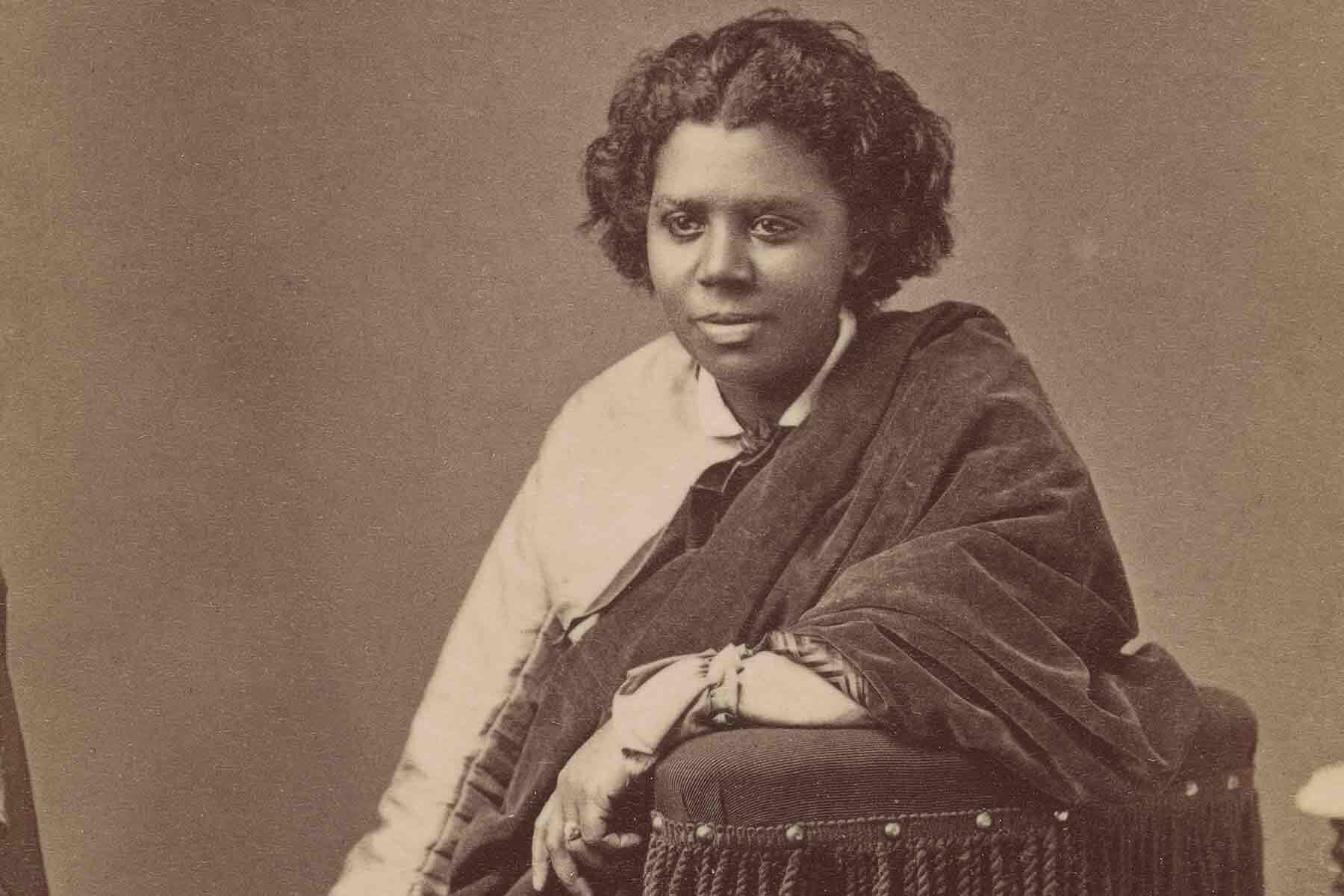
Henry Rocher, Edmonia Lewis, about 1870. Albumen silver print on card. Transfer from Special Collections, Fine Arts Library, Harvard College Library, Bequest of Evert Jansen Wendell. 2010.67. Harvard Art Museums Fogg Museum. Photo © President and Fellows of Harvard College.
Edmonia Lewis, the 19th-century sculptor of Black and Indigenous (Mississauga) descent, rose to success while the Civil War was still playing out. She moved to Boston in 1863 and made friends among the city’s abolitionists, intellectuals and artists. But Rome was the international destination for sculptors in the 19th century. “Not only because of its history and the deep classical traditions of Italy,” said Jeffrey Richmond-Moll, PEM’s George Putnam Curator of American Art, “but also because that was where the marble was, that was where the artisans were, that was where the creative community was.” Lewis gained a large following of patrons who supported her move to Italy just two years later, then quickly garnered international fame with her increasingly ambitious artworks.
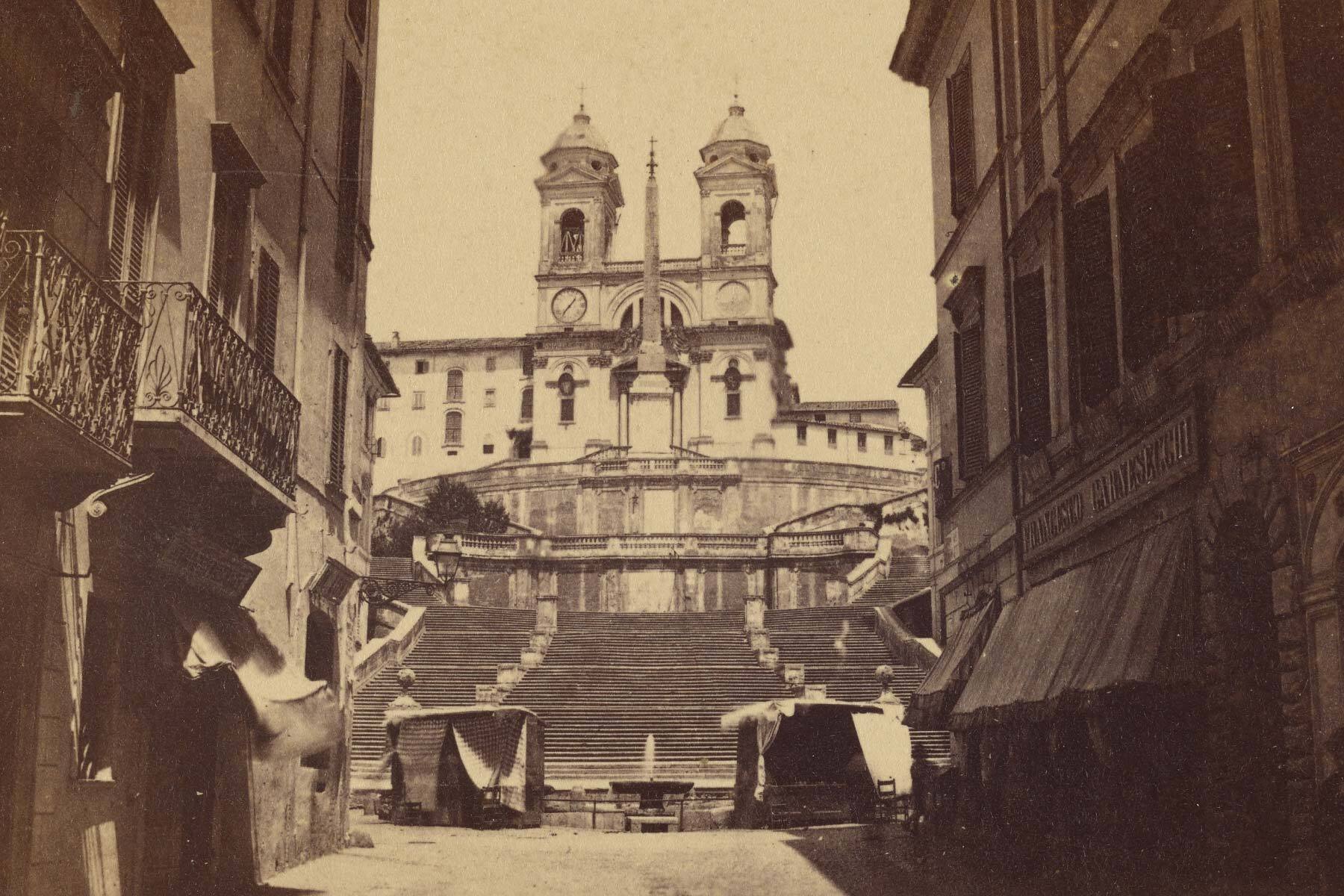
Sommer and Behles, Scala della Piazza di Spagna (Roma), 1865–1870. Albumen silver print. Courtesy of the Getty Museum. Edmonia Lewis’ studio was in a space just off the Piazza di Spagna, in a neighborhood where many American artists, including leading women sculptors, had their studios.
As PEM debuts the first major retrospective exhibition of this captivating artist, Edmonia Lewis: Said in Stone, we asked three of our curators to speak about her life and work, as well as a curator from our co-organizing exhibition partner, the Georgia Museum of Art.
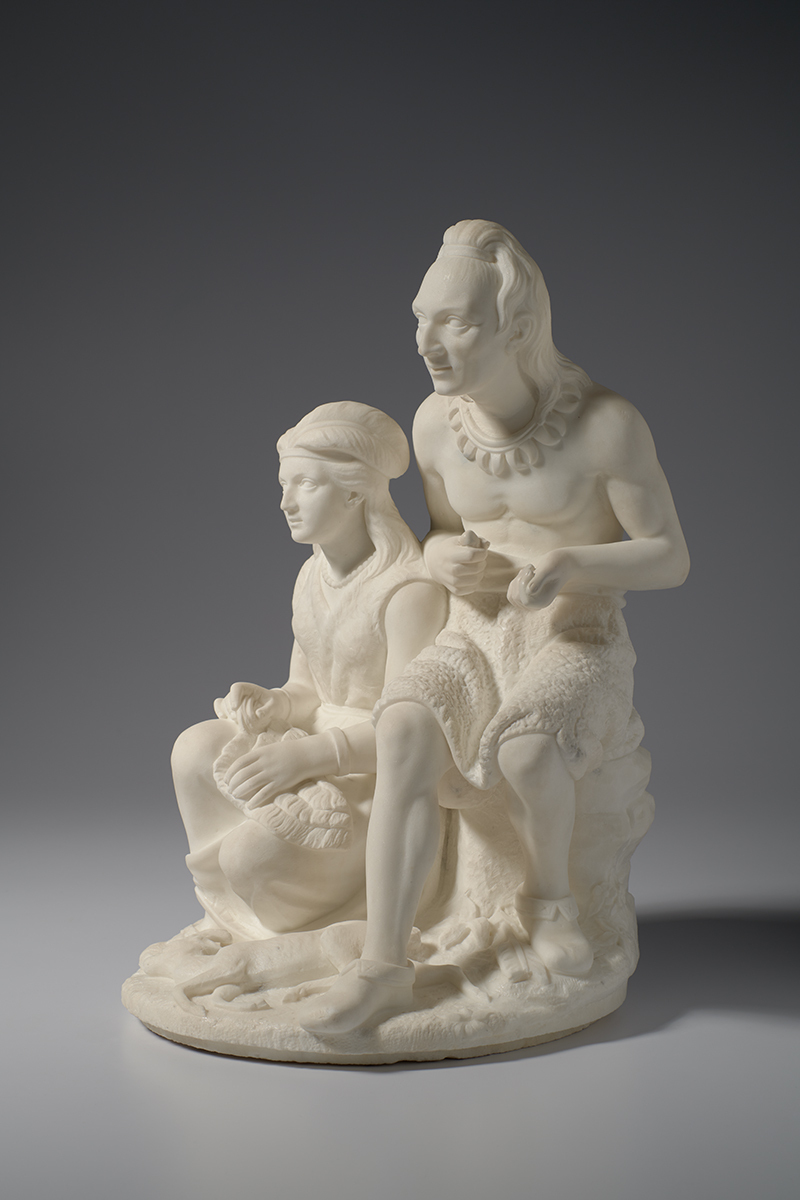
Edmonia Lewis, The Old Indian Arrow Maker and His Daughter, modeled 1866, carved 1867, Marble. Gift of Marilyn Jacobs Preyer, 2022.6. North Carolina Museum of Art, Raleigh.
We will look at how, after her death in 1907, Lewis seemed to fade from history. One of her iconic sculptures, The Death of Cleopatra, was created in Italy with the help of 20 assistants and brought to the United States to exhibit at the Centennial Exposition in Philadelphia in 1876, only to disappear and then reappear again in a grand, twisting story much like the story of Lewis herself. The exhibition at PEM features the largest number of Lewis’ works ever to be exhibited together, along with dozens of other works that illuminate her inspirations and influences. Some are from PEM’s Native American collection, such as beaded bags and carved wooden spoons — things Lewis would have been familiar with growing up, according to Karen Kramer, PEM’s Stuart W. and Elizabeth F. Pratt Curator of Native American and Oceanic Art and Culture.
“One of the things that makes Edmonia Lewis' work so interesting to me is how she was expressing her indigeneity, even with white marble from Rome,” said Kramer, adding that carving traditions go back millennia for Lewis’ Anishinaabe peoples (which includes the Mississauga).
We discuss what a group of scholars and artists discovered when they convened at PEM prior to the exhibition, to learn more about Lewis' Indigenous background. And we talk about the artist’s level of comfort traveling back and forth across the Atlantic in her artistic pursuits. “I do think that being someone who's a person of color of both African and Indigenous descent, that she was quite familiar with what it means to be fluid in this identity as well as being fluid in this world,” said Kramer.
PEM Curator-at-Large Lydia Peabody shares the story of a contemporary artist who has followed in Lewis’ footsteps, both in Rome and right in her own London neighborhood. We also learn about ongoing research into Lewis' lasting legacy from Shawnya L. Harris, Larry D. and Brenda A. Thompson Curator of African American and African Diasporic Art at the Georgia Museum of Art, where the exhibition will travel to in August. In the meantime, visitors are encouraged to come to PEM, starting February 14, to be part of this project of remembering, said Richmond-Moll.
“Her art and the causes that she believed in were inextricable,” he said. “Whether it was the rights of Black people in the 19th century or the rights of Indigenous peoples or the power of religion to uplift the marginalized, this is a much bigger story about overcoming.”
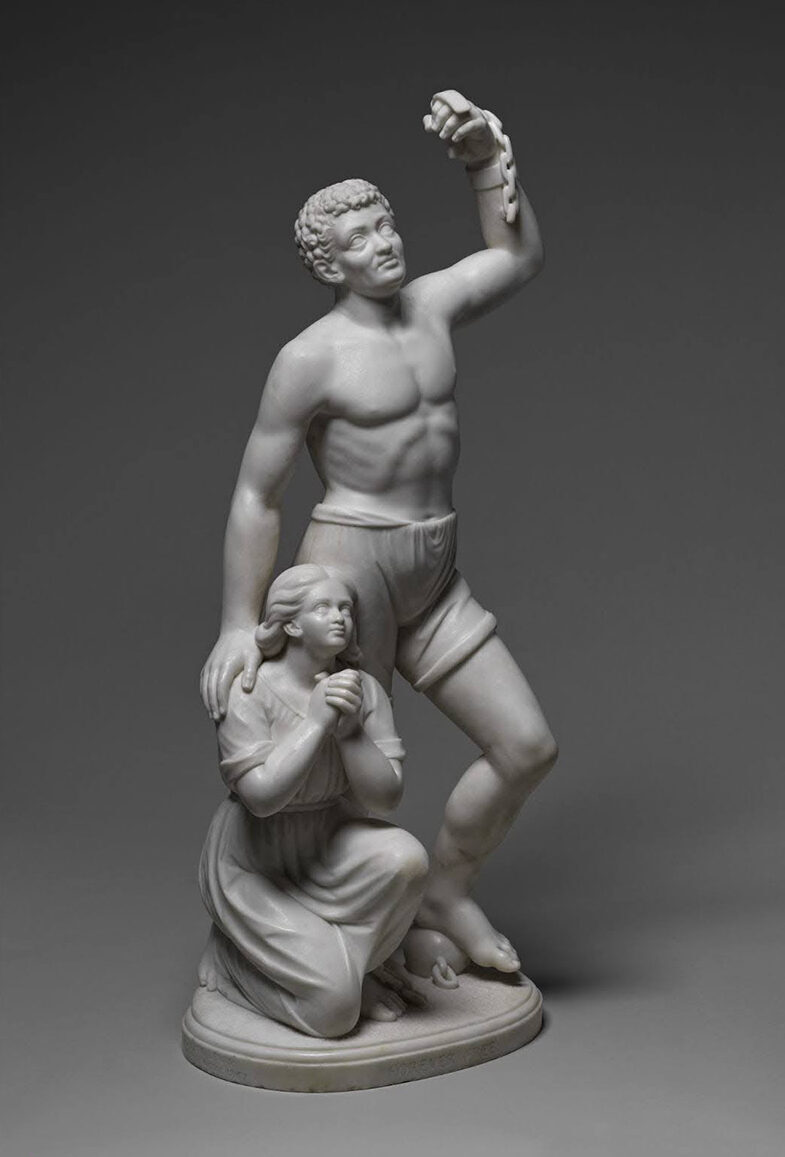
Edmonia Lewis, Forever Free, 1867. Carrara marble. Howard University Gallery of Art, Washington DC / Licensed by Art Resource, NY. Photo: The Metropolitan Museum of Art.
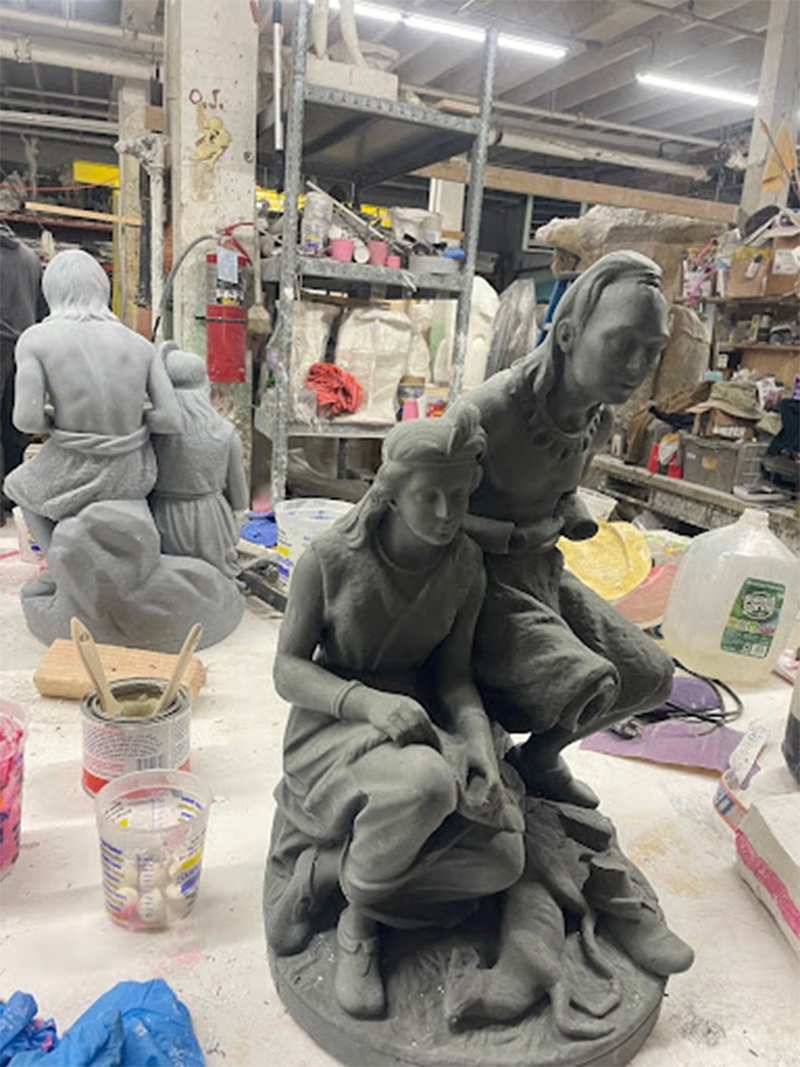
A reproduction of Edmonia Lewis’ The Old Arrow Maker is being created at Skylight Studios in Woburn for inclusion in PEM’s presentation of Edmonia Lewis: Said in Stone. Photo by Dinah Cardin/PEM.
Listen to more episodes of the PEMcast at pem.org and wherever you listen to podcasts. This episode was produced by Dinah Cardin and edited and mixed by Marc Patenaude with theme music by Forest James. Thanks to PEM curators Jeff Richmond-Moll, Lydia Peabody, and Karen Kramer for sharing their time and insight, as well as Shawnya L. Harris of the Georgia Museum of Art.
Edmonia Lewis: Said in Stone opens at the Peabody Essex Museum on February 14 and runs through June 7, 2026. Then the exhibition travels to the Georgia Museum of Art from August 8, 2026 through January 3, 2027, and on to the North Carolina Museum of Art from April 3 through July 11, 2027. For more information, go to pem.org/edmonialewis.
PEMcast 41: The Storied Life of Edmonia Lewis
TRANSCRIPT
Dinah VO: A Black, indigenous woman, five years into the American Civil War, sailing across the Atlantic to work as a sculptor. Sounds like a movie. But that’s true about so much of Edmonia Lewis’s life. She found success among those in the anti-slavery movement, creating portrait medallions of the leaders they admired, like John Brown and Abraham Lincoln. At Oberlin College, she was met with racism and physical violence. Frederick Douglass told her to “seek the East” and when she moved to Boston, she met abolitionists, activists and intellectuals who funded her travels to Europe, and sent letters ahead to wealthy ex-pats who ensured her a warm welcome and helped set her up for the life of a successful artist. Soon after her arrival, she’s met by the American ambassador and, on Christmas Day, dines with sisters from Salem and other artists from the international community.
Dinah VO: Despite wide international acclaim in her day, Edmonia Lewis is not a household name today; but, I can attest, once you know her, you won’t forget her. Her sculptures reveal a powerful story of overcoming, of resilience, and of art that’s inextricable from the causes she believed in.
Welcome to the PEMcast, conversations and stories for the culturally curious. From the Peabody Essex Museum in Salem, Massachusetts, I’m your host, Dinah Cardin.
Dinah VO: We’re diving into PEM’s latest exhibition, Edmonia Lewis: Said in Stone. This is an episode about the first museum retrospective of Edmonia Lewis debuting here at PEM. It’s about sculpture and marble, yes — but it’s also about memory, erasure, pop culture, psychic connections in a London cemetery, and how one artist’s story refuses to disappear.
Dinah VO: We’ll hear from PEM curators working on this project and from our exhibition partner, the Georgia Museum of Art, as we explore Lewis’s extraordinary life, the rediscovery of her work, and what it means to honor her Black and Indigenous legacies today.
Dinah VO: So, let’s meet Edmonia. I asked Jeffrey Richmond-Moll, the George Putnam Curator of American Art here at PEM, and our coordinating curator for this exhibition, this question. Which may be the hardest of all. Briefly, who is Edmonia Lewis?
Jeffey Richmond-Moll: Edmonia Lewis was the first African American and Native American sculptor to achieve international acclaim in the 19th century.
Dinah (VO): It’s such a concise description of an artist whose story is anything but simple.
Jeff: Lewis's story is a story of surmounting obstacles from very early in her life. She's orphaned at a young age and raised by her maternal family. She's cared for by a brother who lives on the other side of the American continent for most of her childhood and then continues to support her through her professional lifetime.
Dinah (VO): Lewis’s story is one of brilliance and resilience — but also of absence. She was famous in her own time, then nearly disappeared from the historical record. When you walk into Said in Stone, you’re meeting someone who, in her own lifetime, was internationally famous. And yet, for many of us today, this may be the first time we’ve ever heard her name. So I asked Jeff: how has her contribution to American sculpture been overlooked?
Jeff: Edmonia Lewis was extremely well known in her day. She became a sculptor after arriving in Boston in 1863, gained a very large following of patrons, and they helped support her move to Italy in 1865. She was well known on an international stage during her lifetime, but after her death in 1907, her name fell out of the popular awareness.
Jeff: Over the last century, there have been sculptures that have gone missing. A lot of the archival records of her life are no longer surviving. That has posed a real challenge for us to remain aware of her memory and her place within the history of American art.
A lot of it also has to do with the fact that many artists of color in the 19th century have been forgotten over the years as certain histories have been written of American art, American painting, American sculpture.
We are really working against a kind of forgetfulness in the discipline more broadly, trying to recover these important stories of artists like Lewis and their role in the larger American story.
After Edmonia Lewis dies in 1907, the prevailing narrative that has been embraced is that she vanished to history. She vanished into obscurity. I think one of the things that's important in telling the story of Lewis' career is that there have been many individuals who have been working to preserve her story and keep the flame of Lewis' art and life alive.
From the early 1900s to the present, community organizations that kept her name in the public awareness, particularly in the Black community in the United States. Scholars and curators who have worked to recover missing sculptures, missing documentation, and bring Lewis' sculptures into public collections so that larger audiences can experience Lewis' work firsthand.
Lewis' story in some ways is a story of recovery and trying to recover and piece together these missing bits of information and objects. It's also a story of many people laboring over decades and even a century to keep that story alive.
Dinah (VO): This forgetfulness isn’t just metaphorical. Sometimes it’s etched into the marble itself. Jeff told us a doozy of a lost and found story.
Jeff: In 1876, Edmonia Lewis debuted The Death of Cleopatra at the Centennial Exposition in Philadelphia. This was an exhibition celebrating the 100th anniversary of American independence.
The sculpture makes its way from Lewis' studio in Italy after 20-some assistants had been working with her to bring it to fruition. It's displayed in Memorial Hall in Philadelphia at the center of the exposition's fairgrounds.
Unfortunately, it does not find a buyer at the exhibition. Lewis sends it on to Chicago in 1878 for another one of these world's fairs. This is a period in the United States when you have these successive fairs celebrating American industry and culture. The Death of Cleopatra appears at this industrial exposition in Chicago in 1878. Again, no buyer. Lewis leaves it behind in Chicago.
She has to go back to Europe, and she has no other choice but to leave it behind with someone to shepherd it. It ends up being displayed to benefit an orphanage in the city of Chicago that's run by a Catholic organization. Eventually, and we're not quite sure how, it ends up in a Chicago saloon.
Dinah VO: A classical white marble sculpture of dead Cleaopatra…held up in a saloon!?
Jeff: Yes. [Laughs] A racetrack owner who happens to own a horse named Cleopatra, his beloved racehorse, decides to buy the sculpture to mark Cleopatra's grave on the racetrack he owns outside the city and it sits there.
Dinah VO: It’s happened upon by a Boy Scout troop who paint over it to protect it. The paint, in some ways, saves the sculpture, says Jeff, and in others creates a nightmare for future conservators. Then, the Historical Society of Forest Park in Illinois gets involved and moves it to the storeroom of a shopping mall.
Jeff: It's there that the scholar Marilyn Richardson comes to see it. She talks about how it was surrounded by all these Christmas decorations that were being stored off season. It was this really surreal experience to walk in, see this monumental sculpture, Lewis' greatest creation surrounded by Christmas decorations.
And there on the back of the sculpture was inscribed the name Edmonia Lewis. It comes to be part of the Smithsonian's collection and a true national treasure. That sculpture continues to live in the Smithsonian's collections today.
Dinah VO: And this rollercoaster of a story mirrors, in some ways, the way Edmonia’s own story has been remembered, forgotten and remembered again.
Jeff: I think the stories of these sculptures that disappear and reappear, that are lost and found, I think are kind of a picture of Lewis' larger story as an artist who was always insisting on her legitimacy as an artist, on her visibility as a sculptor on the world stage, and having to continuously assert her authority, her voice, her creativity.
MUSICAL INTERLUDE
Dinah (VO): To understand Lewis fully, the exhibition doesn’t stop at her fame in Rome or the drama of her lost sculptures. It also looks closely at her complex identity as a woman of African and Indigenous descent — and what it means for her home communities to claim her.
Karen Kramer: My name is Karen Kramer. I am the Stuart W. and Elizabeth F. Pratt Curator of Native American and Oceanic Art and Culture. I'm also the Director of our Native American Fellowship Program here at the Peabody Essex Museum. I have been honored to be a part of this Edmonia Lewis project, and I have served as an advisor and a contributing author to the publication, with an eye toward Edmonia Lewis's indigeneity.
Karen: So we're looking at a sculpture called Old Arrow Maker that was done in 1866 in marble. And there is an indigenous man who's sitting, he's wearing a necklace in the process of making an arrow.
And a woman is kind of kneeling by his side. There's an animal at their feet. It seems like a very warm and cozy domestic moment. His musculature is very pronounced. His bear claw necklace is in relief, it's highly detailed. And the texture of their clothing is remarkably detailed.
We see some really interesting treatments of native people, very sensitive renderings. And so I think that's what, one of the things that makes Edmonia Lewis's work so interesting to me is how she was expressing her indigeneity, even with white marble from Rome.
Dinah VO: In addition to marble sculptures, the exhibition includes objects from PEM’s world-renowned Native American collection.
Karen: So you will see some beaded bags that would have been sold at Niagara Falls, a kind of community of crossroads where Edmonia Lewis would have attended with her aunts who were selling works. You will see some very beautiful carved wooden feast bowl and a carved wooden spoon used in a feast. Very elegant and sophisticated carving. There will be some dolls who are dressed in their finery from the 1850s to 80s or so.
This is what Edmonia would have known and been familiar with because carving traditions go back millennia for her Anishinaabe peoples. It is not a new thing to carve into stone at all. So that's one thing that made it so exciting to think about how figures and figurative works that we see from the 19th century in Anishinaabe art were readily transferred into marble by Edmonia because it's something she would have been used to seeing.
Dinah VO: Let’s go back a bit. Karen shares that the museum has been working to
Karen: Lift up Edmonia Lewis's Indigenous background and put it on an equal playing field with her background as a Black artist of African descent. And this hasn't been done before, ever, on a scale this large. Perhaps it's as simple as the right questions weren't being asked about her indigenous background.
The few times that Edmonia Lewis's artwork had been included in recent years in exhibitions, there was very little research that had been done to establish her indigeneity in a way that could very tightly tie her to her home community and tie her home community to Edmonia Lewis at the same time.
Dinah TAPE: And so when we were talking a minute ago and you said, you know, you and Jeff were talking and you said to him what?
Karen: Well, I said, “Well, how do we know that she is Anishinaabe? And would the community claim her?” Because we see in the field right now, especially, but over the past couple of decades, there are a lot of people who claim Indigenous ancestry and their communities do not claim them. And so we really wanted to close this gap and make sure that if we are saying Edmonia Lewis is Indigenous, that we could back that up and connect with her home community.
Dinah VO: In doing some research, they turned to a 1993 biography.
Karen: So almost all of the scholarship that has been done since Bearden and Henderson's book relies on these footnotes, which is kind of—was a little shocking to me.
Dinah TAPE: It sounds like a metaphor. It's a footnote, right?
Karen: Absolutely. Very good point. And we really wanted to go deeper and lift this story up and do deeper research.
Dinah VO: So, our curators connected with the community at Credit River First Nation and their tribal historian. They also convened a group of people at PEM to bring their knowledge together – scholars and artists, deep thinkers who know their Edmonia Lewis history.
Karen: And what came to light is a much more complicated story where Edmonia Lewis's likely family has Tuscarora heritage, has Six Nations at Grand River connections and is Credit River First Nation.
Dinah TAPE: Can you just set the geographical—where are we? Where are these people and where do we think she grew up?
Karen: So the actual name of Edmonia Lewis's Indigenous community is now called the Mississaugas of the Credit First Nation and they are located on the northeastern shore of Lake Huron. And there's a lot of waterways and rivers and tributaries.
Dinah TAPE: That’s a long way from Rome.
Karen: It's a long way from Rome. It is. The story is just a really rich… it's really, I don't want to say it's an unlikely story, but it is a pretty interesting, mind-blowing story of her life.
Dinah TAPE: As we were talking about the geography, it seemed to me in the essay that back then it was a squishy line between the US and Canada. She traveled by ship to Europe and back something like a dozen times in 10 years. I mean, this is a woman who, with great adversity and so much that could have gone wrong and so much that had been difficult in her life, seemed to just think of borders as something she could just cross very easily. Do you think that had anything to do with where she grew up or any part of her background?
Karen: I think you did hit on a very important part of her upbringing because when she was growing up in what is now Canada and the United States, there is a region in between that is Mohawk territory and she had relatives in Mohawk territory. She traveled through, there was a fluidity. And so some of this was invisible borders. I think many Indigenous people do think of this so-called medicine line that is between the United States and Canada as being permeable and fluid. And it's a political border for some, but not for them because these lines have always been crossed. And so I do think that being someone who's a person of color of both African and Indigenous descent, that already she's quite familiar with what it means to be fluid in this identity as well as being fluid in this world.
Dinah VO: In her essay in the exhibition catalog, Karen references philosopher writer, Kwame Anthony Appiah, who is a scholar who has done a lot of deep thinking about what it means to be a cosmopolitan.
Karen: The line is, “A cosmopolitan is one who retains rootedness to place across distances while being a citizen of the world. A cosmopolitan, in other words, belongs not to a city and not to the earth, but to the universe and the cosmos.” So that really struck me as an important way of thinking about Edmonia Lewis. When we had a convening with many Native American scholars and artists, it became very clear that her cosmopolitanism was so evident because she was going to Rome, living in London, very self-possessed, and someone who had faced a lot of adversity, as you said. I think what I was trying to lean into when I think about Edmonia Lewis as “a cosmopolitan” is someone who can retain their identity and their worldview. It continues to shape them no matter where they are. And because she was such a sophisticated city dweller, but also quite obviously firmly attached to her roots.
Karen: I would say that there is still a lot more work that can be done on Edmonia Lewis and her Indigenous background. And, you know, while we will be looking to stay connected to her Mississauga community and invite the people that we worked with to our openings and programs, I think there's a lot more deep work that can be done. And I'd like to think that this is just a beginning. We've opened the door and hopefully it's open wide enough for lots of people to come through.
Dinah (VO): PEM’s curators aren’t the only ones thinking about Edmonia Lewis. Scholars all around the country have been trying to open the door.
Shawnya L. Harris: I would say we're marking the 10 year anniversary, at least at the institution I'm at right now with the idea of a project around Lewis that could actually take flight.
Dinah (VO): I spoke with Dr. Shawnya L. Harris, the Larry D. and Brenda A. Thompson Curator of African American and African Diasporic Art at the Georgia Museum of Art, our co-organizing partner for Edmonia Lewis: Said in Stone.
Shawnya: I think for many of us who've studied Lewis's work and studied her as a personality historically, she becomes this kind of wonderful chameleon, she becomes something for everyone, you know, whether it's in the study of early African American artists or Black artists, whether it's the study of women artists, whether it is talking about artists that expatriated and practiced in Rome, the rare instances of the achievement of being a sculptor at such an early period and being able to get access to resources and patrons in a period where quite frankly she was producing some of her earliest sculpture while people that look like her were still enslaved and soon after right around the time of emancipation.
Dinah (VO) In Georgia, a conservation project is taking place of a sculpture Edmonia Lewis created in 1871. The curators originally considered the piece too damaged to be in the exhibition. Now conservators are giving it a new life. The piece is called “Cupid Caught,” but it’s also been called…
Shawnya: It's also sometimes called love caught in a trap.
Dinah: I like that one. That sounds like a song.
Shawnya: Yeah, it sounds like Elvis.
Dinah (VO) And fitting that our show at PEM opened on Valentine’s Day. But back to Edmonia.
Shawnya: She's something for everybody, and a lot of contemporary artists still hearken back to a figure like Lewis, her independence, her resilience.
Dinah (VO) In the exhibition catalog, Shawyna wrote an essay, focusing on Edmonia Lewis’ legacy in the 20th century. Despite the ongoing argument that the artist was forgotten, Shawnya Harris kept finding more and more mentions of her throughout history.
Shawna: I found in the black press, Lewis was often echoed. People were looking for her. People were having sightings of Lewis. People were naming their children after Edmonia Lewis. There were social clubs that surrounded Lewis. There were early collectors and some of them prominent, major figures like W.E.B. Du Bois, they knew of Lewis. Lewis knew people like Frederick Douglass. So even at the dawn of the 20th century, there was still kind of the specter of Lewis in people's imagination. And so I think that that is an important notation too, the recovery efforts by Black institutions, the Black church, as well as Black schools, and civic and social organizations, in terms of memorializing figures like Lewis that were a part of the larger cultural history. Recovering the pieces, but also the history as well of Lewis.
Dinah TAPE: What do you admire most about her as a person?
Shawnya: That you can't peg her. In other words, that you can't put her in a box. You can't say she’s just a personality from the past. I mean, she feels so ever-present. I mean, some of the stories that we found along the way, I mean, they sound so contemporary or so close to us. She was with her friends and she's playing the guitar and she talks about wanting to eat donuts. And I just love those stories. You know, that she feels really real, like people can embrace her as a real person and not a far-removed character from the past.
The other part is her determination, where she said, hey, I think I'm going to go to Rome. I'm going to see if I can find some people to support me. I want to practice sculpture. I want to come back to the United States and then go back. I mean, the back and forth movement as a woman traveling, you know, transatlantically and frequently. That's unheard of, even in this era, some people wouldn't have been able to travel like Louis did and under most likely arduous conditions and still be able to create, still be able to promote her work, still be able to network and meet all kinds of individuals, different walks of life, to be able to promote her work and to have a scene. I mean, that level of determination is amazing. And they say that she was a very small woman, small in stature, but very powerful in terms of her personality and her appeal to everyone that she met.
Dinah (VO): These days, Edmonia Lewis seems to be appearing in some surprising places. Still influencing.
Lydia Peabody: Her portrait has been on a U.S. stamp. Right? So she is sort of coming into consciousness, I think, for this generation.
Dinah VO: To further understand Lewis’s legacy today, we turned to another curator on the project. This is PEM Curator-at-large and assistant curator for this exhibition, Lydia Peabody.
Lydia: Of course, she's been an influence for decades for artists and women makers. But it's really interesting to see her in these pop culture moments.
Dinah VO: She’s even been a character in the new Sex in the City reboot.
Lydia: So in that show, there's a character that is a filmmaker and she is producing a project on Black women artists and creatives. And Edmonia Lewis is featured in her project. And I remember there's one scene where there is a photograph of Lewis on the slide she's looking at in the editing room, which was really fun to see.
(Audio from And Just Like That)
Lydia: She was famous, very famous, internationally famous in her lifetime. And then in the 20th century, it was really the work of Black women artists, sculptors of the Harlem Renaissance era, and sort of mid-century, who kept her presence. And, we're always pointing to her legacy. But she seems to keep getting almost discovered again and again.
Dinah (VO): In 2018, The New York Times even published her long overdue obituary.
Lydia: These sculptures are incredible. They're, you know, neoclassical sculpture, like you've never seen it before. I mean, who else is making these classical-looking figures that are free, emancipated people?
So hopefully this project does the good work to really illuminate the ground breaking impact she has had on art history. I think she knew how to network. She had a very keen sense of the power of photography. And she created relationships and allyships with the right people. I think she was very smart in her time and in her sort of building her business. But I also want to give her agency that she made those circumstances for herself possible.
Dinah VO: Lydia has been talking with artists who feel a connection to Edmonia. These artists continue to find her — sometimes even in “psychic” ways. In the exhibition catalog, Lydia has written the story of an artist in London following, literally, in Edmonia’s footsteps.
Lydia: It was really interesting in our research and my research on living artists that are inspired by Edmonia Lewis, that led us down this path to connect with Gisela Torres. And Torres is an American-born artist, but who has lived and worked in London for decades. She is of Afro-Cuban descent, so she is a Black woman. And I came across her project online called Looking for Edmonia: Self-Portrait. I got in touch with the artist. And Gisela has a really fascinating story. So she, like many artists, Black artists in particular, have known of Lewis and sort of the folklore of her, but were unaware, sort of the later part of her life. And Lewis passed away in 1907 in London, and that end of her life is the most understudied part. We don't really know a whole lot. There's not a lot in the archival record. And so it wasn't until, you know, the 2000s that scholars like Marilyn Richardson and others really did the important work of finding Lewis's grave in London, in the Kensal Rise Cemetery. And this part of London happens to be where Gisela lives and has worked and also has walked through that cemetery, you know, like on her sort of daily walks to and from home to the studio.
Dinah TAPE: So there's a cemetery you happen to walk through just in your daily life all the time, and you love this artist, and then you learn that that artist is buried there.
Lydia: Exactly. There was this article, I think from 2008, that Hyperallergic published about Marilyn Richardson and others, like, finding her unmarked grave and raising money to put a proper plaque. And Gisela read this article and felt what she calls a psychic connection, right? Like she had walked by Lewis's grave, unknowing to her, and here she was all along.
And that sparked this inspiration for this project and this, I think, impulse to want to conjure Lewis and figure out where Gisela herself sees her own position within Lewis's legacy. Gisela is a photographer by trade, but after this occurrence, she went to Italy to walk the streets that Lewis walked. She went to where her studio was and the gardens, and she made this series.
Dinah VO: The artist made photographic prints of herself walking through Rome and put them on marble fragments.
Lydia: Well, she chose marble because that was Lewis's chosen medium, right? It's incredibly difficult to work with. It's so tough, but it's also, I think, so fragile at the same time. So she was really wanting to understand the methods and the techniques and the materials that Lewis herself was dealing with and incorporate that into her own artistic production.
Lydia: We're out there, you know, really emphasizing how wonderful this moment is, a long overdue retrospective. And it's really a once-in-a-lifetime opportunity. Once we get the works installed and the galleries all ready and the lighting and people are coming in. And that's when the real learning begins.
Dinah (VO): The exhibition doesn’t just tell Lewis’s story. The curators warn us not to get so dazzled by the biography — as incredible as it is — that we forget to really look at the art. Her story is compelling and inspiring, but we also want to center her mastery of marble. We are invited into the physical reality of what it meant for her, a small woman of color, to carve monumental marble and run a studio enterprise in Rome.
Jeff: One of the things we felt like visitors should understand is how is a marble sculpture made? We tend to look at a 19th-century marble sculpture like one of Lewis' works and we're mystified. How did this thing possibly come to be?
Because sculpture at that time had its mystique about it, as this was a virile pursuit, this was something that male sculptors could demonstrate their masculinity and their prowess, and women artists, therefore, had to really push very hard to assert for their place working with that medium.
Italy was the place where any professional sculptor in the United States wanted to be. Rome as this international site of sculpture making in the 19th century, not only because of its history and the deep classical traditions of Italy, but also because that was where the marble was, that was where the artisans were, that was where the creative community was.
We wanted to demystify the way that sculpture is made and help bring people into a fuller experience with the space of the studio, which is both a space of production in the 19th century and also a space of performance.
They'd see individuals like Edmonia Lewis listed in guidebooks and the address for a studio in Rome and they'd come to see her perform her work as a sculptor, which was an actual practice of making, but it was also a practice of publicly performing her artistry for an audience.
Edmonia Lewis is an artist that might not be very widely known today, but we hope that through this exhibition, once you know Edmonia Lewis, you won't forget her.
Her art, her sculpture tells this really, really powerful story of overcoming, of resilience, of the transcendent power of her sculpture to emphasize these various causes that were like the activist underpinning of her entire career. That for her, her art and the causes that she believed in were inextricable, whether it was the rights of Black people in the 19th century or the rights of Indigenous peoples or the power for her as a devout Catholic, the power of religion to uplift the marginalized, that this is a much bigger story about overcoming.
We also hope that visitors will come away wanting to participate in this memory project, not only to remember Lewis, because I think oftentimes the story of Lewis is a story of how she's forgotten and remembered again. She's an artist who's always forgotten, and we don't want that. We don’t want her to be forgotten again. We want visitors to be part of this project in remembering, and then also think about who else deserves our memory and whose memory can we also carry forward.
Dinah (VO): This exhibition includes 30 sculptures by Edmonia Lewis — the largest number of her works ever brought together. We place those sculptures in conversation with about 120 other objects: works by fellow sculptors and painters, photographs, decorative objects, archival materials, and Indigenous belongings. Altogether they give a fuller picture of Lewis’s creative vision and the world within which her sculpture emerged.
Edmonia Lewis: Said in Stone opens at the Peabody Essex Museum on February 14 and runs through June 7, 2026. Then the exhibition travels to the Georgia Museum of Art, August 8, 2026 through January 3, 2027 and then on to the North Carolina Museum of Art. For more info, go to pem.org.
This episode of the PEMcast was produced by me, Dinah Cardin and edited and mixed by Marc Patenaude. Our theme music is by Forest James. Thanks to PEM curators Jeff Richmond-Moll, Lydia Peabody, and Karen Kramer for sharing their time and insight, as well as Shawnya Harris of the Georgia Museum of Art. From the Peabody Essex Museum in Salem, Massachusetts, I’m Dinah Cardin. Thanks for listening.
Blog
Artist Edmonia Lewis visited Boston women sculptors in Rome in December 1865
6 min read
BLOG
Reproducing 19th-century friendship rings from PEM’s collection
7 min read
PEMcast
PEMcast 35: The Curious Life of Reverend William Bentley
39 Min listen
Press Release
PEM debuts the first major retrospective exhibition of acclaimed 19th-century Black, Indigenous sculptor